Chemistry · Ch 15 — Introduction to Polymer Chemistry
Polyamide polymers
Polyamide polymers
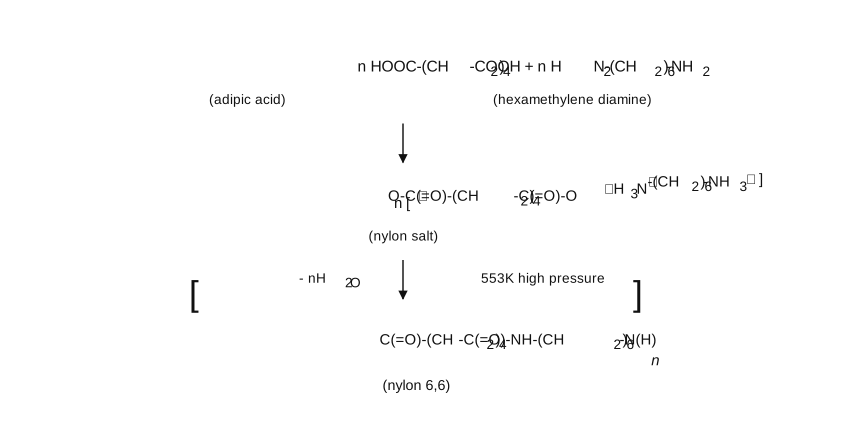
Polyamide polymers -- generally known as nylons -- carry the -CO-NH- (amide) linkage between their repeating units, and can be made by condensation polymerization between a dicarboxylic acid and a diamine, by self-condensation of an amino acid, or by ring-opening polymerization of a lactam. Nylon 6,6 is made from two bifunctional monomers, adipic acid (HOOC-(CH2)4-COOH) and hexamethylenediamine (H2N-(CH2)6-NH2): mixed together they first form an intermediate 'nylon salt', which then undergoes condensation polymerization (eliminating water) under high temperature and pressure to give the polyamide fibre -[CO-(CH2)4-CO-NH-(CH2)6-NH]n-. The numerals '6,6' in its name simply record the number of carbon atoms contributed by each of the two bifunctional monomers. Nylon 6,6 is a high molecular mass (12,000-50,000 u) linear condensation polymer with high tensile strength that does not soak up water, used for sheets, brush bristles, surgical sutures and textile fabrics. Nylon 6, by contrast, is made from a single monomer, epsilon-caprolactam, a cyclic amide (lactam) with six carbon atoms in its ring; heating caprolactam with water at high temperature opens the ring, which then undergoes ring-opening polymerization to give the polyam …
Drawn by us to help you understand the concept clearly, and verified to make sure it's accurate. For exams, practice from your textbook's own diagram.
Two sixes, one salt. Adipic acid and hexamethylene diamine first neutralise each other into the ionic nylon salt (carboxylate and ammonium ends, charges as printed). Heated to 553 K under high pressure it loses nH2O and condenses into the polyamide repeat unit. Both monomers contri …