Chemistry · Ch 15 — Introduction to Polymer Chemistry
Viscose rayon
Viscose rayon
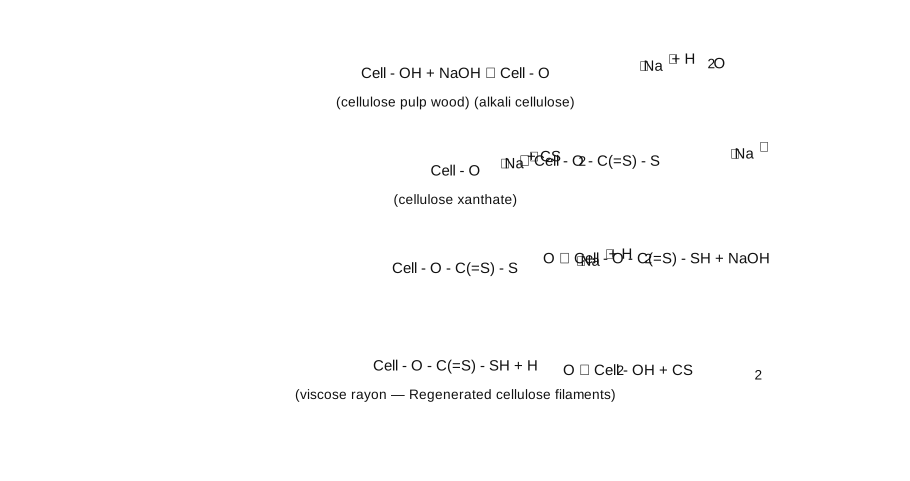
Viscose rayon is a semisynthetic fibre made from regenerated cellulose. Cellulose -- a linear polymer of glucose units, molecular formula (C6H10O5)n, conveniently written Cell-OH -- is obtained as wood pulp and taken through a four-step process (Fig. 15.7) to make the fibre. First, wood-pulp cellulose is treated with concentrated NaOH solution to give fluffy alkali cellulose (Cell-O-Na). Second, the alkali cellulose is converted with carbon disulphide (CS2) into cellulose xanthate (Cell-O-CS-SNa). Third, dissolving the xanthate in dilute NaOH gives the viscous 'viscose' solution. Fourth, the viscose solution is extruded through the fine holes of a spinneret into an acid bath, which reverses the …
Drawn by us to help you understand the concept clearly, and verified to make sure it's accurate. For exams, practice from your textbook's own diagram.
What this figure shows. A four-step reaction sequence, each drawn as a labelled arrow between named intermediates. Step 1: cellulose (wood pulp, Cell-OH) + NaOH -> alkali cellulose (Cell-O-Na+) + H2O. Step 2: alkali cellulose + CS2 -> cellulose xanthate (Cell-O-C(=S)-S-Na+). Step 3: cellulose xanthate + H2O + NaOH (dilute) -> viscose solution, cellulose xanthic acid intermediate (Cell-O-C(=S)-SH) shown reverting toward regeneration. Step 4: on extrusion through spinnerets into an acid bath, the xanthate breaks down back to Cell-OH + CS2, precipitating r …