Chemistry · Ch 15 — Introduction to Polymer Chemistry
Rubber
Rubber
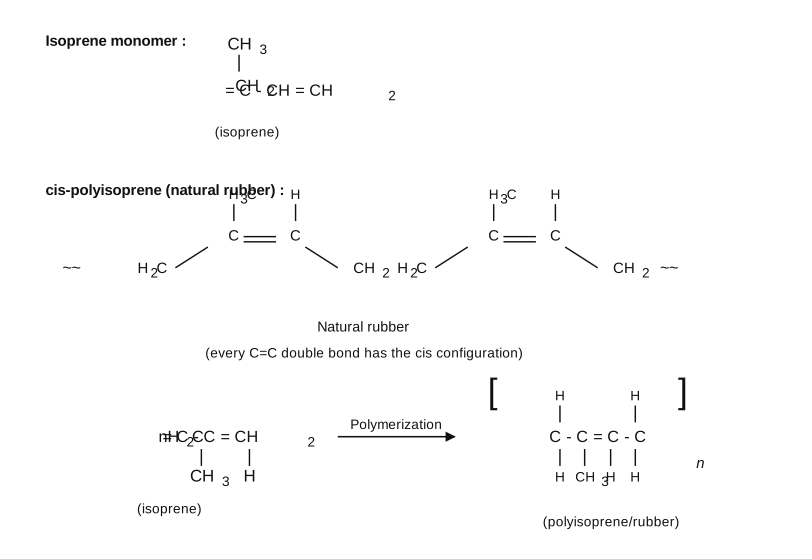
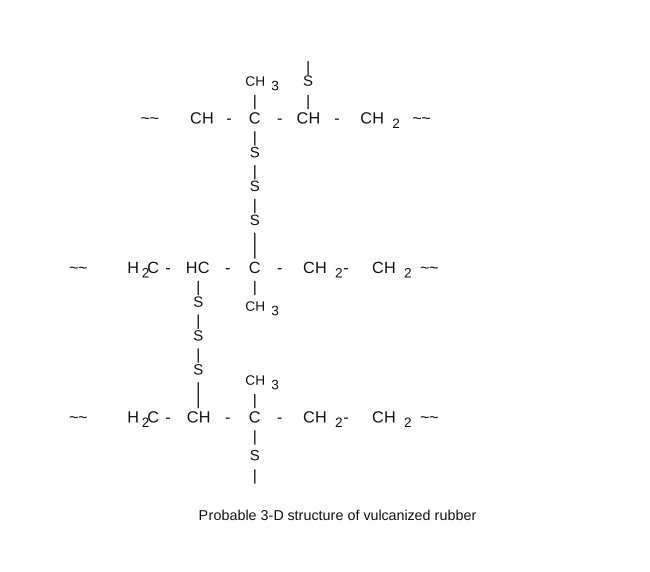
Elastomers are popularly known as rubbers; everyday elastomeric articles include balloons, shoe soles, tyres, surgeon's gloves and garden hoses. Natural rubber's monomer is isoprene (2-methyl-1,3-butadiene, CH2=C(CH3)-CH=CH2); natural rubber itself is a high molecular mass linear addition polymer of isoprene (polyisoprene), with molecular mass ranging from about 130,000 u to 340,000 u, corresponding to roughly 2000 to 5000 monomer units per chain. Its polyisoprene backbone has the double bonds locked in the cis configuration, and the chains -- held together only by weak van der Waals forces -- adopt a loosely coiled structure; this coiled, weakly-held arrangement is exactly what lets natural rubber be stretched like a spring and recover its shape, i.e. exhibit elasticity. Because raw natural rubber's properties are limited (it softens when warm and stiffens when cold), it is almost always improved by vulcanization: heating raw rubber with sulfur powder together with accelerators (commonly zinc butyl xanthate, ZBX) at about 150 degC. During vulcanization, sulfur atoms open the isoprene chain's double bonds and form crosslinking sulfur bridges between neighbouring polyisoprene chains, converting the loosely-held linear rubber into a three-dimensional vulcanized network. The process, invented by Charles Goodyear in 1839, dramatically improves tensile strength, stiffness, elasticity and toughness; using more sulfur gives a harder product, and raising the sulfur content to 40-45% yields ebonite, a hard, non-elastic material. Natural rubber itself first reached the market in the early 19th century, recovered entirely from wild Hevea brasiliensis trees native to the Amazon basin (whose bark-latex is …
Drawn by us to help you understand the concept clearly, and verified to make sure it's accurate. For exams, practice from your textbook's own diagram.
Why rubber stretches. Natural rubber is 1,4-polyisoprene with every double bond cis — the geometry the drawing emphasises. The cis kinks keep chains coiled and touching only through weak van der Waals contacts, so the coils straighten under tension and recoil when released: the elastic behaviour the sectio …
Drawn by us to help you understand the concept clearly, and verified to make sure it's accurate. For exams, practice from your textbook's own diagram.
What sulfur does. Heating raw rubber with sulfur (~150 °C, with accelerators) opens some C=C double bonds and ties neighbouring chains together through sulfur bridges — shown here as -S-S- and -S-S-S- links between three chains. The cross-links stop chains slipping past one another, giving vulcanized rubber its higher strength and resil …