Chemistry · Ch 2 — Solutions
Osmosis
Osmosis
When a solution and pure solvent, or two solutions of different concentrations, are separated by a semipermeable membrane, the solvent molecules pass through the membrane.
What is the direction of the flow of solvent molecules? It is important to understand that the passage of solvent molecules through the semipermeable membrane takes place in both directions, since solvent is on both sides of the membrane. However, the rate of passage of solvent molecules into the solution, or from the more dilute solution to the more concentrated solution, is found to be greater than the rate in the reverse direction. This is favourable, since the vapour pressure of the solvent is greater than that of the solution.
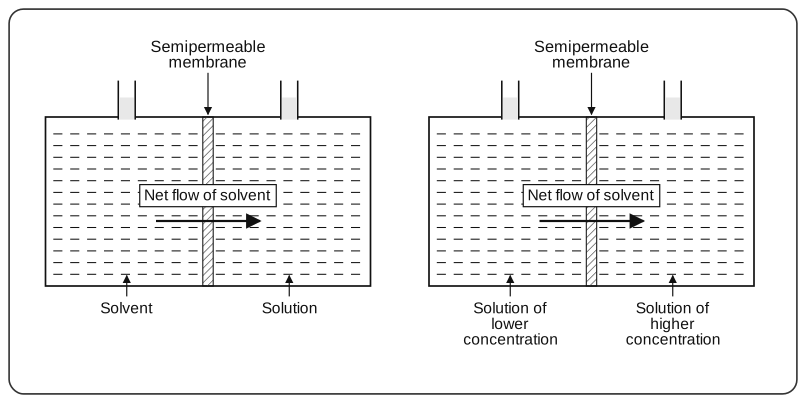
The net spontaneous flow of solvent molecules into the solution, or from the more dilute solution to the more concentrated solution, through a semipermeable membrane, is called osmosis. See Fig. 2.8.
Drawn by us to help you understand the concept clearly, and verified to make sure it's accurate. For exams, practice from your textbook's own diagram.
What this figure shows. Two rectangular two-compartment cells, each divided by a central vertical semipermeable membrane (labelled above, with an arrow pointing down at the membrane) and each compartment topped by a small open tube. In the left cell the compartments hold Solvent and Solution; in the right cell, Solution of lower concentration and Solution of higher concentration. In both cells a bold horizontal arrow across the membrane, captioned Net flow of solvent, points from th …
…