Chemistry · Ch 2 — Solutions
Osmotic Pressure
Osmotic Pressure
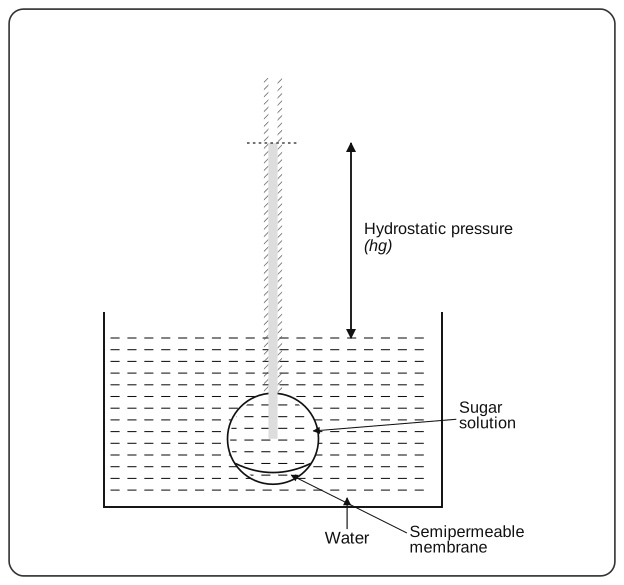
Osmosis can be demonstrated with the experimental set-up shown in Fig. 2.9. A semipermeable membrane is firmly fastened across the mouth of a thistle tube. The solution of interest (for example, a sugar solution) is placed inside an inverted thistle tube. This part of the tube and the membrane are then immersed in a container of pure water.
Drawn by us to help you understand the concept clearly, and verified to make sure it's accurate. For exams, practice from your textbook's own diagram.
What this figure shows. A container of Water (drawn with dashed liquid lines) in which an inverted thistle tube is immersed: its bulb, holding Sugar solution, sits inside the water with a Semipermeable membrane fastened across its mouth at the bottom. Water entering by osmosis has pushed the liquid up the narrow stem; a dotted level line and a vertical double-headed arrow mark the height of the risen column, labelled Hydrostatic pressure as printed in the book -- the pressure of this column, in full (with $\ …
As a result of osmosis, some of the solvent passes through the membrane into the solution. It causes the liquid level in the tube to rise. The liquid column in the tube creates hydrostatic pressure, which pushes the solvent back through the membrane into the container. The column of liquid in the tube continues to rise, and eventually stops rising. At this stage the hydrostatic pressure developed is sufficient to force solvent molecules back through the membrane into the container at the same rate at which they enter the solution.
An equilibrium is thus established where the rates of forward and reverse passages are equal, and the height of the liquid column in the tube remains constant. This implies that the hydrostatic pressure has stopped osmosis.
Remember...
It is important to note that osmotic pressure is not the pressure produced by a solution. It exists only when the solution is separated from the solvent by a suitable kind of semipermeable membrane. …