Chemistry · Ch 8 — Transition and Inner Transition Elements
Actinoids
Actinoids
The last row of elements in the periodic table is the actinoid series. It begins at thorium (Z = 72) and ends at lawrencium (Z = 103).
The book prints "thorium (Z =72)" — thorium's atomic number is 90 (the book's own Table 8.14 lists Th = 90; Z = 72 is hafnium). Read the sentence with Z = 90.
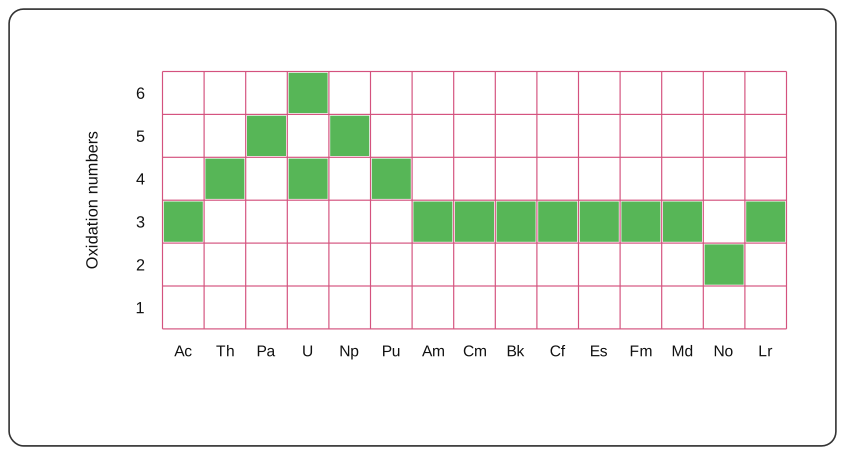
Most of these elements are not found in nature. They are all radioactive and man-made. The half-lives of the isotopes of thorium (Th-232 = 1.4 x 10¹⁰ years) and uranium (U-238 = 4.5 x 10⁹ years) are so long that these elements exist in rocks on earth. The long lived isotopes, such as thorium, protactinium, uranium, neptunium, plutonium and americium, are studied in more detail. These elements have high densities (~ 15-20 g cm⁻³), high melting points (~1000 ) and high boiling points (~3000 ). Actinoids are less reactive than lanthanoids — for example, they react with hot, but not cold, water to give the hydroxide and hydrogen gas. Unlike lanthanoids, they exhibit a range of oxidation numbers in their compounds, which varies from +2 to +8. The most common oxidation numbers of the actinoids are shown in Fig. 8.7.
As can be seen from Fig. 8.7, the most common oxidation state of early actinoids reflects the loss of all outer electrons, which is similar to transition metals rather than the lanthanoids. A ready loss of 5f electrons by early actinoids indicates that these electrons are much closer in energy to the 7s and 6d electrons than the 4f electrons are to the 6s and 5d electrons in the lanthanoids. All three sets of orbitals — 6d, 5f and 7s — have similar energies. For Th, Pa and Np the difference in energy levels is small, so electrons occupy either 6d or 5f orbitals. In the actinoid series the 5f orbitals are appreciably lower in energy; thus from Pu onwards the 5f shell gets filled in a regular way. …
Drawn by us to help you understand the concept clearly, and verified to make sure it's accurate. For exams, practice from your textbook's own diagram.
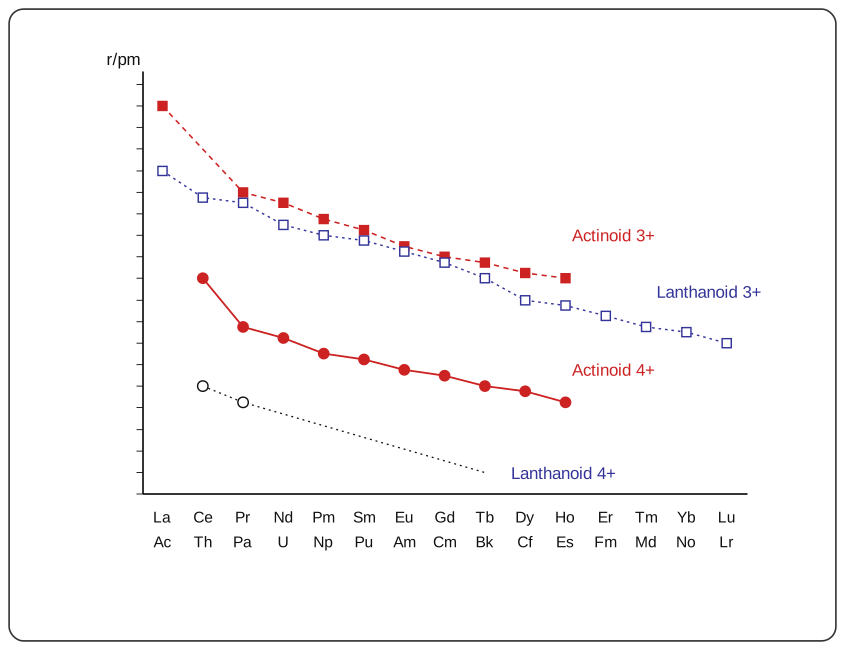
Fig. 8. 8 Figure depicting contraction of ionic radii of lanthanoids and actinoids (caption spacing as printed). Four families, one lesson: whether 3+ (the two upper series) or 4+ (the lower pair), and whether 4f or 5f, the radii fall steadily across each row. The actinoid curves sit above their lanthanoid partners - 5f shells are bigger - but they also fall faster: 5f electrons shield even more poorly than 4f, which is the actinoid contraction the section describes. The filled markers/solid-and-dotted red lines are the …
Drawn by us to help you understand the concept clearly, and verified to make sure it's accurate. For exams, practice from your textbook's own diagram.
Fig. 8. 7 The most common oxidation numbers of actinoids (caption spacing as printed; on its page this figure sits BELOW Fig. 8. 8 - the book's own out-of-order numbering). Read each column's green cell(s): the early actinoids climb - Ac +3, Th +4, Pa +5, U +4 and +6, Np +5, Pu +4 - because their 5f, 6d and 7s electrons are all loosely enough held to be lost, mirroring transition-metal behaviour. From Am through Lr the series settles onto the +3 band (the long green row), with the one famous exceptio …