Chemistry · Ch 8 — Transition and Inner Transition Elements
Extraction of metals
Extraction of metals
Most metals are found in the earth's crust in the form of their salts, such as carbonates, sulphates, sulphides and oxides. A few metals are nonreactive and occur in the free state in the earth's crust — for example silver, gold, and platinum.
Mineral : A naturally occurring substance found in the earth's crust containing inorganic salts, solids, siliceous matter etc. is called a mineral.
The mineral which contains a high percentage of the metal, and from which the metal can be extracted economically, is called an ore.
Table 8.9 : List of minerals and ores of some transition metals.
| Metals | Mineral | Ore |
|---|---|---|
| Iron | Haematite · Magnetite · Limonite · Iron pyrites · Siderite | Haematite |
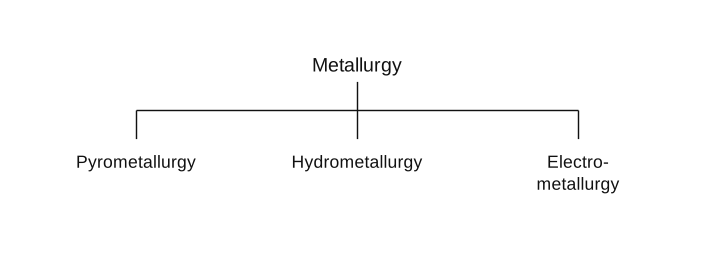
Drawn by us to help you understand the concept clearly, and verified to make sure it's accurate. For exams, practice from your textbook's own diagram.
What this tree shows (uncaptioned in the book). Commercial extraction of metals - metallurgy - splits into the three routes 8.9.1 defines: Pyrometallurgy (reduction at high temperature with carbon, hydrogen or aluminium), Hydrometallurgy (extraction from an aqueous solution of the metal's salts with a suitable reducing agent) and Electro-metallurgy (electrolytic reduction of the molten, fused metallic compound; the branch label wraps with a hyphen exactly as the book p …