Chemistry · Ch 8 — Transition and Inner Transition Elements
Physical properties of first transition series
Physical properties of first transition series
All transition elements are metals, and show properties that are characteristic of metals. They are hard, lustrous, malleable, ductile, and form alloys with other metals. They are good conductors of heat and electricity. Except Zn, Cd, Hg and Mn, all the other transition elements have one or more typical metallic structures at ambient temperature. These transition metals (with the exception of Zn, Cd and Hg) are very hard and have low volatility. T …
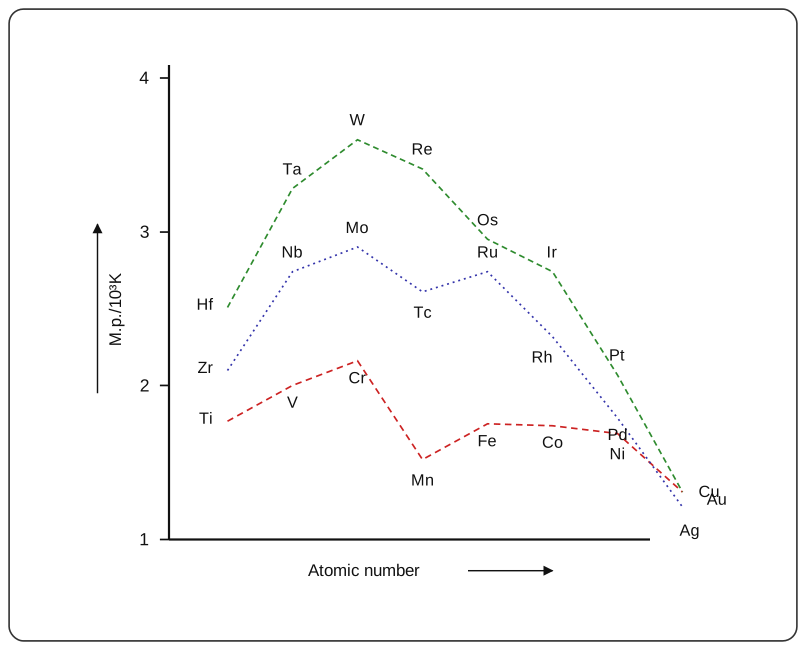
Drawn by us to help you understand the concept clearly, and verified to make sure it's accurate. For exams, practice from your textbook's own diagram.
Fig. 8.2 : Trends in melting points of transition elements. Each of the three dashed curves climbs to its peak near the d⁵ configuration - Cr in the 3d row (red), Mo in the 4d row (blue) and W in the 5d row (green, the highest of all at ~3.7 × 10³ K) - then falls away towards the d¹⁰ end (Cu, Ag, Au). The Mn and Tc dips break the smooth rise: their half-filled, extra-stable configurations contribute fewer unpaired d electrons to metallic bonding. Read the y-axis as thousands of kelvin (M.p./10³K). This is the gr …