Skip to content

Mathematics · Ch 3 — Trigonometric Functions

Inverse Cosecant Function

3.3.4

Inverse Cosecant Function

Consider cosec\text{cosec} restricted to (−π2,π2)−{0}→R−(−1,1)\left(-\dfrac{\pi}{2},\dfrac{\pi}{2}\right)-\{0\}\to\mathbb{R}-(-1,1). Graphically this restriction is one-one and onto R−(−1,1)\mathbb{R}-(-1,1), so its inverse exists, called the inverse cosecant function, denoted cosec−1:R−(−1,1)→(−π2,π2)−{0}\text{cosec}^{-1}:\mathbb{R}-(-1,1)\to\left(-\dfrac{\pi}{2},\dfrac{\pi}{2}\right)-\{0\}. For x∈R−(−1,1)x\in\mathbb{R}-(-1,1) and θ∈(−π2,π2)−{0}\theta\in\left(-\dfrac{\pi}{2},\dfrac{\pi}{2}\right)-\{0\}, we write cosec−1x=θ\text{cosec}^{-1}x=\theta if cosec θ=x\text{cosec}\,\theta=x.

Ex. cosec π6=2\text{cosec}\,\dfrac{\pi}{6}=2, where 2∈R−(−1,1)2\in\mathbb{R}-(-1,1) and π6∈(−π2,π2)−{0}\dfrac{\pi}{6}\in\left(-\dfrac{\pi}{2},\dfrac{\pi}{2}\right)-\{0\}, so cosec−1(2)=π6\text{cosec}^{-1}(2)=\dfrac{\pi}{6}: the principal value of cosec−12\text{cosec}^{-1}2 is π6\dfrac{\pi}{6}. …

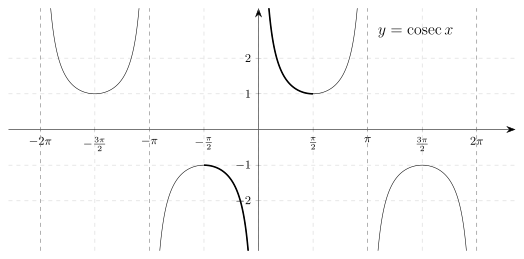
Figure 3.11(a)Fig. 3.11(a) — Graph of y = cosec x drawn over a wide domain, with its one-one restricted domain highlighted in bold
Fig. 3.11(a) — Fig. 3.11(a) — Graph of y = cosec x drawn over a wide domain, with its one-one restricted domain highlighted in bold

Drawn by us to help you understand the concept clearly, and verified to make sure it's accurate. For exams, practice from your textbook's own diagram.

What this figure shows. Shows the graph of y=cosec xy=\text{cosec}\,x drawn only over (−π/2,π/2)−{0}\left(-\pi/2,\pi/2\right)-\{0\} on the x-axis, split into two branches by a vertical asymptote at x=0x=0: the left branch stays at or below −1-1 and the right branch stays at or above +1+1, together covering the excluded-middle range R−(−1,1)\mathbb{R}-(-1,1) exactly once …

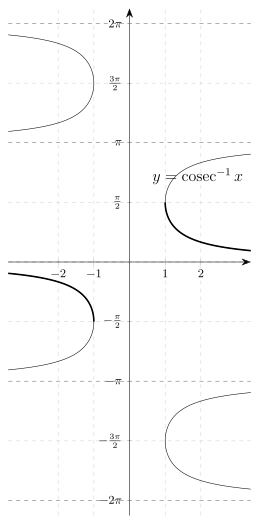
Figure 3.11(b)Fig. 3.11(b) — Graph of the inverse function y = cosec⁻¹ x (reflection across y = x), with the principal branch in bold
Fig. 3.11(b) — Fig. 3.11(b) — Graph of the inverse function y = cosec⁻¹ x (reflection across y = x), with the principal branch in bold

Drawn by us to help you understand the concept clearly, and verified to make sure it's accurate. For exams, practice from your textbook's own diagram.

What this figure shows. Shows the graph of y=cosec−1xy=\text{cosec}^{-1}x over its domain R−(−1,1)\mathbb{R}-(-1,1) on the x-axis, obtained by reflecting the restricted cosecant graph in the line y=xy=x; it forms two separate branches approaching but never touching y=0y=0, one lying in (−π/2,0)\left(-\pi/2,0\right) for negative xx and one in (0,π/2)\left(0,\pi/2\right) for po …