Mathematics · Ch 3 — Trigonometric Functions
Inverse Cotangent Function
Inverse Cotangent Function
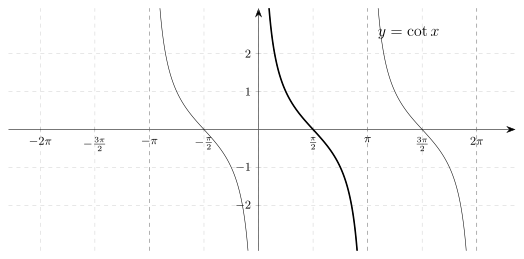
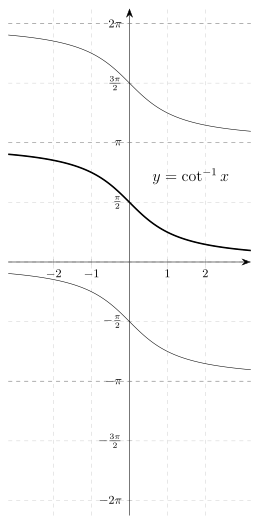
Consider restricted to . Graphically this restriction is one-one and onto , so its inverse exists, called the inverse cotangent function, denoted . For and , we write if .
Ex. , where and , so : the principal value of is . …
Drawn by us to help you understand the concept clearly, and verified to make sure it's accurate. For exams, practice from your textbook's own diagram.
What this figure shows. Shows the graph of drawn only over the open interval on the x-axis, with vertical asymptotes as dashed lines at and that the curve approaches but never reaches; the curve falls steadily from to across the interval, one-one and onto all of $\mathbb{R} …
Drawn by us to help you understand the concept clearly, and verified to make sure it's accurate. For exams, practice from your textbook's own diagram.
What this figure shows. Shows the graph of over its full domain on the x-axis, obtained by reflecting the restricted cotangent graph in the line ; the curve falls steadily from near for very negative , through at the origin, down toward for very positive , always staying strictly inside $ …