Physics · Ch 13 — AC Circuits
LC Oscillations
LC Oscillations
So far every circuit considered has included an external AC source continuously driving the current. This section instead asks: what happens if a capacitor, already charged to some potential, is disconnected from any source and connected directly to an ideal (zero-resistance) inductor, with no driving emf at all?
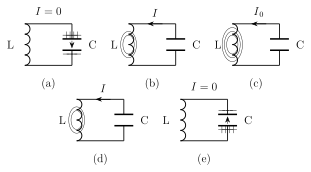
Initially (Fig. 13.16a), the fully-charged capacitor holds all of the circuit's energy in its electric field, , with zero current and hence zero energy in the inductor's magnetic field. Once the loop is closed, the capacitor begins to discharge through the inductor (Fig. 13.16b): a growing current builds up a magnetic field in the inductor, so energy is progressively transferred from the capacitor's electric field into the inductor's magnetic field. At the instant the capacitor becomes fully discharged (Fig. 13.16c), the current reaches its maximum value , and ALL the original electrostatic energy has been converted into magnetic energy, (energy conservation, since no resistance is present to dissipate any of it). The process then continues in reverse: as the magnetic flux through the inductor now begins to fall, an induced emf (Lenz's law) keeps the current flowing in the SAME direction a little longer, which recharges the capacitor -- but now with the OPPOSITE polarity to its initial state (Fig. 13.16d-e). Once the capacitor is again fully charged (in this reversed polarity), the whole process repeats itself in the opposite direction, and the cycle continues indefinitely. …
Drawn by us to help you understand the concept clearly, and verified to make sure it's accurate. For exams, practice from your textbook's own diagram.
What this figure shows. A sequence of five circuit snapshots (a) through (e), each showing the same simple loop of a capacitor connected directly to an inductor (no source, no resistor), depicting one half-cycle of the charge-discharge oscillation in order: (a) the capacitor holds an initial charge at , plates fully charged, zero current in the loop, all energy stored in the capacitor's electric field and none in the inductor; (b) the circuit is closed and the capacitor begins discharging through the inductor, a growing current I now flows, building up a magnetic field in the inductor, so energy is now split between the shrinking electric field and the growing magnetic field; (c) at a later instant the capacitor is FULLY discharged (zero charge, zero potential difference across its plates) while the current has reached its maximum value , so ALL the original electrostatic energy has converted to magnetic-field energy in the inductor; (d) the magnetic flux linked with the inductor now begins to DECREASE, inducing a current in the SAME direction (by Lenz's law) that persists but with decreasing magnitude, which now charges the capacitor in the OPPOSITE polarity to its original state, so magnetic energy converts back into electrostatic energy; (e) the process continues until the capacitor is fully charged again, but now with a polarit …