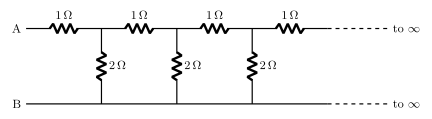
Q.In the following circuit diagram, an infinite series of resistances is shown. Equivalent resistance between points A and B is (A) 2 \Omega (B) 4 \Omega (C) 8 \Omega (D) 16 \Omega
Concept understanding — Kirchhoff's Laws and Circuit Analysis
Kirchhoff's Laws and Circuit Analysis
Complex circuits that cannot be reduced to simple series–parallel combinations are solved with Kirchhoff's two rules:
- Junction (current) rule — the algebraic sum of currents meeting at a node is zero, . It expresses conservation of charge.
- Loop (voltage) rule — around any closed loop the algebraic sum of EMFs and drops is zero, . It expresses conservation of energy.
To apply them, assign a current to each branch, write one junction equation per independent node and one loop equation per independent mesh, and solve the simultaneous equations; a negative answer simply means the assumed direction was reversed. Where node potentials are given, the current in a branch follows directly from Ohm's law, , and the junction rule fixes an unknown branch current from the others.
These laws handle multi‑cell networks (cells aiding or opposing), unbalanced bridges, and questions such as 'the current through a resistor is unchanged when an extra cell is added', which reduce to setting up and solving the loop and junction equations.
Kirchhoff's junction and loop rules are a core, high-weightage part of the CBSE Class 12 Physics Current Electricity chapter, frequently searched as "Kirchhoff's laws class 12 physics important questions" or "Kirchhoff's current and voltage law examples". Solving multi-loop and multi-cell networks with these rules is one of the most heavily tested numerical skills in board exams as well as JEE Main and NEET.
Unlock everything free for 14 days
- Full step-by-step solutions
- Concept-first explanations
- Methods, shortcuts & mistakes
- PYQ mapping + timed mock tests
Full access for 14 days. No credit card required.