Physics · Ch 3 — Kinetic Theory of Gases and Radiation
Pressure of Ideal Gas
Pressure of Ideal Gas
This section derives, from first principles of Newtonian mechanics, how the macroscopic pressure exerted by a gas arises from the microscopic motion and collisions of its molecules.
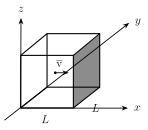
Setup. Consider moles of an ideal gas enclosed in a cubical box of side (so volume ), with the box's edges parallel to the coordinate axes and its walls held at a constant temperature (Fig. 3.2). As a simplifying (and physically reasonable) first approximation, intermolecular collisions are neglected altogether, and only elastic collisions between molecules and the walls are considered -- justified because, as Section 3.4 showed, the mean free path can be made much larger than intermolecular spacing at the pressures under discussion, so the gas is effectively arranged so molecules mostly collide with the walls rather than with each other.
Drawn by us to help you understand the concept clearly, and verified to make sure it's accurate. For exams, practice from your textbook's own diagram.
What this figure shows. The setup of the pressure derivation: a cube of side L (volume V = L³) with edges along the coordinate axes. A single molecule moves with velocity v̄ toward the shaded wall, which is parallel to the yz-plane — in an elastic collision with this wall only the x-component of t …
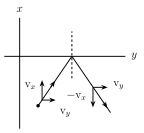
One collision. Take a single molecule of mass moving with velocity (components ) about to strike the shaded wall of the cube, which lies parallel to the -plane. Because the collision is elastic and the wall is rigid, only the velocity component perpendicular to the wall, , reverses sign; the components and parallel to the wall are completely unaffected. Averaged over all the molecules striking this wall, the - and -components of velocity are also unaffected in aggregate, since the gas remains uniformly distributed and gains no net drift in the or directions from collisions with a wall parallel to the -plane.
The change in the molecule's momentum due to one collision is therefore entirely in the -direction:
so the momentum transferred to the wall in this collision is .
Average force from one molecule. After bouncing off the shaded wall, the molecule travels to the opposite wall, reflects, and returns -- covering a round-trip distance of before striking the shaded wall again. So the time between successive collisions with this wall is , and the average force this one molecule exerts on the wall is
Summing over all molecules. Adding up the contributions of every molecule (with -velocity-components ) gives the total average force on the wall, and dividing by the wall's area gives the average pressure:
where is the average of over all molecules.
Removing the axis dependence. Since for every molecule, and by symmetry no direction is preferred (the molecules move equally in every direction on average), . Substituting gives the central result of this section: …
Drawn by us to help you understand the concept clearly, and verified to make sure it's accurate. For exams, practice from your textbook's own diagram.
What this box figure shows. A particle striking a wall lying along the y-axis: resolving the velocity into components, the collision reverses the component perpendicular to the wall (vx → −vx) and leaves the parallel component vy unchanged — the two-dimensional picture behind the mome …