Physics · Ch 3 — Kinetic Theory of Gases and Radiation
Root Mean Square (rms) Speed
Root Mean Square (rms) Speed
Equation from Section 3.5 can be rearranged to give the mean square speed of the gas molecules directly in terms of macroscopic quantities:
Using the ideal gas equation , and writing the total mass (where is the molar mass of the gas), this becomes
Taking the square root gives the root mean square (rms) speed:
This single formula lets us estimate how fast molecules of any real gas are moving, once its molar mass and temperature are known. At 300 K, for instance, nitrogen molecules have , while oxygen molecules (being heavier) move somewhat slower, at -- both speeds are of order a few hundred metres per second, consistent with everyday experience of how quickly a smell diffuses across a room. …
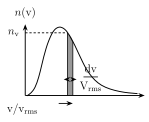
Drawn by us to help you understand the concept clearly, and verified to make sure it's accurate. For exams, practice from your textbook's own diagram.
What this box figure shows. Molecules of a gas have speeds ranging from zero to infinity; the curve gives the number of molecules as a function of speed at a temperature T — Maxwell's distribution of molecular speeds. The shaded strip of width dv has area n_v dv, the number of molecules with speeds between v and v + dv; averages such …