Physics · Ch 3 — Kinetic Theory of Gases and Radiation
Spectral Distribution of Blackbody Radiation
Spectral Distribution of Blackbody Radiation
The radiant energy emitted per unit area per unit time by a blackbody is not spread out evenly across all wavelengths -- it depends both on the body's temperature and on the wavelength under consideration. Hot objects radiate across a broad range of wavelengths simultaneously, so it is natural to describe the emission as a function of wavelength: the power radiated per unit area, per unit wavelength interval, at a given temperature.
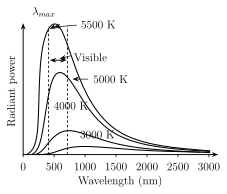
Lummer and Pringsheim's measurements. Lummer and Pringsheim experimentally studied how this energy distribution varies with wavelength, using a cavity radiator (Section 3.11) held at several different fixed temperatures, and measuring the radiant power at each wavelength. Plotting radiant power per unit wavelength interval against wavelength , at each fixed temperature, produces the family of curves shown in Fig. 3.5. These experimental curves reveal several important, consistent features:
Drawn by us to help you understand the concept clearly, and verified to make sure it's accurate. For exams, practice from your textbook's own diagram.
What this figure shows. The experimental blackbody spectra of Lummer and Pringsheim: radiant power per unit wavelength against wavelength for 3000 K, 4000 K, 5000 K and 5500 K. Each curve rises to a maximum at λmax and falls; hotter curves are taller and their λmax (dashed lines) shifts toward shorter wavelengths — the content of Wien's displacement law. The area under e …
- At a given temperature, energy is not distributed uniformly across the spectrum (as a function of wavelength) of the blackbody.
- At a given temperature, radiant power initially increases with increasing wavelength, reaches a single maximum, and then decreases. The particular wavelength at which this maximum occurs, , is characteristic of -- and depends only on -- the temperature of the radiating body (note carefully: is not the maximum wavelength the object emits at all; emission continues, at reduced intensity, well beyond in both directions).
- The area under the curve represents the total energy emitted per unit time per unit area by the blackbody, summed over all wavelengths.
- As temperature increases, the peak of the curve shifts towards shorter wavelengths -- i.e. decreases as increases. This shift is quantified precisely by Wien's displacement law (Section 3.14.1).
- At higher temperatures, the total radiant power (the area under the curve, summed over all wavelengths) also increases -- this quantitative growth with temperature is what the Stefan-Boltzmann law (Section 3.15) makes precise.
- At around 300 K (roughly room temperature), the most intense wavelength is about m, with the radiant power falling off for other wavelengths -- and practically all of the radiant energy at this temperature is carried by wavelengths longer than red visible light, i.e. by infrared radiation (which is why objects at room temperature do not glow visibly, consistent with Section 3.12).
The historical puzzle. No existing theory of the time could fully explain this experimentally observed curve shape. Wien derived an expression for the spectral distribution from the laws of thermodynamics that matched the experimental data well only at short wavelengths. Lord Rayleigh and Sir James Jeans separately derived a formula based on the classical equipartition of energy (the same principle used throughout Section 3.8-3.9) that fitted the long-wavelength region well, but diverged (tended to infinity) at short wavelengths -- an unphysical failure. It became clear that a genuinely new model of radiation was needed. Planck, aware of the shortcomings of both existing approaches, combined ideas from both using a new empirical formula that successfully reproduced the observed spectrum across all wavelengths. …
Do you know? The idea of quantization of energy was first proposed by Planck to explain the blackbody spectrum. He pictured the atoms of the cavity walls as tiny electromagnetic oscillators, each with its own characteristic frequency ν, exchanging energy with the cavity — but only in amounts E = nhν, where h = 6.626 × 10⁻³⁴ J s is a universal constant and n a positive integer. The oscillators radiate in 'jumps' (quanta) between quantized levels rather than continuously. Planck's model …