Physics · Ch 2 — Mechanical Properties of Fluids
Fluid
Fluid
Any substance that can flow is called a fluid: formally, a fluid is a substance that deforms continually under the action of an external force, and this definition is broad enough to include liquids, gases, and even plasmas (a distinct fourth state of matter made of ionised gas — a mix of ions, free electrons and neutral atoms) as fluids. A fluid flows whenever it is subjected to a force or a pressure gradient, but the resulting motion of a real fluid is generally very complicated to analyse exactly. To make progress, we introduce a simplified model, the ideal fluid, that captures the essential behaviour while dropping the complications. An ideal fluid is assumed to have four properties: (1) it is incompressible — its density stays perfectly constant; (2) its flow is irrotational — the flow is smooth, with no turbulence anywhere; (3) it is nonviscous — there is no internal friction at all within the flow, i.e. the fluid has zero viscosity; and (4) its flow is steady — the fluid's velocity at any given point stays constant over time (even though it may differ from one point to another).
It helps to sharpen the distinction between a solid and a fluid by comparing how each responds to two different kinds of applied stress. A solid can be subjected to shear (tangential) stress — a force applied parallel to one of its faces while the opposite face is held fixed, which it resists by developing an internal restoring force, exactly as studied for the modulus of rigidity in Class 11. A solid can equally be subjected to normal stress — a force applied perpendicular to a surface, either squeezing it (compressive) or stretching it (tensile), which again it resists elastically. Fluids behave completely differently: an ideal fluid has zero shear modulus, meaning it offers no resistance whatsoever to a shearing force — in simple words, a fluid cannot resist any shear force applied to it at all. Air, water, flour dough and toothpaste are everyday examples of fluids in this sense (even molten lava counts as a fluid). An ideal fluid can only be subjected to a normal, compressive stress, which is specifically given the name pressure — it can never be subjected to a tensile (pulling) stress the way a solid rod can, since a fluid simply flows apart rather than resisting being pulled. Real fluids are slightly less extreme than this ideal: because of viscosity, a real fluid does offer a very weak resistance to deformation, and so can sustain low levels of shear stress, unlike a perfectly ideal fluid.
This absence of any resistance to shear directly explains a fluid's most basic observed properties: fluids do not oppose deformation the way a solid does — instead they simply deform permanently (i.e. flow); they have the ability to flow at all; and they have the ability to take on the exact shape of whatever container holds them. All three of these everyday properties follow from the single underlying fact that a fluid, in static equilibrium, cannot oppose a shear stress. …
Drawn by us to help you understand the concept clearly, and verified to make sure it's accurate. For exams, practice from your textbook's own diagram.
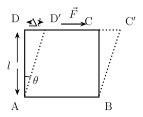
What this figure shows. A rectangular block or cube of solid material is shown with its bottom face held fixed and a force applied tangentially (parallel) to its top face, so the top face is displaced sideways relative to the bottom, changing the block's shape into a slanted parallelogram without changing its size. The figure illustrates the kind of tangential (shear) stress that a solid, unlike an ideal fluid, is able to resist by developing an internal restoring force — exactly the shearing-stress geometry from the Class-11 Mechanical Properties of Solids chapter, now used here to draw the contrast that a fluid's shear modulus is zero, so …
Drawn by us to help you understand the concept clearly, and verified to make sure it's accurate. For exams, practice from your textbook's own diagram.
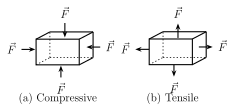
What this figure shows. Two-part figure showing a solid rod or block subjected to a normal (perpendicular-to-the-cross-section) force in two opposite senses: (a) compressive — two equal and opposite forces applied inward at the two ends of the rod, squeezing it and shortening its length; (b) tensile — two equal and opposite forces applied outward at the two ends, stretching and elongating the rod. Both are examples of normal stress (as opposed to the tangential shear stress of Fig. 2.1), which a solid resists elastically; the figure sets up the contrast that follows immediately in the text — that an ideal fluid can only be subjected to a normal, compressive stress (called pressure), never a tensile one, since …
Drawn by us to help you understand the concept clearly, and verified to make sure it's accurate. For exams, practice from your textbook's own diagram.
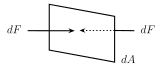
What this figure shows. A small flat imaginary surface element of area dA is shown suspended within a larger body of fluid that is entirely at rest. Two equal and opposite force arrows, each labelled dF, are drawn perpendicular to the two faces of this small surface, pointing inward toward it from both sides. Because the surface element does not accelerate (the fluid around it is static), the surrounding fluid must exert equal normal forces on both of its faces — there is no net force and no tangential component at all, only these equal-and-opposite normal (perpendicular) pushes. This is the foundational picture behind the formal definition of pressure in section 2.3, and behind Figs. 2.4 and 2.5 which apply the same idea to a …