Physics · Ch 2 — Mechanical Properties of Fluids
Fluids in Motion
Fluids in Motion
Moving fluids are part of everyday life: water flowing out of a tap, cooking gas flowing through a tube, or water flowing through a river or a canal are all examples that can be understood using the concepts developed in this section. The branch of physics that studies the properties of fluids in motion is called hydrodynamics. Because the motion of a real fluid is generally very complicated, this study is restricted to the motion of an ideal fluid (as defined already in section 2.2).
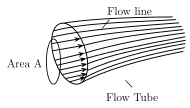
A few terms are needed to describe fluid flow precisely. A flow line is the actual path traced out by one individual particle of a moving fluid. A streamline is a curve whose tangent, at any point, points in the direction of the fluid's velocity of flow at that very point; for a steady flow, streamlines and flow lines turn out to be identical to each other. A flow tube is an imaginary bundle of flow lines, bounded by an imaginary wall; for a steady flow, fluid can never cross the walls of a flow tube, so fluid in two adjacent flow tubes never mixes with each other. …
Drawn by us to help you understand the concept clearly, and verified to make sure it's accurate. For exams, practice from your textbook's own diagram.
What this figure shows. A pipe with an arbitrarily changing cross-sectional area and direction is shown, with the fluid flowing along it as indicated by direction arrows. Several curved flow lines — the actual paths individual fluid particles trace as they travel through the pipe — are drawn running along its length, and an imaginary tube-shaped bundle of adjacent flow lines (a flow tube), bounded by an imaginary wall, is outlined within the wider pipe. The figure illustrates that fluid confined within a given flow tube stays confined to it and never crosses into a neighbouring flow tube, a property used repeatedly in the equat …

Drawn by us to help you understand the concept clearly, and verified to make sure it's accurate. For exams, practice from your textbook's own diagram.
What this figure shows. Two-part figure: (a) streamline (laminar) flow, showing several smooth, parallel, non-intersecting curved lines representing adjacent layers of fluid sliding smoothly over one another with no mixing between layers, characteristic of a steadily-flowing river; (b) turbulent flow, showing a chaotic, irregular tangle of flow paths with visible loops and eddies, where the flow pattern is constantly changing and never settles into any steady, orderly arrangement, characteristic of a flooded river or a tap turned on ve …
Drawn by us to help you understand the concept clearly, and verified to make sure it's accurate. For exams, practice from your textbook's own diagram.
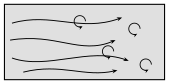
What this figure shows. Turbulent flow beyond the critical velocity: the flow pattern changes continuously, with crossing paths and rotational eddies, so no steady streamline picture exists. A flooded river or a fully opened tap shows exactly this irregular, churning patt …
Streamline flow | Turbulent flow
- The smooth flow of a fluid, with velocity smaller than certain critical velocity (limiting value of velocity), is called streamline flow or laminar flow of a fluid. | 1) The irregular and unsteady flow of a fluid when its velocity increases beyond critical velocity is called turbulent flow.
- In a streamline flow, velocity of a fluid at a given point is always constant. | 2) In a turbulent flow, the velocity of a fluid at any point does not remain constant.
- Two streamlines can never intersect, i.e., they are always parallel. | 3) In a turbulent flow, at some points, the fluid may have rotational motion which gives rise to eddies. …