Physics · Ch 2 — Mechanical Properties of Fluids
Pressure
Pressure
A fluid at rest exerts a force on any surface it is in contact with — this surface might be a container's wall, or the bottom of an open vessel holding the fluid. The pressure p of the fluid is defined as the normal force F it exerts per unit area A of that surface of contact:
Because pressure is a force divided by an area, an object with only a small weight can still exert a very high pressure if that weight is concentrated on a small enough area — for example, a force of 10 N acting on an area of 1 cm² produces a pressure of 10⁵ N/m², whereas the very same force of 10 N spread over a much larger area of 1 m² produces a pressure of only 10 N/m². This is exactly why a knife has a sharp (narrow-area) edge and a needle a sharp (tiny-area) tip — concentrating a modest applied force onto a very small contact area produces an enormous local pressure, enough to cut or pierce. …
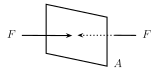
Drawn by us to help you understand the concept clearly, and verified to make sure it's accurate. For exams, practice from your textbook's own diagram.
What this figure shows. A container holding a fluid is shown with several force arrows drawn perpendicular to (pressing directly into) one of its vertical walls, at different points/depths along that wall. The arrows illustrate that a fluid at rest presses normally (perpendicular to the surface) on any wall it touches, including a vertical one — not just downward under gravity — establishing that the pressure defined by p = F/A acts on every surface of con …
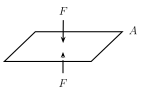
Drawn by us to help you understand the concept clearly, and verified to make sure it's accurate. For exams, practice from your textbook's own diagram.
What this figure shows. The same container of fluid is shown with force arrows drawn pointing straight down onto its horizontal base (the bottom of the container), representing the weight of the fluid column above pressing down on the floor of the vessel. This is the companion case to Fig. 2.4 for a horizontal surface, and together the two figures establish that a fluid at rest presses on every surface of its container — vertical walls and the horizontal base alike — always normal (perpendicular) to that surface, exactly as the s …