Physics · Ch 2 — Mechanical Properties of Fluids
Stokes' Law
Stokes' Law
In 1845, Sir George Gabriel Stokes (1819-1903) stated the law that gives the viscous force acting on a small spherical object as it falls through a viscous medium. Stokes' law states that the viscous force acting on a small sphere falling through a viscous medium is directly proportional to the radius of the sphere (r), its velocity through the fluid (v), and the coefficient of viscosity of the fluid (η):
The constant of proportionality, found empirically, is :
…
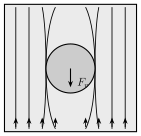
Drawn by us to help you understand the concept clearly, and verified to make sure it's accurate. For exams, practice from your textbook's own diagram.
What this figure shows. A small sphere is shown falling downward through a column of viscous fluid, with an upward-pointing arrow labelled marking the viscous drag force that opposes its downward motion. This is the basic geometry to which Stokes' law applies directly, and is developed further in section 2.7.1 into the full force-balance that determines the sphere's terminal …