Physics · Ch 2 — Mechanical Properties of Fluids
Equation of Continuity
Equation of Continuity
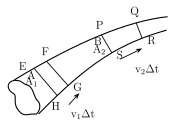
Consider the steady flow of an incompressible fluid through a flow tube whose cross-sectional area varies along its length. In a steady flow, the velocity of a fluid particle at any given point stays constant over time, though it can certainly vary from one point to another along the tube. Consider two sections of such a flow tube, and , where has a larger cross-sectional area than ; let and be the fluid's speeds at sections and respectively. A fluid particle necessarily has to move faster through the narrower section (where there is less space available) in order to let the particles behind it keep up, and correspondingly slows down again on entering a wider section, where more space becomes available. Since the fluid is incompressible, it cannot simply be squeezed to fit into a narrow region — it must instead speed up there, and slow down in a wider region, to keep the same amount of fluid moving through every cross-section in a given time.
Consider a tube of flow — recalling that all fluid confined to a given flow tube must pass through every cross-section that cuts across the tube, and can neither leave the tube nor enter it from outside. Since matter is neither created nor destroyed anywhere within the region of the tube enclosed between two sections (at a point A) and (at a point B), the mass of fluid contained within this enclosed region must stay constant over time — meaning that whatever mass m of fluid enters through section in a given time, an equal mass m must leave through section in that same time.
Let the fluid crossing section (at point A) have speed ; in a time interval , the mass of fluid entering the tube through this section is . Similarly, let the fluid crossing section (at point B) have speed ; in the same time interval , the mass of fluid leaving the tube through this section is . Since the fluid is incompressible, the mass entering at A must equal the mass leaving at B:
…
Drawn by us to help you understand the concept clearly, and verified to make sure it's accurate. For exams, practice from your textbook's own diagram.
What this figure shows. A flow tube, bounded by streamlines, is shown with a wider cross-section (marked by a cross-section EFGH at point A, where fluid enters with speed ) and a narrower cross-section further along (marked by a cross-section PQRS at point B, where fluid leaves with speed ). This is the exact geometry used to derive the equation of continuity by equating the mass of fluid entering the tube at during a small time interval to the mass leaving at $A …