Physics · Ch 1 — Rotational Dynamics
Vehicle Along a Horizontal Circular Track
Vehicle Along a Horizontal Circular Track
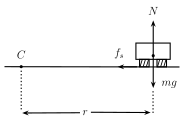
Consider a car (treated as a particle for simplicity) taking a turn on a FLAT, horizontal, circular road of radius r. Three forces act on it: its weight mg, vertically downward; the normal reaction N from the road, vertically upward, which balances mg (so here, since there is no vertical acceleration); and the force of STATIC friction between the tyres and the road surface. This is static (not kinetic) friction because the tyres are not sliding relative to the road -- they only tend to slip outward, and friction opposes that tendency. Since weight and normal reaction cancel vertically, the force of static friction alone is the (horizontal) resultant force, and being directed towards the centre of the track, it is entirely responsible for supplying the centripetal force: .
Drawn by us to help you understand the concept clearly, and verified to make sure it's accurate. For exams, practice from your textbook's own diagram.
What this figure shows. A vertical cross-section of a car shown as a simple block on a flat horizontal road, at the instant it is on a circular track of radius r, drawn so that the plane of the figure is a vertical plane perpendicular to the track but passing through the track's centre C. Three force arrows act on the car (treated as a particle): weight mg drawn vertically downward from the car's centre; normal reaction N drawn vertically upward from the point of contact with the road, equal in magnitude to mg; and the force of static friction drawn horizontally, pointing towards the centre C of the circular track (i.e. towards the left or right depending on which side of the car the centre lies), representing the ne …
For a given track (r fixed) and a given vehicle (mg, and hence N, fixed), as the speed v increases, the REQUIRED friction also increases proportionally to . But static friction cannot grow without bound -- it has an upper limit , where is the coefficient of static friction between the road and the tyres. This sets an upper limit on the safe turning speed: at the maximum possible speed , friction is at its limiting value, so , giving . Exceeding this speed means the required centripetal force exceeds what friction can supply, and the vehicle skids outward. In practice this dependence on friction is a serious limitation, because is rarely constant (it drops sharply on a wet, oily, sandy or otherwise non-uniform road surface) -- which is exactly the motivation, developed in section 1.3.3, for BANKING a curved road instead of relying on friction alone. It is also worth noting that in reality a four-wheeler's normal reaction is shared unequally among all four tyres (not equal, as the point-mass model assumes) and …