Physics · Ch 1 — Rotational Dynamics
Vehicle on a Banked Road
Vehicle on a Banked Road
Relying on friction to provide the centripetal force has two real drawbacks: friction has an upper limit, and on a real road its value is rarely constant, since road surfaces are never perfectly uniform (and can be wet, dusty, or oily in patches). To reduce this dependence on friction, curved roads are deliberately TILTED with the horizontal at some angle -- this is called banking a road.
Drawn by us to help you understand the concept clearly, and verified to make sure it's accurate. For exams, practice from your textbook's own diagram.
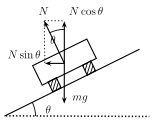
What this figure shows. A vertical cross-section of a road curved to radius r and banked (tilted) at angle to the horizontal, with a vehicle (point mass) shown resting on the inclined surface, friction ignored for this idealised diagram. Two force arrows act: weight mg drawn vertically downward, and normal reaction N drawn PERPENDICULAR to the inclined road surface (i.e. tilted at angle from the vertical). The figure shows N resolved into its vertical component (balancing mg) and horizontal component (directed towards the centre of the circular track, supplying the n …
Considering the vehicle as a point and IGNORING friction for the moment (not eliminating it -- just setting the safest-case baseline), only two forces act: weight mg, vertically downward, and normal reaction N, perpendicular to the (now tilted) road surface. Since the vehicle's actual motion is along a HORIZONTAL circle, the net force must be purely horizontal, which means the VERTICAL component of N must exactly balance mg: . The HORIZONTAL component of N, , is then the entire resultant force, and being directed towards the centre of the track, it is the centripetal force: . Dividing the second relation by the first eliminates N:
This single relation serves two complementary engineering purposes. (a) For a road of GIVEN radius r and banking angle (both fixed once built), it gives the unique 'most safe speed' -- not a minimum or maximum, but the one special speed at which the vehicle needs NO help from friction at all. (b) When DESIGNING a road for an intended speed v and radius r, it instead gives the required banking angle,
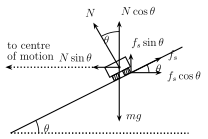
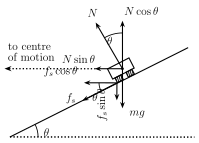
In practice, vehicles never travel at exactly this one safe speed , so friction (up to its limit ) does come into play to extend the usable speed range on either side.
Drawn by us to help you understand the concept clearly, and verified to make sure it's accurate. For exams, practice from your textbook's own diagram.
What this figure shows. The same banked-road cross-section as Fig. 1.6, radius r, banking angle , but now for a vehicle travelling SLOWER than the safe speed (so that alone would be MORE than the actual centripetal force needed). Three force arrows act: weight mg vertically down, normal reaction N perpendicular to the road, and the force of static friction drawn ALONG the inclined road surface pointing UPWARD (up the slope), since at this lower speed the vehicle tends to slide down/inward and friction acts to prevent that, its horizontal component opposing part of ; t …
…
Drawn by us to help you understand the concept clearly, and verified to make sure it's accurate. For exams, practice from your textbook's own diagram.
What this figure shows. The same banked-road cross-section as Figs. 1.6-1.7, but now for a vehicle travelling FASTER than the safe speed (so alone would be LESS than the centripetal force actually needed). The same three forces act -- weight mg down, normal reaction N perpendicular to the road, and static friction -- but now is drawn ALONG the inclined surface pointing DOWNWARD (down the slope), since at this higher speed the vehicle tends to skid up/outward and friction acts to prevent that, its horizontal component now ADDING to ; this comb …