Physics · Ch 1 — Rotational Dynamics
Conical Pendulum
Conical Pendulum
A tiny bob (a point mass) attached to a long, flexible, effectively massless and inextensible string, suspended from a rigid support and made to revolve so that the string sweeps out the surface of a right circular cone (rather than swinging back and forth in one vertical plane, which would instead be a simple pendulum) is called a conical pendulum.
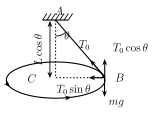
Drawn by us to help you understand the concept clearly, and verified to make sure it's accurate. For exams, practice from your textbook's own diagram.
What this figure shows. A vertical cross-section of a conical pendulum: a rigid support at point A, from which a string of length L runs down and outward at angle to the vertical to a bob (point mass) at position B, tracing a horizontal circle of radius about centre C directly below A. In this INERTIAL (ground) frame, only two force arrows act on the bob: weight mg drawn vertically downward, and the string tension drawn ALONG the string from B towards the support A. The vertical component balances mg, while the horizontal component is the net (resultant, and hence centrip …
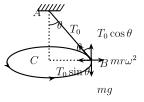
Drawn by us to help you understand the concept clearly, and verified to make sure it's accurate. For exams, practice from your textbook's own diagram.
What this figure shows. The identical geometry as Fig. 1.9(a) -- support A, string of length L at angle , bob at B tracing radius -- but now redrawn as seen in the NON-INERTIAL frame that rotates along with the bob. Here a THIRD force arrow is added: the centrifugal (pseudo) force, drawn horizontally OUTWARD from the bob (away from the centre C), of magnitude . In this frame the bob is at rest, so all three forces (weight mg down, tension along the string, and the outward centrifugal force) are shown in exact balance, with now interpreted as balancing the centrifugal force rather …
The bob itself performs a practically uniform HORIZONTAL circular motion. Let L be the string length, the (constant) semi-vertical angle the string makes with the vertical at the support, and the radius of the bob's horizontal circular path.
Only two forces act on the bob: its weight mg, vertically downward, and the string tension , directed along the string towards the support. Since the bob's actual motion is horizontal, the net force must be horizontal, so the VERTICAL component of tension balances the weight: --- (1.6). The HORIZONTAL component is then the resultant, and hence centripetal, force: --- (1.5). Dividing (1.5) by (1.6), (using , so ). This gives the period of revolution and the frequency Both depend only on the string length L, the angle , and g -- crucially, NEITHER depends on the mass of the bob, which cancels out of the ratio of Eqs. (1.5) and (1.6) entirely.
The same result is obtained (equally validly) by working in the NON-inertial frame that co-rotates with the bob: here the bob is at rest, and in addition to weight and tension a centrifugal pseudo-force must be introduced, acting horizontally outward; for equilibrium in this frame, must balance this centrifugal force, giving back the identical Eq. (1.5). …