Q.Why should a photodiode be operated in reverse biased mode?
You're viewing a preview — the full solution, concept, methods & PYQ mapping are locked.
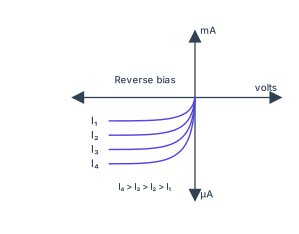
Start your 14-day free trial to unlock the full solution →In REVERSE bias, an ordinary (unilluminated) p-n junction carries only a small, essentially constant reverse ('dark') current, set purely by the concentration of minority carriers on either side of the junction -- this current does not depend significantly on the exact reverse voltage applied, only on the minority-carrier population. When light falls on the junction, additional electron-hole pairs are photo-generated in the depletion region and swept apart by the junction's own field, ADDING to this reverse current in direct proportion to the incident light intensity. Because the baseline (dark) current is small and stable, this added photocurrent is easily distinguishable and gives the photodiode its useful, close-to-linear response to light intensity, together with fast switching and good sensitivity -- exactly the properties needed for a practical light-detecting device. If the same junction were instead operated in FORWARD bias, it would carry a comparatively LARGE majority-carrier current that has nothing to do with illumination at all; any small photocurrent contribution from incident light would be completely swamped by this much larger forward current, making the device useless as a light detector in that bias mode. Reverse bia …
Unlock everything free for 14 days
- Full step-by-step solutions
- Concept-first explanations
- Methods, shortcuts & mistakes
- PYQ mapping + timed mock tests
Full access for 14 days. No credit card required.