Q.Explain the principle of operation of a photodiode.
You're viewing a preview — the full solution, concept, methods & PYQ mapping are locked.
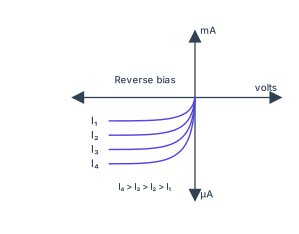
Start your 14-day free trial to unlock the full solution →A photodiode is a p-n junction diode operated in REVERSE bias. In the dark (unilluminated), it carries a small, essentially voltage-independent reverse ('dark') current, determined entirely by the concentration of MINORITY carriers on either side of the junction (electrons in the p-region, holes in the n-region). When light falls on the exposed junction, photons with energy greater than the semiconductor's band gap generate additional electron-hole pairs within the depletion region; the junction's own built-in electric field immediately separates these pairs -- sweeping electrons towards the anode side and holes towards the cathode side -- adding them to the current flowing through the external circuit. The TOTAL current through an illuminated, reverse-biased photodiode is therefore the sum of this light-generated (photo) current and the ever-present dark current. Because the number of photo-generated pairs scales directly with how many photons arrive per second, the additional reverse current is (over a useful range) directly proportional to the INTENSITY of the incident light -- this proportionality is exactly what makes a photodiode a useful light-intensity sensor, since measuring its current directly indicates the light level falling on it. At sufficiently high illumination, this current eventually levels off at a SATURATION value. Reverse bias is specifically chosen for this operation bec …
Unlock everything free for 14 days
- Full step-by-step solutions
- Concept-first explanations
- Methods, shortcuts & mistakes
- PYQ mapping + timed mock tests
Full access for 14 days. No credit card required.