Physics · Ch 16 — Semiconductor Devices
Ripple Factor
Ripple Factor
The output of a rectifier is never perfectly smooth DC -- it always retains a small leftover AC component riding on top of the intended steady DC level. This unwanted AC component is called RIPPLE, and it is undesirable because it causes the rectifier's output voltage to fluctuate rather than stay constant, which most electronic loads cannot tolerate. The RIPPLE FACTOR r quantifies exactly how much ripple remains: it is defined as the ratio of the root-mean-square (rms) value of the AC component in the rectifier's output to the value of the DC component in that same output, . A SMALLER ripple factor means the rectifier's output is closer to pure, steady DC -- i.e. the rectifier is more effective. Since a full wave rectifier's output pulses are twice as frequent and never drop all the way to zero between pulses (unlike a half wave rectifier's, which does), a full wave rectifier's ripple factor is inherently smaller than a ha …
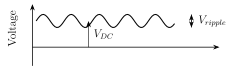
Drawn by us to help you understand the concept clearly, and verified to make sure it's accurate. For exams, practice from your textbook's own diagram.
What this figure shows. A single time-axis graph showing a rectifier's raw (unfiltered) output voltage: a roughly constant, elevated DC baseline level, but with the curve continuously wavering -- rising and falling in small, regular, wave-like oscillations riding on top of that baseline -- rather than being a perfectly flat horizontal line. The DC baseline itself is marked/implied as the average level around which these small oscillations occur, visually separating the graph into its two conceptual components: a steady DC part plus a smaller superimposed AC 'ripple' part whose rms magnitude, relative to the DC level, is what the ripple factor $r …