Physics · Ch 15 — Structure of Atoms and Nuclei
Energy of the Electrons
Energy of the Electrons
The electron's total energy in the nth orbit is the sum of its kinetic energy and its (negative) electrostatic potential energy, . Substituting the expressions for and derived in the previous section and simplifying gives the compact result , or, after substituting the values of all the physical constants, the far more useful practical form eV.
The NEGATIVE sign is essential and physically meaningful: it signals that the electron is bound to the nucleus, meaning energy must be SUPPLIED to it to bring its total energy up to zero (the point at which the electron becomes free of the atom entirely). As n increases, becomes LESS negative -- the energy increases toward (but never reaches) zero as . The n=1 orbit, with the most negative (lowest) energy, is called the ground state, the atom's naturally lowest-energy and hence most stable configuration; any orbit with n > 1 is called an excited state, and an electron occupying the nth orbit is said to be in the nth energy state.
For hydrogen (Z=1) specifically, the ground-state energy is exactly eV. The energy needed to move an electron from the ground state up to some excited state n is called the excitation energy of that state, equal to ; for example, the minimum excitation energy, to the very first excited state (n=2), is eV. Carrying this logic to its natural conclusion, the energy needed to remove the ground-state electron completely from the atom (raising its energy all the way to zero) is called the ionization energy -- exactly 13.6 eV for hydrogen -- and this is numerically identical to the (positive) binding energy of the ground-state electron: the energy that would be RELEASED if a free proton and a free electron, starting infinitely far apart, were brought together to form a hydrogen atom in its ground state. …
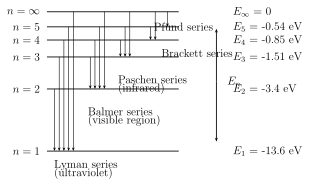
Drawn by us to help you understand the concept clearly, and verified to make sure it's accurate. For exams, practice from your textbook's own diagram.
What this figure shows. An energy-level diagram (explicitly noted as 'not to scale') showing a series of horizontal lines stacked vertically, each representing one allowed energy of the hydrogen electron: the lowest line (ground state, n=1) drawn at -13.6 eV, then successive lines above it for n=2 (-3.4 eV), n=3 (-1.51 eV) and further excited states, with the lines crowding closer together as n increases and approaching a horizontal dashed line at 0 eV (the ionization limit, n to infinity) at the very top. Several vertical downward arrows are drawn connecting pairs of levels, each representing a possible electron transition accompanied by photon emission -- arrows terminating on the n=1 line represent Lyman-series transitions, arrows terminating on the n=2 line represent Balmer-series transitions, and s …
Worked out. Using eV for hydrogen, the energies of the first two excited states (n=2 and n=3) are computed directly: eV and eV. The excitation energy of a state is then defined and computed as the difference between that state's energy and the ground-state energy (-13.6 eV): eV for the n=2 state and eV for the n=3 state, distinguishing 'excitation energy of a given excited state' from the single fixed 13.6 eV 'ionization energy' of the ground state its …
Worked out. Applies the Rydberg formula with n=3 (Paschen series) and m=4,5,6 (the first three lines) to , working through each value of m in turn to obtain three progressively shorter wavelengths in the infrared: approximately m for m=4, m for m=5, and m for m=6 -- concretely demonstrating both the use of the Rydberg constant m and the pattern (visible in Fig.15.3) of successive lines in a series growing cl …