Physics · Ch 7 — Wave Optics
Comparison of Young's Double Slit Interference Pattern and Single Slit Diffraction Pattern
Comparison of Young's Double Slit Interference Pattern and Single Slit Diffraction Pattern
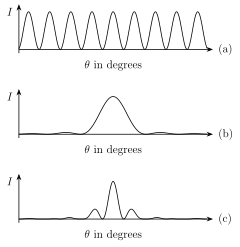
In an actual laboratory setting, a Young's double-slit interference pattern (slit separation typically a few millimetres, commonly produced using a biprism or Lloyd's mirror rather than genuine mechanically-cut slits) shows roughly 30 to 40 bright and dark fringes, all of essentially EQUAL width and brightness. A single-slit diffraction pattern, by contrast (slit width typically under 1 mm), shows only about 20 to 30 visible fringes -- but with the CENTRAL fringe distinctly the brightest AND twice as wide as every other fringe (Section 7.9.3), and the intensity of the side fringes tapering off progressively further from the centre (Fig. 7.16(b)), quite unlike the double slit's uniform brightness across its whole pattern (Fig. 7.16(a)).
Drawn by us to help you understand the concept clearly, and verified to make sure it's accurate. For exams, practice from your textbook's own diagram.
What this figure shows. Three intensity–angle graphs: (a) double-slit interference — many equally bright, equally spaced fringes; (b) single-slit diffraction — a broad central maximum with rapidly fading side maxima; (c) double-slit diffraction — the interference fringes of …
…