Physics · Ch 7 — Wave Optics
Experimental Set Up for Fraunhofer Diffraction
Experimental Set Up for Fraunhofer Diffraction
The standard laboratory setup for observing Fraunhofer diffraction (Fig. 7.14) uses two converging lenses. A monochromatic point (or, for slit-shaped elements, linear) source S is placed exactly at the focal point of the FIRST lens; light emerging from this lens, ignoring aberrations, consists of parallel rays -- a genuine plane wavefront -- travelling towards the diffracting element itself (which could be a single slit, a circular aperture, a double slit, or a diffraction grating). After diffracting at this element, the emerging beam (now spread over a range of diffraction angles) passes through a SECOND converging lens, which focuses parallel rays leaving the element at any one particular angle down to a single corresponding point on a screen placed at that second lens's focal plane.
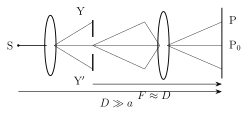
Drawn by us to help you understand the concept clearly, and verified to make sure it's accurate. For exams, practice from your textbook's own diagram.
What this figure shows. A monochromatic source S at the focus of a converging lens produces a plane wavefront that falls on the diffracting slit. The diffracted parallel rays are brought to a focus on the screen by a second converging lens (F ≈ D, D >> a) — the arr …
…