Physics · Ch 7 — Wave Optics
Rayleigh's Criterion for Limit of Resolution
Rayleigh's Criterion for Limit of Resolution
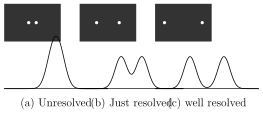
Lord Rayleigh's criterion answers the question of exactly how close two objects can be before an instrument can no longer resolve them, by relating it directly to their overlapping DIFFRACTION patterns (rather than to any geometric or ray-optics argument): two objects are said to be JUST RESOLVED when the FIRST MINIMUM of one object's own diffraction pattern falls exactly on top of the CENTRAL MAXIMUM of the other object's diffraction pattern (and, by the same symmetric logic, vice versa). If the two objects are closer together than this, their two central maxima overlap so heavily that the resultant (summed) intensity pattern shows only a single smooth peak, with no discernible dip between them -- the objects are NOT resolved (Fig. 7.17(a)). Exactly at the Rayleigh separation, the summed pattern shows a small but clearly noticeable dip between two peaks -- the borderline 'just resolved' case (Fig. 7.17(b)). Further apart still, the dip becomes deep and unambiguous -- the objects are clearly, comfortably resolved (Fig. 7.17(c)).
Drawn by us to help you understand the concept clearly, and verified to make sure it's accurate. For exams, practice from your textbook's own diagram.
What this figure shows. Rayleigh's criterion illustrated for two nearby objects. (a) Unresolved — the diffraction patterns overlap with no dip between them. (b) Just resolved — the central maximum of one falls on the first minimum of the other, giving a just-noticeable dip. (c) W …
For two LINEAR objects (such as a pair of narrow slits) viewed through an aperture of width a, the angular position of the first diffraction minimum (Section 7.9.3) is . Since, by Rayleigh's criterion, this exact angular separation is what makes the two objects just resolved, it IS the instrument's limit of resolution for linear objects: , and correspondingly the minimum resolvable LINEAR separation at distance D from the instrument is -- simply the distance of the diffraction pattern's own first minimum from its centre. …
Drawn by us to help you understand the concept clearly, and verified to make sure it's accurate. For exams, practice from your textbook's own diagram.
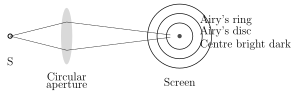
What this figure shows. A point source imaged through a circular aperture gives, not a point, but a central bright disc (the Airy disc) surrounded by concentric rings — Airy's rings. This diffraction pattern limits how finely an optical inst …

Drawn by us to help you understand the concept clearly, and verified to make sure it's accurate. For exams, practice from your textbook's own diagram.
What this figure shows. A representation of a real Airy pattern: a bright central disc with several orders of concentric rings, such as a red laser beam makes on passing through a ~90 μm pinhole. (Our own schema …