Physics · Ch 7 — Wave Optics
Resolving Power of a Telescope
Resolving Power of a Telescope
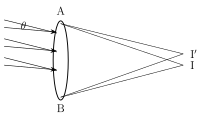
A telescope is normally used to view very distant objects -- stars -- which, being both extremely far away and (for resolving-power purposes) essentially point-like sources, produce Airy-disc diffraction patterns exactly like the point objects of Section 7.10.2. But because the objects themselves are so far away, only their ANGULAR separation as seen from the telescope matters for resolving power -- their actual physical (linear) separation in space is irrelevant to the calculation. Fig. 7.20 shows the telescope's objective AB, of full aperture (diameter) D, receiving two sets of essentially parallel rays from two distant point sources with angular separation between them; resolving power is defined, exactly as before, as the reciprocal of the smallest angular separation at which the two objects remain just resolvable.
Drawn by us to help you understand the concept clearly, and verified to make sure it's accurate. For exams, practice from your textbook's own diagram.
What this figure shows. Two distant point objects send parallel beams, separated by a small angle θ, to a telescope objective AB. Their diffraction patterns (Airy discs) form at I and I'; by Rayleigh's criterion they are just resolved when θ = 1.22λ/D, so a larger aperture D gives a …
Applying Rayleigh's criterion (via Abbe's Airy-disc theory, exactly as in the self-luminous point-object case of Section 7.10.2, since stars are genuinely self-luminous): the path difference between the extreme rays reaching the first dark ring is , and with the full objective diameter (aperture), the resulting geometry gives directly -- this angular limit of resolution IS the telescope's limit of resolution, and the resolving power is its reciprocal, .
This result carries a clear, actionable design implication: for a FIXED wavelength of light being observed, a telescope's resolving power improves in direct proportion to its objective's APERTURE D -- so building progressively LARGER telescope objectives is the single most direct way to improve resolving power. In practice, very large lenses run into serious difficulties -- chromatic and other optical aberrations, the sheer difficulty of precisely moulding a large piece of glass, and (for space telescopes) the heavy mass and mechanical complexity of supporting and adjusting a large lens after launch -- so modern telescopes instead favour a front-coated curved MIRROR as the objective (specifically a PARABOLIC mirror shape, which eliminates spherical aberration, as covered in Class XI). Since even constructing a single very large mirror in one piece remains difficult, the most recent large telescopes use SEGMENTED mirrors -- many smaller hexagonal mirror segments precisely aligned together to form one very large effective parabolic surface -- with the two largest optical telescopes currently under construction using mirrors of 30 m and 40 m diameter respectively. …
Drawn by us to help you understand the concept clearly, and verified to make sure it's accurate. For exams, practice from your textbook's own diagram.
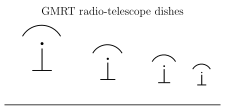
What this figure shows. The GMRT at Narayangaon near Pune, Maharashtra: because radio wavelengths are large (metres), a single dish cannot give good resolution, so an ARRAY of parabolic dishes spread over several kilometres is used together. (Our own schematic of th …
Internet my friend — links the textbook itself suggests: