Question 73 of 102
Q.Explain the working of Daniel cell with a neat diagram.
Puducherry TnboardTamil Nadu HSC (DGE) Board 2018Subjective· 5mImportance★★★★★
72% · 73/102 Questions
You're viewing a preview — the full solution, concept, methods & PYQ mapping are locked.
Start your 14-day free trial to unlock the full solution →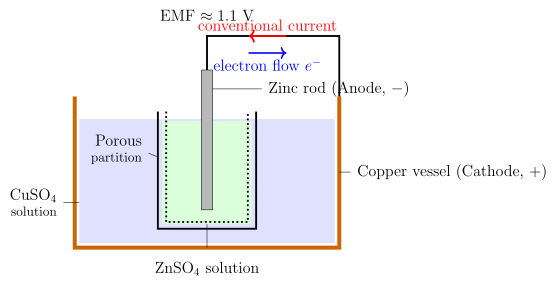
The Daniell cell is a primary electrochemical cell that converts the chemical energy of a zinc-copper redox reaction into electrical energy, using a porous partition to separate the two electrolytes.
- Construction: a copper vessel (or rod) immersed in copper sulphate () solution acts as the cathode (positive electrode); a zinc rod immersed in dilute sulphuric acid or zinc sulphate () solution, contained inside a porous pot placed within the copper vessel, acts as the anode (negative electrode). The porous pot allows ion migration but prevents the two solutions from mixing freely.
- Oxidation at the anode: at the zinc electrode, zinc atoms lose electrons and pass into solution as ions: .
- Reduction at the cathode: the electrons released flow through the external circuit to the copper electrode, where ions from solution gain these electrons and are deposited as metallic copper: . …
Unlock everything free for 14 days
- Full step-by-step solutions
- Concept-first explanations
- Methods, shortcuts & mistakes
- PYQ mapping + timed mock tests
Full access for 14 days. No credit card required.