Q.Explain the equivalent resistance of a series and parallel resistor network.
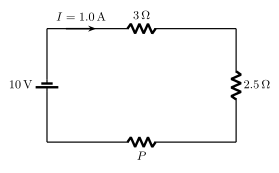
Step 1 (Series). When resistors are connected end to end, the same current I flows through all of them (charge cannot accumulate anywhere along the chain).
Step 2. By Ohm's law, the voltage drops across each differ: , , ; the supply voltage V equals their sum, .
Step 3. Writing defines the series equivalent resistance, -- always GREATER than the largest individual resistor.
Step 4 (Parallel). When the same three resistors are instead all connected across the same two points, each sees the identical voltage V, but the total current I splits into branch currents , , , which sum to the total: .
Step 5. Writing defines the parallel equivalent resistance through -- always LESS than the smallest individual resistor.
Step 6. These two rules let any resistor network, however complex, be reduced by repeatedly collapsing obvious series or parallel sub-groups from the inside outward, until one single equivalent resistance remains for the whole network.
Series resistors add directly, (result always exceeds the largest resistor); parallel resistors add as reciprocals, (result always less than the smallest resistor).
Unlock everything free for 14 days
- Full step-by-step solutions
- Concept-first explanations
- Methods, shortcuts & mistakes
- PYQ mapping + timed mock tests
Full access for 14 days. No credit card required.