Q.Write notes on Photodiode.
You're viewing a preview — the full solution, concept, methods & PYQ mapping are locked.
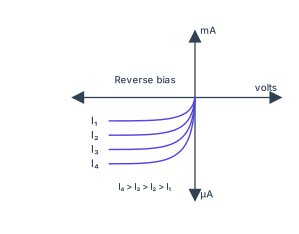
Start your 14-day free trial to unlock the full solution →Step 1 (Definition). A photodiode is a p-n junction diode that converts an optical signal into an electrical signal -- its operation is exactly the inverse of an LED's, and unlike the LED it is operated in REVERSE bias.
Step 2 (Structure). It is a p-n junction of photosensitive material housed in a plastic case with a small transparent window that lets incident light reach the junction; its circuit symbol shows arrows pointing TOWARDS the device (light going in), the mirror image of the LED's symbol.
Step 3 (Operation). When a photon of sufficient energy strikes the depletion region, it elevates a valence electron into the conduction band, creating an electron-hole pair (exactly like thermal generation, but driven by light).
Step 4. The reverse-bias electric field sweeps these newly created carriers across the junction (holes towards the n-side, electrons towards the p-side) before they can recombine, and completing an external circuit turns this into a measurable photocurrent, proportional to the incident light intensity -- which is why photodiodes are used as light sensors. …
Unlock everything free for 14 days
- Full step-by-step solutions
- Concept-first explanations
- Methods, shortcuts & mistakes
- PYQ mapping + timed mock tests
Full access for 14 days. No credit card required.