Q.Why does a solid sphere have smaller moment of inertia than a hollow cylinder of same mass and radius, about an axis passing through their axes of symmetry?
🔒You're viewing a preview — the full solution, concept, methods & PYQ mapping are locked.
🔒 Start your 14-day free trial to unlock the full solution →Concept understanding — Rotational Inertia Comparison
Rotational Inertia Comparison: From Intuition to Precision
Imagine pushing a shopping cart that's nearly empty, then pushing the same cart loaded with bricks. The loaded cart is harder to get moving — it resists changes to its motion more. That resistance is inertia, and it depends only on how much mass is there.
Now imagine spinning a bicycle wheel. If you hold the axle and try to tilt the spinning wheel, it fights you. But here's the twist: a lightweight wheel that's large in diameter can be harder to spin or stop than a heavy wheel that's small in diameter, even if the heavy wheel has more mass. Why? Because rotational inertia depends not just on how much mass, but on where that mass is placed relative to the axis of rotation.
Rotational inertia (also called moment of inertia) is the rotational equivalent of mass. It measures how difficult it is to change an object's rotational motion — to start it spinning, stop it, or change its spin speed.
The Core Idea: Mass × Distance²
The precise statement is this:
I=∑miri2
For a collection of point masses, rotational inertia I is the sum of each mass mi multiplied by the square of its perpendicular distance ri from the axis of rotation.
That square is crucial. Doubling the distance from the axis quadruples the rotational inertia. A mass far from the axis contributes much more to rotational inertia than the same mass close to the axis.
Why Comparison Matters
When you compare two objects, you're asking: Which is harder to spin? The answer depends on both mass and shape.
Example 1: A ring vs. a disk of the same mass and radius
- A ring has all its mass at the outer edge (r=R for all mass). Its rotational inertia is Iring=MR2.
- A solid disk has mass spread evenly from center to edge. Its rotational inertia is Idisk=21MR2.
The ring has twice the rotational inertia of the disk. Same mass, same radius — but the ring is harder to spin because its mass is concentrated farther from the axis.
Example 2: A long rod vs. a short rod of the same mass
- A rod spun about its center: I=121ML2.
- A rod spun about one end: I=31ML2.
The same rod, same mass — but spinning it about the end is four times harder than spinning it about the center. The mass is, on average, farther from the axis.
A common mistake is to think that rotational inertia depends only on mass. It does not. Two objects with the same mass can have wildly different rotational inertias depending on how their mass is distributed.
The Intuition Behind the Square
Why distance squared? Think of a spinning object. A mass far from the axis has to travel a longer path in the same time — it has a higher linear speed for the same angular speed. To change that speed (to accelerate or decelerate the rotation), you need to apply a force over that longer distance. The square comes from the geometry: the work required scales with distance, and the lever-arm effect also scales with distance. The two factors multiply.
A Quick Comparison Table
| Object | Axis location | Rotational inertia I | Relative difficulty to spin |
|---|---|---|---|
| Point mass m at distance R | Through point | mR2 | Baseline |
Concept: Rotational Inertia Comparison
The moment of inertia (I) of an object depends on its mass and how that mass is distributed relative to the axis of rotation. Objects with more mass concentrated closer to the axis have a smaller moment of inertia.
- For a hollow cylinder of mass M and radius R rotating about its axis of symmetry, all its mass is located at the maximum distance R from the axis. Its moment of inertia is Icylinder=MR2.
- For a solid sphere of mass M and radius R rotating about an axis passing through its center (its axis of symmetry), its mass is distributed throughout its volume, from the center (r=0) to the surface (r=R). Its moment of inertia is Isphere=52MR2. …
A solid sphere has a smaller moment of inertia than a hollow cylinder of the same mass and radius because, in the sphere, a greater proportion of its mass is distributed closer to the axis of rotation, resulting in less resistance to angular acceleration.
The moment of inertia, often called rotational inertia, is a fundamental concept in rotational dynamics. It quantifies an object's resistance to changes in its rotational motion, much like mass quantifies resistance to changes in linear motion. The key factors determining moment of inertia are the object's total mass and, crucially, how that mass is distributed relative to the axis of rotation. The further the mass is, on average, from the axis, the greater the moment of inertia.
To understand why a solid sphere has a smaller moment of inertia than a hollow cylinder of the same mass and radius about their axes of symmetry, we need to compare how mass is distributed in each object.
- Recall the Moment of Inertia Formulas: For a solid sphere of mass M and radius R, rotating about an axis passing through its center (which is its axis of symmetry), the moment of inertia is given by:
Isphere=52MR2
For a thin-walled hollow cylinder of mass $M$ and radius $R$, rotating about its central axis (its axis of symmetry), the moment of inertia is given by:
Ihollow_cylinder=MR2
> [!IMPORTANT]
> These formulas are standard results derived from integration, considering the mass distribution.
2. Compare the Coefficients:
Let's look at the coefficients multiplying MR2 in both formulas:
* For the solid sphere: 52=0.4
* For the hollow cylinder: 1
Clearly, 0.4<1. This mathematical comparison directly shows that Isphere<Ihollow_cylinder for the same mass M and radius R.
- Understand the Physical Reason (Mass Distribution):
The difference in these coefficients arises from how the mass is distributed in each object relative to the axis of rotation.
- Hollow Cylinder: In a thin-walled hollow cylinder, all of its mass M is concentrated at the maximum radius R from the axis of rotation. There is no mass closer to the axis than R. …
Concept: Moment of Inertia Depends on How Mass Is Distributed Relative to the Axis
I=∫r2dm
Mass located farther from the axis contributes more to I (weighted by r2); mass located closer contributes less.
Step 1: Moment of inertia of the hollow cylinder
For a thin-walled hollow cylinder of mass M, radius R, spinning about its central axis, every mass element sits at exactly r=R:
Icylinder=MR2
Step 2: Moment of inertia of the solid sphere
For a solid sphere of mass M, radius R, spinning about a diameter, the mass is spread throughout the volume, from r=0 at the centre out to r=R at the surface:
Isphere=52MR2
Step 3: Compare
52MR2<MR2since 52=0.4<1 …
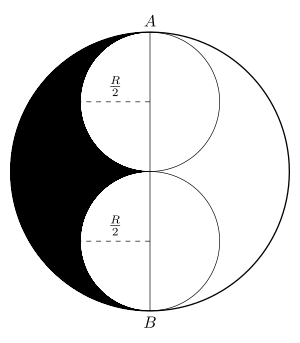
- TG EAPCET 2026Set eng-2026-05-09-FN1 markMCQQ.A uniform thin circular disc of mass M and radius R is shown in the figure. The moment of inertia of the shaded region about the diameter AB of the disc is (A) 167MR2 (B) 647MR2 (C) 327MR2 (D) 16MR2
›Reveal solutionSolution
Take the left semicircular half of the disc (MR2/8 about AB) and subtract the two removed half-circles of radius R/2 (together MR2/64). The result is 7MR2/64 — option (B).
The concept first
Two ideas make this a short calculation instead of a nasty integral.
1. Moment of inertia is additive. I is a sum (integral) of dmr2, so if a body is a whole minus a hole, then Ibody=Iwhole−Ihole, provided both are taken about the same axis. That lets us handle an awkward hatched shape with two standard results.
2. Symmetry halves the work. The axis AB is a vertical diameter, and the disc is symmetric about it. So the left half and right half contribute equally: each is 21Idisc. The same symmetry argument applies to each small circle, because its centre lies on AB — that is the crucial geometric fact in the figure. AB passes through the centre of each small circle, so AB is a diameter of the small circle too, and its left half contributes half of the small circle's I.
Standard result used: for a uniform disc of mass m, radius r, about a diameter, I=41mr2.
Step-by-step
- Surface mass density.
σ=πR2M
- Whole disc about the diameter AB.
Idisc=41MR2
- Left half of the big disc about AB. By symmetry about AB,
Ileft half=21×4MR2=8MR2
- Mass of one small circle (radius R/2):
m=σ×π(2R)2=πR2M×4πR2=4M
- One whole small circle about AB. AB passes through its centre, so AB is a diameter of that circle: …
- TG EAPCET 2026Set eng-2026-05-11-AN1 markMCQQ.A steel solid sphere of diameter 2 cm collides head-on elastically with another steel solid sphere of radius 2 cm at rest. The fraction of the initial kinetic energy of the smaller sphere transferred to the larger sphere during collision is (A) 2716 (B) 916 (C) 98 (D) 8132
›Reveal solutionSolution
For a head-on elastic collision between two spheres, the fraction of kinetic energy transferred from the smaller to the larger depends only on their mass ratio. Here the masses are proportional to the cubes of the radii, giving a mass ratio of 1:8, and the fraction transferred is 8116. The correct option is (D).
The key idea is that in a one-dimensional elastic collision, the velocities after impact are completely determined by conservation of momentum and conservation of kinetic energy. The fraction of energy transferred from the projectile to the target depends only on the mass ratio. Since both spheres are made of steel, their masses are proportional to their volumes, i.e., to the cube of their radii.
Why this approach works:
We don’t need to compute forces or time of contact — elastic collisions have a neat algebraic result: the final velocity of the initially stationary target is v2f=m1+m22m1v1i. The kinetic energy transferred is then simply 21m2v2f2, and the fraction is that divided by the initial kinetic energy 21m1v1i2. The result simplifies to a function of the mass ratio alone.
- Find the masses. The smaller sphere has diameter 2 cm, so its radius is r1=1 cm. The larger sphere has radius r2=2 cm. Since both are steel (same density ρ), mass is proportional to volume:
m1=ρ⋅34π(1)3,m2=ρ⋅34π(2)3
Hence
m2m1=2313=81.
So m2=8m1.
- Set up the collision. Let the smaller sphere (mass m1) move initially with speed u toward the larger sphere (mass m2=8m1) at rest. After an elastic head-on collision, the velocity of the larger sphere is given by the standard formula:
v2=m1+m22m1u.
Substituting m2=8m1:
v2=m1+8m12m1u=9m12m1u=92u.
- Compute the kinetic energy transferred. Initial kinetic energy of the smaller sphere:
- TG EAPCET 2026Set eng-2026-05-11-AN1 markMCQQ.Two solid spheres of radii 10 cm and 5 cm are in contact with each other. If the density of the material of the smaller sphere is twice the density of the material of the larger sphere, then the distance of the centre of mass of the system of the two spheres from the centre of the smaller sphere is (A) 6 cm (B) 9 cm (C) 12 cm (D) 8 cm
›Reveal solutionSolution
The centre of mass lies along the line joining the centres, weighted by mass.
Using the smaller sphere’s centre as origin, the COM distance from it is 9 cm → option (B).
Concept & Intuition
The centre of mass of two point masses (or uniform spheres, which behave as point masses at their centres) is the weighted average of their positions, where the weights are the masses.
Here the spheres touch, so the distance between their centres is the sum of their radii: 10+5=15 cm.
The smaller sphere has twice the density of the larger, so even though its volume is smaller, its mass is not simply proportional to volume — we must compute each mass using density × volume.
Step-by-step solution
-
Set up coordinates
Place the centre of the smaller sphere at x=0 and the centre of the larger sphere at x=15 cm (since they touch, the distance between centres is 10+5=15 cm).
-
Find the masses
Let the density of the larger sphere be ρ. Then the density of the smaller sphere is 2ρ.
Volume of a sphere: V=34πr3.
- Larger sphere: radius R=10 cm → VL=34π(10)3=34000π cm³. Mass ML=ρ⋅VL=34000πρ.
- Smaller sphere: radius r=5 cm → VS=34π(5)3=3500π cm³. Mass MS=2ρ⋅VS=2ρ⋅3500π=31000πρ.
-
Apply the centre of mass formula
For points along a line, the COM coordinate (with origin at the smaller sphere’s centre) is:
xCOM=MS+MLMS⋅0+ML⋅15
Substitute the masses:
xCOM=31000πρ+34000πρ0+34000πρ⋅15
The factor 3πρ cancels from numerator and denominator:
xCOM=1000+40004000×15=500060000=12 cm
- Interpret the result …
-
- TG EAPCET 2026Set ap-2026-05-05-FN1 markMCQQ.If a rope wound to a solid cylinder is allowed to unwind by holding the free end of the rope, then the acceleration with which the cylinder falls down is (A) 6.53ms−2 (B) 9.8ms−2 (C) 3.27ms−2 (D) 19.6ms−2
›Reveal solutionSolution
When a solid cylinder unwinds a rope by falling, it undergoes both translational and rotational motion. By applying Newton's second law for both types of motion and relating the linear and angular accelerations, we find the acceleration of the cylinder to be 32g. The calculated acceleration is 6.53ms−2.
The problem describes a solid cylinder with a rope wound around it, which is allowed to unwind as the cylinder falls. This setup involves two types of motion simultaneously: the cylinder's center of mass moves downwards (translational motion), and the cylinder rotates about its axis (rotational motion). To find the acceleration, we need to apply Newton's second law for both translational and rotational dynamics and then combine these equations.
Here's the underlying concept:
- Translational Motion: The net force acting on the cylinder determines its linear acceleration. The forces involved are gravity pulling it down and the tension in the rope pulling it up.
- Rotational Motion: The net torque acting on the cylinder determines its angular acceleration. The tension in the rope creates a torque about the cylinder's central axis, causing it to rotate.
- Constraint: Since the rope unwinds without slipping, there's a direct relationship between the linear acceleration of the cylinder's center of mass and its angular acceleration.
Let's denote the mass of the cylinder as M, its radius as R, its linear acceleration as a, and its angular acceleration as α. The acceleration due to gravity is g.
- Analyze Translational Motion: The forces acting on the cylinder are its weight, Mg, acting downwards, and the tension in the rope, T, acting upwards. Applying Newton's second law for translational motion in the vertical direction:
Fnet=Ma
Mg−T=Ma(1)
Here, we've taken the downward direction as positive.2. Analyze Rotational Motion:
The tension T in the rope creates a torque about the cylinder's central axis. This torque causes the cylinder to rotate. The moment of inertia for a solid cylinder about its central axis is I=21MR2.
The torque τ is given by the force multiplied by the perpendicular distance from the axis of rotation, which is the radius R.
τ=TR
Applying Newton's second law for rotational motion:τnet=Iα
TR=(21MR2)α(2)
- Relate Linear and Angular Acceleration: Since the rope unwinds without slipping, the linear acceleration of the point on the cylinder's circumference in contact with the rope is the same as the linear acceleration of the rope itself (which is the acceleration of the cylinder's center of mass). This gives us the kinematic relationship:
a=Rα
From this, we can express $\alpha$ in terms of $a$:α=Ra(3)
- Solve the System of Equations: Now we substitute equation (3) into equation (2):
TR=(21MR2)(Ra)
TR=21MRa
We can cancel $R$ from both sides (assuming $R \neq 0$): … - TG EAPCET 2026Set ap-2026-05-05-FN1 markMCQQ.A rectangular door of mass 18 kg and width 90 cm is hinged at one end can rotate about the vertical axis without friction. A bullet of mass 15 g fired with a speed of 450ms−1 into the door gets embedded exactly at the center of the door. The angular speed of the door just after the bullet embeds into it is (A) 2.5rad s−1 (B) 0.625rad s−1 (C) 0.416rad s−1 (D) 1.25rad s−1
›Reveal solutionSolution
Conserving angular momentum about the hinge: the bullet's L=mv(L/2)=3.04 kg m2s−1 divided by the total moment of inertia I=31MdL2+m(L/2)2=4.86 kg m2 gives ω≈0.625 rad s−1.
Angular momentum of the bullet about the hinge (embeds at the centre, r=L/2=0.45 m):
Lbullet=mvr=(0.015)(450)(0.45)=3.0375 kg m2s−1.
Moment of inertia after embedding. Door hinged at one edge (mass Md=18 kg, width L=0.9 m):
Idoor=31MdL2=31(18)(0.9)2=4.86 kg m2, …
- TG EAPCET 2025Set eng-2025-05-04-AN1 markMCQQ.If the length of a thin uniform rod is 'L' and the radius of gyration of the rod about an axis perpendicular to its length and passing through one end is K, then K : L = (A) 1:3 (B) 1:2 (C) 1:3 (D) 1:2
›Reveal solutionSolution
The radius of gyration about an axis through one end of a thin uniform rod is K=L/3, so the ratio K:L=1:3. The correct option is (A).
The key idea is that the radius of gyration K is defined by I=MK2, where I is the moment of inertia about the given axis. For a thin uniform rod of length L and mass M, the moment of inertia about an axis perpendicular to the rod through one end is 31ML2. Equating gives K2=L2/3, so K=L/3. The ratio K:L is therefore 1:3.
- Recall the definition of radius of gyration. For any rigid body, the radius of gyration K about a given axis is the distance from the axis at which the entire mass M could be concentrated to produce the same moment of inertia. Mathematically,
I=MK2⇒K=MI.
So finding K reduces to finding the moment of inertia I about the specified axis.
- Identify the moment of inertia for the rod. A thin uniform rod of length L and mass M has a well-known moment of inertia about an axis perpendicular to its length through its center:
Icenter=121ML2.
But here the axis passes through one end, not the center. Use the parallel axis theorem:
Iend=Icenter+Md2,
where d is the distance from the center to the new axis. For a rod, the center is at L/2 from either end, so d=L/2.
Iend=121ML2+M(2L)2=121ML2+41ML2.
Combine the fractions: 121+123=124=31. Hence
Iend=31ML2.
- Relate to the radius of gyration. Set Iend=MK2:
- TG EAPCET 2025Set eng-2025-05-04-FN1 markMCQQ.If the length of a thin uniform rod is ‘L’ and the radius of gyration of the rod about an axis perpendicular to its length and passing through one end is K, then K : L = (A) 1:3 (B) 1:2 (C) 1:3 (D) 1:2
›Reveal solutionSolution
The radius of gyration K about an axis through one end of a thin uniform rod is 3L, so the ratio K:L is 1:3.
The radius of gyration K is defined as the distance from the axis at which the entire mass of the body could be concentrated to give the same moment of inertia. In other words, if I is the moment of inertia about the given axis and M is the mass, then I=MK2. So K=I/M.
For a thin uniform rod of length L and mass M, the moment of inertia about an axis perpendicular to its length and passing through one end is a standard result. Why? Because the rod is a continuous distribution of mass, and we can integrate r2dm from the axis. The centre of mass is at L/2, and the parallel axis theorem lets us shift from the centre to the end.
Let’s work it out step by step.
- Moment of inertia about the centre For a thin rod about a perpendicular axis through its centre, the moment of inertia is
Icm=121ML2.
This comes from integrating x2dm from −L/2 to L/2, where dm=(M/L)dx.
- Shift the axis to one end using the parallel axis theorem The parallel axis theorem says: I=Icm+Md2, where d is the distance between the two parallel axes. Here, the axis through the end is a distance d=L/2 from the centre. So
Iend=121ML2+M(2L)2=121ML2+41ML2.
- Combine the fractions 41=123, so
Iend=121ML2+123ML2=124ML2=31ML2.
- Find the radius of gyration By definition, I=MK2, so …
- TG EAPCET 2024Set ap-2024-05-07-FN1 markMCQQ.Two solid spheres of radii 'r1' and 'r2' (r2>r1) made of the same material are kept in contact. The distance of their center of mass from their point of contact is (A) r13+r23r13(r1+r2) (B) r13+r23r23(r1+r2) (C) r13+r23r14−r24 (D) r13+r23r24−r14
›Reveal solutionSolution
Masses scale as r3 (same material). Taking the contact point as origin, the centre of mass lies at r13+r23r24−r14 from it. Option (D).
Same material ⇒ same density, so each mass is proportional to volume: m1∝r13, m2∝r23.
-
Set up coordinates. Put the point of contact at the origin. The centre of sphere 1 lies at x=−r1 and the centre of sphere 2 at x=+r2 (their centres are one radius away from the contact point, on opposite sides).
-
Centre of mass. …
-
🎓Unlock everything free for 14 days
- ✓Full step-by-step solutions
- ✓Concept-first explanations
- ✓Methods, shortcuts & mistakes
- ✓PYQ mapping + timed mock tests
Full access for 14 days. No credit card required.