Q.A wheel in uniform motion about an axis passing through its centre and perpendicular to its plane is considered to be in mechanical (translational plus rotational) equilibrium because no net external force or torque is required to sustain its motion. However, the particles that constitute the wheel do experience a centripetal acceleration directed towards the centre. How do you reconcile this fact with the wheel being in equilibrium?
How would you set a half-wheel into uniform motion about an axis passing through the centre of mass of the wheel and perpendicular to its plane? Will you require external forces to sustain the motion?
🔒You're viewing a preview — the full solution, concept, methods & PYQ mapping are locked.
🔒 Start your 14-day free trial to unlock the full solution →Concept understanding — Static Equilibrium
Static Equilibrium: The Art of Staying Put
Imagine a book lying flat on a table. It doesn't move. A lamp hanging from the ceiling — still. A bridge holding up cars — motionless. What do all these have in common? They are in static equilibrium.
The word "static" means unchanging or stationary. "Equilibrium" comes from Latin aequilibrium — "equal balance." Put them together: a state where an object is completely at rest, with no tendency to start moving or rotating.
But here's the key insight: being at rest doesn't mean nothing is happening. Forces are still acting on that book — gravity pulls it down, the table pushes it up. The lamp feels tension from the ceiling pulling up and gravity pulling down. These forces are cancelling each other out perfectly.
Static equilibrium is dynamic balance — forces are present, but their net effect is zero. The object "chooses" to stay still because all pushes and pulls are perfectly matched.
The Two Conditions for Static Equilibrium
For an object to be truly static (not moving or rotating), two separate things must be true simultaneously.
Condition 1: No Net Force (Translational Equilibrium)
The sum of all forces acting on the object must be zero. In vector form:
∑F=0
This means:
- All upward forces equal all downward forces
- All leftward forces equal all rightward forces
- All forward forces equal all backward forces
If you break it into components (the standard exam approach):
∑Fx=0,∑Fy=0,∑Fz=0
Why this alone isn't enough: Imagine pushing a door at its handle — it rotates open. The forces might balance (you push, the hinges push back), but the door still moves. That's why we need the second condition.
Condition 2: No Net Torque (Rotational Equilibrium)
The sum of all torques (twisting effects) about any point must be zero:
∑τ=0
Torque depends on three things: the force applied, the distance from the pivot point, and the angle at which you push. For a force F applied at distance r from the pivot, at angle θ:
τ=rFsinθ
A common mistake: thinking torque only matters if the object is actually rotating. Torque can be present even when nothing moves — it's just balanced by other torques. A seesaw with two kids of equal weight at equal distances is a perfect example.
Putting It All Together
For an object to be in static equilibrium:
∑F=0and∑τ=0
Both conditions must hold simultaneously. If either fails, the object will either accelerate (move in a straight line) or start rotating (or both).
A Simple Example: The Book on the Table
Consider a 2 kg book on a horizontal table. Gravity pulls down with force Fg=mg=2×9.8=19.6 N.
The table pushes up with a normal force N=19.6 N.
Check condition 1: ∑Fy=N−Fg=19.6−19.6=0 ✓ …
Equilibrium doesn't mean individual particles have zero acceleration — it means the net external force and torque are zero. Internal forces supply each particle's centripetal acceleration and cancel in the total, for the full wheel and for the half-wheel.
In the full wheel, internal (interatomic) forces provide each particle's centripetal acceleration; by Newton's third law these cancel in pairs, so they contribute zero net external force or torque — the wheel needs no external help to keep spinning uniformly. …
A wheel spinning uniformly about a fixed axis through its own centre is in equilibrium because the centripetal acceleration of every particle is supplied entirely by internal forces, which cancel in pairs and contribute no net external force or torque. The same argument applies unchanged to a half-wheel spinning about an axis through its own centre of mass: no external torque is needed to sustain the motion, regardless of the half-wheel's lack of symmetry. An external torque is needed only to start it spinning, not to keep it going.
Reconciling equilibrium with centripetal acceleration
Mechanical equilibrium of a rigid body means: zero net external force (so the centre of mass doesn't accelerate) and zero net external torque (so the angular velocity doesn't change). A uniformly spinning wheel satisfies both — its centre of mass sits still at the axis, and ω is constant.
But every particle of the wheel does have centripetal acceleration, directed toward the centre. This is not a contradiction: that acceleration is supplied by internal forces — the elastic (interatomic) forces holding the rigid body together. By Newton's third law, these internal forces occur in equal-and-opposite pairs between neighbouring particles. Summed over the whole wheel, they cancel completely and contribute zero net force and zero net torque on the wheel as a whole. Internal forces can accelerate individual particles; they cannot move or spin up the body as a whole. That is why no external force or torque is required to sustain the wheel's uniform rotation, even though each particle is constantly accelerating.
Does the half-wheel need an external torque to keep spinning?
The same internal-force argument applies to any rigid body, symmetric or not, as long as it rotates about an axis through its own centre of mass. For a flat (planar) body like a half-wheel, an axis perpendicular to its plane through its centre of mass is automatically a principal axis of the body — a mathematical fact true for every lamina, regardless of how irregular its shape is. Rotating about a principal axis means the angular momentum vector L=Iω stays fixed along that same axis as the body spins, with no tendency to wander.
So once the half-wheel is spinning at angular velocity ω about an axis through its own centre of mass:
- its centre of mass is on the axis and stationary — no net external force needed;
- L stays constant along the axis — no net external torque needed. …
Concept: Mechanical Equilibrium Means Zero Net External Force/Torque — Not Zero Acceleration of Every Particle
Step 1: State the equilibrium conditions precisely
A rigid body is in mechanical equilibrium when the net external force is zero (centre of mass doesn't accelerate) and the net external torque is zero (angular velocity doesn't change) — this says nothing about individual particles.
Step 2: Reconcile this with centripetal acceleration
Every particle of a spinning wheel does have centripetal acceleration toward the centre. This acceleration is supplied entirely by internal (interatomic/elastic) forces holding the rigid body together. By Newton's third law these internal forces occur in equal-and-opposite pairs; summed over the whole body they cancel completely, contributing zero net external force and zero net external torque. Internal forces can accelerate individual particles but cannot move or spin up the body as a whole — hence no external force/torque is needed to sustain uniform rotation.
Step 3: Apply the same argument to a half-wheel
The internal-force cancellation argument above works for any rigid body — symmetric or not — as long as it rotates about an axis through its own centre of mass. For a flat (planar) body like a half-wheel, an axis perpendicular to its plane through its centre of mass is automatically a principal axis (a general fact for any lamina, regardless of shape): the angular momentum L=Iω then stays fixed along that axis, with no tendency to wander.
Step 4: Conclude
Once spinning at constant ω about an axis through its centre of mass:
- the centre of mass sits on the axis and stays stationary → no net external force needed; …
Showing the 12 most recent of 23 on this concept.
- TG EAPCET 2026Set eng-2026-05-10-AN1 markMCQQ.The time taken by a projectile to reach the maximum height is 4 s. If the horizontal distance between the positions of the projectile at times 3 s and 5 s is 60 m, then its velocity of projection is (Acceleration due to gravity =10 ms−2) (A) 50 ms−1 (B) 35 ms−1 (C) 40 ms−1 (D) 30 ms−1
›Reveal solutionSolution
The key idea is that the horizontal velocity is constant, and the time to maximum height gives the vertical component. Using the horizontal distance between symmetric times around the peak, we find the horizontal speed, then combine to get the projection speed. The answer is 40 m/s.
Concept & Intuition
For a projectile under gravity (no air resistance), the motion separates into independent horizontal (constant velocity) and vertical (constant acceleration) components. The time to reach maximum height is when vertical velocity becomes zero: tpeak=guy. Here, tpeak=4 s, so we immediately get uy=g⋅4=40 m/s.
The horizontal distance between positions at 3 s and 5 s is given as 60 m. Notice that 3 s and 5 s are symmetric about the peak time (4 s). At these times, the projectile is at the same height (one on the way up, one on the way down), so the vertical positions match. The horizontal distance between them is simply the horizontal velocity multiplied by the time difference (2 s), because horizontal motion is uniform. This gives ux. Then the projection speed is u=ux2+uy2.
Step-by-step solution
- Find the vertical component of projection velocity Time to maximum height: tpeak=guy=4 s. With g=10 m/s², we have
uy=10×4=40 m/s.
- Interpret the horizontal distance condition At t=3 s and t=5 s, the projectile is at the same height because these times are symmetric about t=4 s (the peak). The horizontal distance between these two positions is purely due to horizontal motion:
Horizontal distance=ux×(5−3)=ux×2.
Given this distance is 60 m,
- TG EAPCET 2026Set eng-2026-05-11-FN1 markMCQQ.A block of mass 2kg is kept on a horizontal surface and is pulled with a horizontal force F. If the surface is smooth, the acceleration of the block is 8ms−2. If the surface is rough and the coefficient of kinetic friction between the block and the surface is 0.25, then the acceleration of the block is (Acceleration due to gravity =10ms−2) (A) 5.5ms−2 (B) 6.5ms−2 (C) 4.5ms−2 (D) 3.5ms−2
›Reveal solutionSolution
The pull F is fixed by the smooth-surface case (F=16N); on the rough surface friction (5N) reduces the net force to 11N, giving a=5.5m/s2 — option (A).
Find the applied force from the smooth case. With no friction, F=masmooth:
F=2kg×8m/s2=16N.
Kinetic friction on the rough surface. The normal force equals the weight:
N=mg=2×10=20N,fk=μkN=0.25×20=5N. …
- TG EAPCET 2026Set ap-2026-05-04-FN1 markMCQQ.A steel wire of initial length 149 cm extends by 0.5 cm when a tension of 50 N is applied along its length. If an additional tension of 100 N is applied to the same wire, then the final length of the wire is (A) 150.5 cm (B) 150 cm (C) 151 cm (D) 151.5 cm
›Reveal solutionSolution
The wire obeys Hooke’s law in the elastic region, so extension is proportional to tension. The first extension is 0.5 cm for 50 N; adding 100 N gives a total tension of 150 N, which causes a total extension of 1.5 cm. The final length is 149+1.5=150.5 cm.
The key idea is that within the elastic limit, a material like steel follows Hooke’s law: the extension is directly proportional to the applied force. The problem gives you one data point — a 50 N force produces a 0.5 cm extension. That tells you the wire’s stiffness (or spring constant) in this range. Since the wire is the same, and we stay within its elastic limit, the same proportionality holds for any additional tension.
A common mistake is to think that the additional 100 N causes the same extension as the first 50 N did, or to add extensions without scaling properly. Let’s work it cleanly.
- Find the extension per unit force. For 50 N, extension = 0.5 cm. So the extension per newton is
50 N0.5 cm=0.01 cm/N.
- Determine the total tension after the additional force. The wire initially has 50 N. Adding 100 N gives a total tension of
50+100=150 N.
- Calculate the total extension for 150 N. Using the proportionality:
Total extension=150×0.01=1.5 cm.
- Add the extension to the original length. …
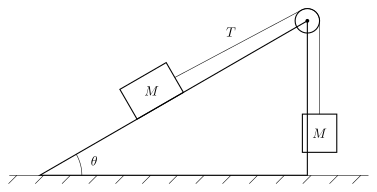
- TG EAPCET 2026Set ap-2026-05-05-FN1 markMCQQ.In the given figure, if the inclined plane and the pulley are frictionless, then the tension T in the string is (A) 2Mg(1−sinθ) (B) 2Mg(1+sinθ) (C) Mg(1−sinθ) (D) Mg(1+sinθ)
›Reveal solutionSolution
The key is to treat the two masses as a single system to find acceleration, then isolate one mass to solve for tension. The correct expression is T=2Mg(1+sinθ), which corresponds to option (B).
We have two blocks of mass M each: one on a frictionless inclined plane (angle θ), the other hanging vertically. They are connected by a string over a frictionless pulley. The goal is the tension T in the string.
Concept & Intuition
Since the pulley and incline are frictionless, the only forces doing work are gravity and the tension (which is internal to the two-mass system). The acceleration of both masses must be the same in magnitude because the string is inextensible. The classic trick: find the system’s acceleration first by considering the net force on the whole system, then isolate one mass to find tension. This avoids solving simultaneous equations blindly.
-
Choose a sign convention
Let the hanging mass move downward (positive direction for it), and the mass on the incline move upward along the incline (positive direction for it). Because the string is taut, if the hanging mass moves down by x, the incline mass moves up the slope by the same x. So both have the same acceleration a.
-
Forces on the hanging mass (mass M)
- Weight downward: Mg
- Tension upward: T Net force: Mg−T=Ma …(1)
-
Forces on the incline mass (mass M)
- Component of weight down the incline: Mgsinθ
- Tension up the incline: T Net force up the incline: T−Mgsinθ=Ma …(2)
-
Add equations (1) and (2) to eliminate T
(Mg−T)+(T−Mgsinθ)=Ma+Ma
The T cancels: Mg−Mgsinθ=2Ma
So Mg(1−sinθ)=2Ma
Hence acceleration:
a=2g(1−sinθ)
- Substitute a back into equation (1) to find T From (1): T=Mg−Ma …
-
- TG EAPCET 2025Set eng-2025-05-03-AN1 markMCQQ.A truck of mass 8 ton is carrying a block of mass 2 ton. If a breaking force of 25 kN is applied on the truck, then the frictional force acting on the block is (Coefficient of static friction between the block and the truck is 0.3) (A) 6250 N (B) 6000 N (C) 5000 N (D) 1000 N
›Reveal solutionSolution
The block will not slip if the required frictional force stays below the maximum static friction; here the truck’s deceleration demands only 5000 N from friction, which is less than the 6000 N limit, so the frictional force is exactly 5000 N — answer (C).
Concept & Intuition
When the truck brakes, it tries to slow down. The block on top, due to inertia, wants to keep moving forward. Friction between the block and the truck is what “pulls” the block backward to slow it with the truck. The key question: does the block slip? If the needed frictional force is less than or equal to the maximum static friction, the block stays put and the friction force equals whatever is needed to give it the same acceleration as the truck. If the needed force exceeds the maximum, the block slips and kinetic friction takes over. Here we must first find the truck’s deceleration, then see what force that demands on the block, and compare with the friction limit.
Step-by-step solution
- Find the total mass and the deceleration of the truck+block system The braking force acts on the truck alone, but the block is carried along. The total mass being decelerated is
Mtotal=8 ton+2 ton=10 ton=10000 kg.
The braking force is Fbrake=25 kN=25000 N.
By Newton’s second law, the deceleration of the whole system (assuming no slipping) is
a=MtotalFbrake=1000025000=2.5 m/s2.
- What force must friction provide to the block? The block has mass m=2 ton=2000 kg. To give it the same acceleration a=2.5 m/s2, the net horizontal force on the block must be
Fneeded=ma=2000×2.5=5000 N.
This force can only come from static friction between the block and the truck bed.
- What is the maximum possible static friction? The normal force on the block is its weight:
N=mg=2000×9.8=19600 N.
With coefficient of static friction μs=0.3, the maximum static friction is
fmax=μsN=0.3×19600=5880 N.
(Using g=10 m/s2 gives 6000 N, a common approximation — we’ll check both.) …
- TG EAPCET 2025Set eng-2025-05-03-FN1 markMCQQ.A truck of mass 8 ton is carrying a block of mass 2 ton. If a breaking force of 25 kN is applied on the truck, then the frictional force acting on the block is (Coefficient of static friction between the block and the truck is 0.3) (A) 5000 N (B) 6250 N (C) 1000 N (D) 6000 N
›Reveal solutionSolution
The block does not slip because the required frictional force to keep it accelerating with the truck is less than the maximum static friction; the frictional force equals the block’s mass times the common acceleration, which is 5000 N.
Concept & Intuition
The key is to realize that the block and truck move together if static friction can provide the force needed to accelerate the block at the same rate as the truck. The braking force acts only on the truck, so the block’s only horizontal force is friction from the truck bed. We must first find the common acceleration of the system, then compute the friction force required to give the block that acceleration. Finally, check if that required friction is within the limit of static friction (μₛ × normal force). If it is, the block doesn’t slip, and the actual friction is exactly that required value.
- Find the total mass and the common acceleration The braking force of 25 kN = 25,000 N acts on the truck alone, but the entire system (truck + block) decelerates together if no slipping occurs. Total mass = 8 ton + 2 ton = 10 ton = 10,000 kg. Using Newton’s second law:
a=mtotalF=10000 kg25000 N=2.5 m/s2
This is the deceleration of the whole system.
- Determine the friction force needed on the block The block (mass 2 ton = 2000 kg) must decelerate at 2.5 m/s². The only horizontal force on it is static friction f from the truck bed.
f=mblock⋅a=2000×2.5=5000 N
So friction must be 5000 N toward the rear (opposing the truck’s forward motion) to slow the block with the truck.
- Check if static friction can supply this force Maximum static friction:
- TG EAPCET 2025Set ap-2025-04-29-AN1 markMCQQ.The minimum velocity of a projectile is 50% of its maximum velocity. If the minimum velocity of the projectile is 10 ms−1, then the time of flight of the projectile is (Acceleration due to gravity =10 ms−2) (A) 43 s (B) 33 s (C) 23 s (D) 3 s
›Reveal solutionSolution
The minimum speed of a projectile occurs at the top of its trajectory, where only the horizontal component remains. Using the given ratio, we find the initial velocity and then the time of flight. The answer is 23 s.
The key idea here is that a projectile’s speed changes throughout its flight. It is maximum at launch (and at landing, if the launch and landing heights are the same) and minimum at the highest point, where the vertical component of velocity becomes zero. At that instant, only the horizontal component remains, so the minimum speed equals ucosθ, where u is the initial speed and θ is the angle of projection.
The problem tells us that the minimum velocity is 50% of the maximum velocity. The maximum velocity is simply u (at launch). So we have:
ucosθ=21u
This immediately gives cosθ=21, so θ=60∘.
Now we also know the actual value of the minimum velocity: 10 ms−1. That means:
ucos60∘=10⇒u⋅21=10⇒u=20 ms−1
We now have the initial speed and the angle. The time of flight for a projectile launched from ground level and returning to the same height is:
- TG EAPCET 2025Set ap-2025-04-29-AN1 markMCQQ.One end of a steel wire of length 2 m is attached to the roof and the other end is loaded with 2 kg mass. Another steel wire of same thickness but 1 m in length is held horizontally and stretched by applying two 20 N forces at its two ends. The ratio of the elongations produced in the two wires is (Acceleration due to gravity =10 ms−2) (A) 1:1 (B) 1:3 (C) 4:1 (D) 2:1
›Reveal solutionSolution
The key idea is to apply the elongation formula ΔL=AYFL to each wire separately, then take the ratio. The ratio of elongations is 1:1, so option (A) is correct.
The problem gives two different loading situations for steel wires of the same material and thickness (same cross-sectional area A and Young’s modulus Y). The elongation in a wire under tension is given by Hooke’s law for elastic materials: ΔL=AYFL, where F is the tensile force, L is the original length, A is the cross-sectional area, and Y is Young’s modulus. Since both wires are steel and have the same thickness, A and Y are identical for both. The ratio of elongations therefore depends only on the product FL for each wire.
Let’s work through each wire step by step.
-
First wire (vertical, loaded with mass)
Length L1=2 m. A mass of 2 kg is attached, so the tensile force is the weight: F1=mg=2×10=20 N.
Elongation: ΔL1=AYF1L1=AY20×2=AY40.
-
Second wire (horizontal, stretched by two forces)
Length L2=1 m. Two equal forces of 20 N are applied at the ends, pulling outward. The tension in the wire is 20 N throughout (the net force on the wire is zero, but the internal tension is 20 N).
Elongation: ΔL2=AYF2L2=AY20×1=AY20. …
-
- TG EAPCET 2025Set ap-2025-04-29-FN1 markMCQQ.A uniform metre scale of mass 700 g is suspended horizontally using two strings tied at 20 cm and 70 cm marks on the scale. The tension in the string at 70 cm mark is (Acceleration due to gravity =10 ms−2) (A) 2.8 N (B) 280 N (C) 4.2 N (D) 420 N
›Reveal solutionSolution
To find the tension in the string at the 70 cm mark, we apply the conditions for both translational and rotational equilibrium to the metre scale. The tension in the string at the 70 cm mark is 4.2 N.
When an object is suspended horizontally and remains stationary, it is in static equilibrium. This means two conditions must be met:
- Translational Equilibrium: The net force acting on the object is zero. This implies that the sum of all upward forces equals the sum of all downward forces, and similarly for horizontal forces (though there are no horizontal forces in this problem).
- Rotational Equilibrium: The net torque acting on the object about any point is zero. This means the sum of all clockwise torques equals the sum of all anti-clockwise torques.
For a uniform metre scale, its entire mass can be considered to act at its geometric center, which is the 50 cm mark. The two strings provide upward forces (tensions) that balance the downward force of gravity (weight) and prevent rotation.
Let's break down the solution step-by-step.
- Identify the forces and their points of application.
- The mass of the metre scale is M=700 g=0.7 kg.
- The weight of the scale, W, acts downwards at its center of mass, which is the 50 cm mark.
W=Mg=0.7 kg×10 ms−2=7 N
*   Let $T_1$ be the tension in the string tied at the 20 cm mark, acting upwards.
*   Let $T_2$ be the tension in the string tied at the 70 cm mark, acting upwards. We need to find $T_2$.
2. Apply the condition for translational equilibrium.
Since the scale is in equilibrium, the sum of upward forces must equal the sum of downward forces.
T1+T2=W
T1+T2=7 N(∗)
-
Apply the condition for rotational equilibrium.
To find T2, we can choose a pivot point. Choosing one of the points where a string is attached simplifies the calculation because the torque due to that string's tension about that point will be zero. Let's choose the 20 cm mark as our pivot point.
- The force T1 acts at the pivot, so its torque about the 20 cm mark is zero.
- The weight W acts at the 50 cm mark. Its distance from the pivot (20 cm mark) is 50 cm−20 cm=30 cm=0.3 m. This force tends to cause a clockwise rotation.
- The tension T2 acts at the 70 cm mark. Its distance from the pivot (20 cm mark) is 70 cm−20 cm=50 cm=0.5 m. This force tends to cause an anti-clockwise rotation. …
- TG EAPCET 2024Set eng-2024-05-10-AN1 markMCQQ.A block is kept on a rough horizontal surface. The acceleration of the block increases from 6 ms−2 to 11 ms−2 when the horizontal force acting on it increases from 20 N to 30 N. The coefficient of kinetic friction between the block and the surface is (Acceleration due to gravity =10 ms−2) (A) 0.2 (B) 0.3 (C) 0.4 (D) 0.5
›Reveal solutionSolution
The coefficient of kinetic friction is found by applying Newton’s second law to two different applied forces, subtracting the equations to eliminate the unknown mass, and solving for μ. The result is 0.4.
Concept & Intuition
When a horizontal force pulls a block across a rough surface, the net force is the applied force minus the kinetic friction force. The friction force is constant (since it depends only on the normal force and the coefficient of friction, not on speed). So if we increase the applied force, the net force—and therefore the acceleration—increases by the same amount as the increase in applied force. By writing Newton’s second law for two different applied forces, we can solve for the friction force and then for μ, without needing to know the mass.
Step-by-step solution
- Set up Newton’s second law for the first situation Applied force F1=20 N, acceleration a1=6 m/s2. Kinetic friction force fk=μN=μmg (since the surface is horizontal, normal force N=mg). Net force: F1−fk=ma1. So
20−μmg=6m.(1)
- Set up Newton’s second law for the second situation Applied force F2=30 N, acceleration a2=11 m/s2.
30−μmg=11m.(2)
- Subtract equation (1) from equation (2) to eliminate the friction term
(30−μmg)−(20−μmg)=11m−6m
The μmg terms cancel, leaving
10=5m⇒m=2 kg.
- Substitute the mass back into either equation to find μ Using equation (1): 20−μ(2)(10)=6(2) …
- TG EAPCET 2024Set eng-2024-05-10-FN1 markMCQQ.A block of mass 2 kg is tied to one end of a 2 m long metal wire of 1.0mm2 area of cross-section and rotated in a vertical circle such that the tension in the wire is zero at the highest point. If the maximum elongation in the wire is 2 mm, the Young’s modulus of the metal is (Acceleration due to gravity =10ms−2) (A) 1.0×10¹¹ Nm−2 (B) 1.2×10¹¹ Nm−2 (C) 2.0×10¹¹ Nm−2 (D) 0.2×10¹¹ Nm−2
›Reveal solutionSolution
Tension is maximum at the lowest point, T=6mg=120 N; then Y=AΔLTL=1.2×10¹¹ N m−2 — option B.
Speed at the top. Tension zero at the highest point means gravity alone supplies the centripetal force:
mg=Lmvtop2⇒vtop2=gL.
Speed at the bottom. The bottom is a height 2L (the diameter) below the top:
vbot2=vtop2+2g(2L)=gL+4gL=5gL.
Maximum tension (at the lowest point).
T−mg=Lmvbot2=5mg⇒T=6mg=6(2)(10)=120 N.
This gives the maximum elongation. …
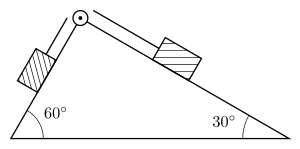
- TG EAPCET 2023Set eng-2023-05-13-FN1 markMCQQ.Two blocks of equal masses are tied to the ends of a light string. The string passes over a mass less pulley fixed on frictionless surface as shown in the figure. The acceleration of the centre of mass of the blocks is (g – acceleration due to gravity) [FIGURE] (A) (423−1)g (B) (423+1)g (C) (223−1)g (D) (223+1)g
›Reveal solutionSolution
Find each block's acceleration from Newton's second law, then (for equal masses) the centre-of-mass acceleration is the vector average acm=2a1+a2. Its magnitude is 42(3−1)g, so the correct option is (A).
Two equal masses m are connected by a light string over a massless, frictionless pulley; one block rests on a horizontal surface and the other on an incline. Because the pulley is ideal, the tension is the same throughout the string and both blocks share the same magnitude of acceleration a.
Acceleration of the system. Writing Newton's second law for each block — tension T on the horizontal block, and the down-slope weight component minus T on the incline block — and eliminating T gives the common magnitude a.
Centre-of-mass acceleration. For equal masses,
🎓Unlock everything free for 14 days
- ✓Full step-by-step solutions
- ✓Concept-first explanations
- ✓Methods, shortcuts & mistakes
- ✓PYQ mapping + timed mock tests
Full access for 14 days. No credit card required.