Q.If P(B)=53, P(A∣B)=21 and P(A∪B)=54, then P((A∪B)′)+P(A′∪B) equals
(A) 51
(B) 54
(C) 21
(D) 1
🔒You're viewing a preview — the full solution, concept, methods & PYQ mapping are locked.
🔒 Start your 14-day free trial to unlock the full solution →Concept understanding — Probability Complement Rule
The Probability Complement Rule
Every event A splits the sample space in two: outcomes where A happens, and outcomes where it does not. The second group is the complement of A, written A′ (also Ac or Aˉ). Because exactly one of the two must occur, their probabilities together fill the whole space:
P(A)+P(A′)=1⟹P(A′)=1−P(A).
That is the complement rule: the probability that A does not happen is 1 minus the probability that it does.
Why It Holds
A and A′ are mutually exclusive (no outcome lies in both) and exhaustive (together they are the entire sample space S, with P(S)=1). So P(A)+P(A′)=P(S)=1, and rearranging gives the rule.
A Simple Example
For a fair die, P(six)=61, so P(not six)=1−61=65.
Why It Is So Useful: the "At Least One" Trick
Counting "at least one" directly often means adding many separate cases, while its complement, "none," is a single easy case. For instance, the probability of at least one head in three tosses of a fair coin:
P(at least one head)=1−P(no heads)=1−(21)3=1−81=87.
Computing "no heads" once is far quicker than summing the one-head, two-head and three-head cases separately. …
Given P(B)=53, P(A∣B)=21, P(A∪B)=54.
P(A∩B)=P(A∣B)P(B)=21⋅53=103, and P(A)=54−53+103=21.
P((A∪B)′)=1−P(A∪B)=1−54=51. …
P((A∪B)′)=51 and P(A′∪B)=54, so their sum is 1 — option (D).
Setup
We are given P(B)=53, P(A∣B)=21, P(A∪B)=54. First recover P(A∩B) and P(A):
P(A∩B)=P(A∣B)P(B)=21⋅53=103,
P(A)=P(A∪B)−P(B)+P(A∩B)=54−53+103=21.
First term
By the complement rule, P((A∪B)′)=1−P(A∪B)=1−54=51.
Second term
Use De Morgan's law: (A′∪B)′=A∩B′, so P(A′∪B)=1−P(A∩B′).
Since A splits into the parts inside and outside B, P(A∩B′)=P(A)−P(A∩B)=21−103=51. …
Method: Complement rule and De Morgan for compound expressions
Use this for expressions built from unions, complements and conditionals that must each be simplified before adding.
Steps
Step 1: Simplify each complemented compound with De Morgan / complement rule.
P((A∪B)′)=1−P(A∪B),(A′∪B)′=A∩B′.
So P(A′∪B)=1−P(A∩B′).
Step 2: Reduce the leftover joint terms to known quantities. …
Common Mistakes
Mistake 1: Writing P(A′∪B)=1−P(A∪B).
Why it's wrong: the complement of A∪B is A′∩B′, not A′∪B. Correct approach: use De Morgan — (A′∪B)′=A∩B′, so P(A′∪B)=1−P(A∩B′).
Mistake 2: Leaving P(A∩B′) unreduced. …
Showing the 12 most recent of 32 on this concept.
- TG EAPCET 2025Set eng-2025-05-02-AN1 markMCQQ.A, B are the events in a random experiment. If P(A)=21, P(B)=31, P(A∩B)=41, then P(BcAc)+P(BA)= (A) 1 (B) 54 (C) 811 (D) 37
›Reveal solutionSolution
The problem asks for the sum of two conditional probabilities: P(Ac∣Bc)+P(A∣B). Using the definitions and given probabilities, we compute each term separately and add them. The result is 811, which corresponds to option (C).
We are given P(A)=21, P(B)=31, and P(A∩B)=41. The notation P(BcAc) means P(Ac∣Bc), the probability of A not happening given that B does not happen. Similarly, P(BA) is P(A∣B).
The key idea: conditional probability is defined as P(X∣Y)=P(Y)P(X∩Y), provided P(Y)>0. We will compute each conditional probability using the given data, then sum them.
- Compute P(A∣B) By definition:
P(A∣B)=P(B)P(A∩B)=1/31/4=41⋅13=43.
- Compute P(Ac∣Bc) First, find P(Bc):
P(Bc)=1−P(B)=1−31=32.
Next, find P(Ac∩Bc). By De Morgan’s law, Ac∩Bc=(A∪B)c, so
P(Ac∩Bc)=1−P(A∪B).
We need P(A∪B):
P(A∪B)=P(A)+P(B)−P(A∩B)=21+31−41.
Get a common denominator of 12:
126+124−123=127.
Thus,
P(Ac∩Bc)=1−127=125.
Now, …
- TG EAPCET 2025Set eng-2025-05-04-AN1 markMCQQ.A and B are two events of a random experiment such that P(B) = 0.4, P(A ∩ B) = 0.5, P(A ∪ B) + P(A∪BB) = 1.15, then P(A) = (A) 0.9 (B) 0.8 (C) 0.7 (D) 0.25
›Reveal solutionSolution
The key is to use the given probabilities and the conditional probability formula to set up an equation for P(A). Solving yields P(A)=0.7, so the correct option is (C).
We are given:
- P(B)=0.4
- P(A∩B)=0.5
- P(A∪B)+P(A∪BB)=1.15
We need P(A).
Concept and intuition:
The problem mixes union, intersection, complement, and conditional probability. The key is to express everything in terms of P(A) and known quantities. The conditional probability P(B∣A∪B) can be rewritten using the definition:
P(B∣A∪B)=P(A∪B)P(B∩(A∪B))
Then we simplify the numerator using set algebra. The given sum then becomes an equation in P(A).
Step-by-step solution:
- Express P(A∪B) in terms of P(A). We know P(A∪B)=P(A)+P(B)−P(A∩B). Also, P(A∩B)=P(A)−P(A∩B). Given P(A∩B)=0.5, we have
P(A)−P(A∩B)=0.5⇒P(A∩B)=P(A)−0.5.
Therefore,
P(A∪B)=P(A)+0.4−(P(A)−0.5)=0.9.
So P(A∪B)=0.9 — interestingly independent of P(A)! This is a key simplification.
- Find P(A∪B). Note that A∪B is the complement of B∩A? Better: Use
P(A∪B)=P(A)+P(B)−P(A∩B).
We have P(B)=1−0.4=0.6 and P(A∩B)=0.5. So
P(A∪B)=P(A)+0.6−0.5=P(A)+0.1.
- Compute the numerator for the conditional probability. We need P(B∩(A∪B)). By distributive law:
B∩(A∪B)=(B∩A)∪(B∩B)=(A∩B)∪∅=A∩B.
So P(B∩(A∪B))=P(A∩B)=P(A)−0.5 (from step 1).
- Write the conditional probability.
P(A∪BB)=P(A∪B)P(A∩B)=P(A)+0.1P(A)−0.5.
- Set up the given equation. We have
- TG EAPCET 2025Set eng-2025-05-04-FN1 markMCQQ.A and B are two events of a random experiment such that P(B) = 0.4, P(A ∩ B) = 0.5, P(A ∪ B) + P(A∪BB) = 1.15, then P(A) = (A) 0.9 (B) 0.25 (C) 0.7 (D) 0.8
›Reveal solutionSolution
The key is to use the given probability equation to solve for P(A) by expressing everything in terms of P(A) and P(B), using set identities and conditional probability. The final value is P(A)=0.7.
The problem gives you a mix of basic probability and conditional probability. The trick is not to panic at the messy-looking term P(A∪BB) — that’s just conditional probability notation for P(B∣A∪B). The equation P(A∪B)+P(B∣A∪B)=1.15 is the main tool. You already know P(B)=0.4 and P(A∩B)=0.5. Your goal is to find P(A).
Let’s work through it step by step.
- Express P(A∪B) in terms of P(A) and P(B). The union formula: P(A∪B)=P(A)+P(B)−P(A∩B). You don’t have P(A∩B) directly, but you have P(A∩B)=0.5. Since A is the disjoint union of A∩B and A∩B, we have:
P(A)=P(A∩B)+P(A∩B)
So P(A∩B)=P(A)−0.5.
Therefore:
P(A∪B)=P(A)+0.4−(P(A)−0.5)=0.9
Interesting — P(A∪B) simplifies to a constant 0.9, independent of P(A)! That’s a neat simplification.
- Now handle the conditional probability term. P(B∣A∪B) means the probability of B happening, given that A∪B has occurred. By definition:
P(B∣A∪B)=P(A∪B)P(B∩(A∪B))
We need to simplify the numerator and denominator.
- Simplify B∩(A∪B). Using distributive law: B∩(A∪B)=(B∩A)∪(B∩B). But B∩B=∅, so this is just B∩A=A∩B. Hence:
P(B∩(A∪B))=P(A∩B)=P(A)−0.5
- Simplify P(A∪B). Use the union formula: P(A∪B)=P(A)+P(B)−P(A∩B). P(B)=1−P(B)=0.6, and P(A∩B)=0.5. So:
P(A∪B)=P(A)+0.6−0.5=P(A)+0.1
- Plug into the given equation. The equation is: …
- TG EAPCET 2026Set eng-2026-05-11-FN1 markMCQQ.If A and B are any two events of a random experiment, then P[(A∩Bc)∪(Ac∩B)∪(A∩B)]= (A) P(A)+P(B) (B) P(Ac∪Bc) (C) 1−P(A∪B) (D) P(A∪B)
›Reveal solutionSolution
The union of the three disjoint pieces — A only, B only, and both — is exactly the event that at least one of A or B occurs. So the probability is P(A∪B), which is option (D).
The question asks for the probability of a union of three set expressions. Before diving into algebra, notice what each piece represents:
- A∩Bc : outcomes in A but not in B (only A).
- Ac∩B : outcomes in B but not in A (only B).
- A∩B : outcomes in both A and B.
These three sets are mutually disjoint — no outcome can belong to more than one of them at the same time. Their union therefore covers every outcome that belongs to A or to B (or to both). That is exactly the definition of A∪B.
So the whole expression simplifies immediately:
(A∩Bc)∪(Ac∩B)∪(A∩B)=A∪B.
Taking probability on both sides gives:
P[(A∩Bc)∪(Ac∩B)∪(A∩B)]=P(A∪B).
Now check the options:
- Option (A) P(A)+P(B) is only correct when A and B are disjoint — not guaranteed here.
- Option (B) P(Ac∪Bc) is the probability that at least one of them does not occur, which is 1−P(A∩B) — not the same. …
- TG EAPCET 2021Set eng-2021-08-06-AN1 markMCQQ.If P(A∪B)=0.8 and P(A∩B)=0.3, then P(Ac)+P(Bc)= (A) 0.3 (B) 0.5 (C) 0.7 (D) 0.9
›Reveal solutionSolution
Use the complement rule and the inclusion–exclusion principle to express P(Ac)+P(Bc) in terms of the given probabilities. The answer is 0.9.
The key idea is that P(Ac)=1−P(A) and P(Bc)=1−P(B), so their sum is 2−[P(A)+P(B)]. We don’t know P(A) or P(B) individually, but we can find P(A)+P(B) from the given P(A∪B) and P(A∩B) using the inclusion–exclusion formula.
- Recall the inclusion–exclusion principle For any two events A and B,
P(A∪B)=P(A)+P(B)−P(A∩B).
This is the fundamental relation that connects the union, intersection, and individual probabilities.
- Plug in the given values We have P(A∪B)=0.8 and P(A∩B)=0.3. Substituting:
0.8=P(A)+P(B)−0.3.
So
P(A)+P(B)=0.8+0.3=1.1.
- Express the required sum using complements The complement rule says P(Ac)=1−P(A) and P(Bc)=1−P(B). Therefore
P(Ac)+P(Bc)=[1−P(A)]+[1−P(B)]=2−[P(A)+P(B)].
- Substitute the sum from step 2 …
- TG EAPCET 2021Set eng-2021-08-06-FN1 markMCQQ.Two friends A and B meet every weekend either at a party or at a Sports Club. The probability that they meet at Sports Club is 94. The probability that they will dine together at a party and at the Club are respectively 31 and 52. On a certain weekend the probability that they disperse without dine together (A) 13586 (B) 2710 (C) 2717 (D) 13556
›Reveal solutionSolution
This problem asks for the total probability that two friends disperse without dining together, considering two possible meeting locations (party or sports club) and their respective conditional probabilities of dining. We use the concept of complementary events and the Law of Total Probability to sum the probabilities of not dining in each scenario. The final probability is 13586.
The core idea in this problem is to use the Law of Total Probability. Since the friends must meet either at a party or at a sports club, these two events form a partition of the sample space. This means they are mutually exclusive (cannot happen at the same time) and exhaustive (cover all possibilities). We can calculate the probability of "not dining together" for each location separately and then sum these probabilities to get the overall probability.
Here's how we break it down:
-
Define Events and Given Probabilities:
Let's clearly define the events involved to avoid confusion:
- S: The friends meet at the Sports Club.
- P: The friends meet at a Party.
- DS: The friends dine together at the Sports Club.
- DP: The friends dine together at a Party.
From the problem statement, we are given the following probabilities:
- The probability they meet at the Sports Club: P(S)=94.
- Since they meet either at a party or at a Sports Club, these are the only two possibilities. Therefore, the probability they meet at a Party is the complement of meeting at the Sports Club: P(P)=1−P(S)=1−94=95.
- The probability they dine together given they are at a party: P(DP∣P)=31.
- The probability they dine together given they are at the Sports Club: P(DS∣S)=52.
-
Calculate Probabilities of Not Dining Together (Conditional):
We are interested in the event that they disperse without dining together. Let D′ denote this event.
If they are at a party, the probability they do not dine together is the complement of dining together at the party:
P(DP′∣P)=1−P(DP∣P)=1−31=32.
Similarly, if they are at the Sports Club, the probability they do not dine together is the complement of dining together at the club:
P(DS′∣S)=1−P(DS∣S)=1−52=53.
-
Calculate Joint Probabilities of Not Dining Together:
Now, we need to find the probability of two specific scenarios where they do not dine together:
- Scenario 1: They meet at a Party and do not dine together there. This is the joint probability P(P∩DP′).
- Scenario 2: They meet at the Sports Club and do not dine together there. This is the joint probability P(S∩DS′).
We use the definition of conditional probability, which states P(A∩B)=P(B∣A)⋅P(A):
For Scenario 1:
P(P∩DP′)=P(DP′∣P)⋅P(P)=32⋅95=2710.
For Scenario 2:
P(S∩DS′)=P(DS′∣S)⋅P(S)=53⋅94=4512.
This fraction can be simplified by dividing both the numerator and denominator by their greatest common divisor, 3: 45÷312÷3=154.
-
Apply the Law of Total Probability: …
-
- TG EAPCET 2023Set eng-2023-05-12-FN1 markMCQQ.If A and B are two events in a random experiment such that P(A)+P(B)=2P(A∩B) then (A) P(A)+P(B)=1 (B) P(A)=P(B) (C) P(A)+P(B)>1 (D) P(A)=0,P(B)=1
›Reveal solutionSolution
The condition P(A)+P(B)=2P(A∩B) forces the two events to have equal probability, so the correct choice is (B).
We start with the given equation:
P(A)+P(B)=2P(A∩B).
The key concept is the inclusion–exclusion principle for two events:
P(A∪B)=P(A)+P(B)−P(A∩B).
This formula always holds, and probabilities lie between 0 and 1. The given condition is unusual because it ties the sum of the individual probabilities directly to the intersection. Our job is to see what restriction this places on P(A) and P(B).
- Rewrite the given condition using inclusion–exclusion. From P(A)+P(B)=2P(A∩B), subtract P(A∩B) from both sides:
P(A)+P(B)−P(A∩B)=P(A∩B).
The left side is exactly P(A∪B), so we get:
P(A∪B)=P(A∩B).
-
Interpret what P(A∪B)=P(A∩B) means.
For any two events, A∩B⊆A∪B, so P(A∩B)≤P(A∪B).
Here they are equal, which implies that the set difference (A∪B)∖(A∩B) has probability zero.
In other words, the parts of A and B that are not in the overlap have zero probability.
This forces P(A∖B)=0 and P(B∖A)=0.
-
Conclude that A and B are essentially the same event (up to a null set).
Since P(A∖B)=0, we have P(A)=P(A∩B).
Similarly, P(B∖A)=0 gives P(B)=P(A∩B).
Therefore:
P(A)=P(B)=P(A∩B).
- Check the options.
- (A) P(A)+P(B)=1: Not forced; e.g., if P(A)=P(B)=0.3, then P(A)+P(B)=0.6=1.
- (B) P(A)=P(B): Yes, we just proved this. …
- TG EAPCET 2026Set eng-2026-05-09-AN1 markMCQQ.A bag A contains 3 red, 2 white and 2 black balls and another bag B contains 1 red, 2 white and 4 black balls. A die is thrown to select a bag from which a ball has to be chosen. If an odd prime number appears on the die, a ball is drawn from bag A; otherwise, a ball is drawn from bag B. With this condition, if the ball drawn is found to be black, then the probability that it is drawn from bag B is (A) 76 (B) 73 (C) 51 (D) 54
›Reveal solutionSolution
Use Bayes' theorem to reverse the conditional probability: the chance that the black ball came from bag B is 54.
The problem is a classic Bayes' theorem setup. We are told the outcome (a black ball) and need the probability that it came from a particular source (bag B). The die decides which bag is chosen first, so we have prior probabilities for each bag. Then, given the bag, we know the chance of drawing a black ball. Bayes' theorem lets us flip the condition: from "probability of black given bag" to "probability of bag given black."
Let’s define the events clearly:
- A: bag A is chosen
- B: bag B is chosen
- Bl: a black ball is drawn
The die: an odd prime number on a die is 3 or 5 (since 2 is prime but even, and 1 is not prime). So odd primes are 3 and 5 — that's 2 outcomes out of 6.
-
Prior probabilities
P(A)=62=31 (when die shows 3 or 5)
P(B)=1−31=32 (when die shows 1, 2, 4, or 6)
-
Likelihoods — probability of drawing a black ball from each bag
Bag A: 3 red, 2 white, 2 black → total 7 balls, so P(Bl∣A)=72
Bag B: 1 red, 2 white, 4 black → total 7 balls, so P(Bl∣B)=74
-
Apply Bayes' theorem
We want P(B∣Bl), the probability that the ball came from bag B given it is black.
Bayes' theorem says:
P(B∣Bl)=P(Bl)P(Bl∣B)⋅P(B)
The denominator P(Bl) is the total probability of drawing a black ball:
P(Bl)=P(Bl∣A)P(A)+P(Bl∣B)P(B)
=(72)(31)+(74)(32)
=212+218=2110
- Now compute the numerator and the final probability …
- TG EAPCET 2026Set eng-2026-05-09-FN1 markMCQQ.If A, B, C are three mutually exclusive and exhaustive events such that P(A):P(B):P(C) = 1:l:m, then P(A \cup B) + P(B \cup C) + P(C \cup A) + P(A \cup B \cup C) = (A) 31 (B) 3 (C) 43 (D) 1
›Reveal solutionSolution
The key idea is to express all probabilities in terms of a single unknown using the given ratio, then apply the inclusion-exclusion principle for three mutually exclusive and exhaustive events. The sum simplifies to a constant independent of the ratio, giving the answer 3.
We are told that A, B, C are mutually exclusive (no two can happen at once) and exhaustive (together they cover the whole sample space). That means:
- P(A∩B)=P(B∩C)=P(C∩A)=0
- P(A∪B∪C)=1
The ratio P(A):P(B):P(C)=1:l:m is given, but note that l and m are just positive numbers (not necessarily integers). Since the events are exhaustive, the sum of their probabilities is 1.
Let’s work through the problem step by step.
- Set up the probabilities using the ratio. Let P(A)=k. Then from the ratio, P(B)=lk and P(C)=mk. Because the events are exhaustive:
P(A)+P(B)+P(C)=k+lk+mk=k(1+l+m)=1
So:
k=1+l+m1
- Interpret the required expression. We need:
S=P(A∪B)+P(B∪C)+P(C∪A)+P(A∪B∪C)
Since A, B, C are mutually exclusive, the union of any two is just the sum of their probabilities. For example:
P(A∪B)=P(A)+P(B)(no overlap)
Similarly for the other pairs. And P(A∪B∪C)=1 because they are exhaustive.
- Substitute these simplifications. S=[P(A)+P(B)]+[P(B)+P(C)]+[P(C)+P(A)]+1 …
- TG EAPCET 2023Set eng-2023-05-12-AN1 markMCQQ.If A and B are two events of a random experiment such that P(A∪B)=P(A∩B), then which one amongst the following four options is not true (A) A and B are equally likely (B) P(A∩B′)=0 (C) P(A′∩B)=0 (D) P(A)+P(B)=1
›Reveal solutionSolution
The condition P(A∪B)=P(A∩B) forces A and B to be identical events (up to probability zero), making them equally likely and their complements disjoint from each other — but it does not force their probabilities to sum to 1. Option (D) is the one that is not true.
The key insight here is to translate the given equality into a relationship between the events themselves. For any two events, the union probability is always at least as large as the intersection probability — they are equal only when the part of the union that lies outside the intersection is empty (in a probabilistic sense).
Let’s unpack that.
- Rewrite the condition using the addition rule. The standard formula is
P(A∪B)=P(A)+P(B)−P(A∩B).
The problem gives P(A∪B)=P(A∩B). Substitute:
P(A∩B)=P(A)+P(B)−P(A∩B).
Bring the P(A∩B) term from the right to the left:
2P(A∩B)=P(A)+P(B).
So we have
P(A)+P(B)=2P(A∩B).(1)
- Interpret what (1) means. Notice that P(A)≥P(A∩B) and P(B)≥P(A∩B). The only way their sum can be exactly twice the intersection is if each equals the intersection:
P(A)=P(A∩B)andP(B)=P(A∩B).
Why? Because if either P(A)>P(A∩B), then P(A)+P(B)>2P(A∩B) (since P(B)≥P(A∩B)). The equality in (1) forces both to be exactly equal to the intersection.
Hence
P(A)=P(B)=P(A∩B).
- Consequences of P(A)=P(A∩B). If P(A)=P(A∩B), then the part of A that is not in B has probability zero:
P(A∩B′)=P(A)−P(A∩B)=0.
Similarly, P(B)=P(A∩B) gives
P(A′∩B)=P(B)−P(A∩B)=0.
So options (B) and (C) are true.
- Are A and B equally likely? …
- TG EAPCET 2021Set eng-2021-08-06-AN1 markMCQQ.The probability distribution of a random variable X is given below:
[!FORMULA] X=xP(X=x)001k22k32k43k5k262k277k2+k
Then P(0<x<4)= (A) 54 (B) 53 (C) 21 (D) 41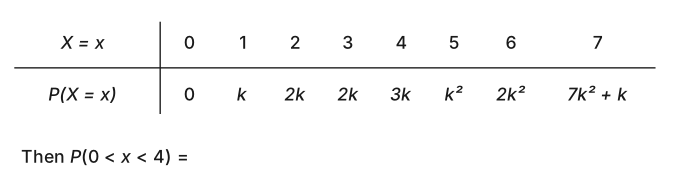
›Reveal solutionSolution
The key idea is to use the fact that the total probability must sum to 1 to solve for k, then sum the probabilities for X=1,2,3 to get P(0<X<4). The result is 21, so the correct option is (C).
We are given a discrete probability distribution. The sum of all probabilities must equal 1. That’s our anchor. Once we find k, we can directly compute the required probability.
- Set up the total probability equation. The probabilities for X=0 through X=7 are:
0,k,2k,2k,3k,k2,2k2,7k2+k
Summing them:
0+k+2k+2k+3k+k2+2k2+(7k2+k)=1
- Combine like terms.
- Linear terms in k: k+2k+2k+3k+k=9k
- Quadratic terms in k2: k2+2k2+7k2=10k2 So:
10k2+9k=1
- Solve the quadratic equation. Rearranging:
10k2+9k−1=0
Using the quadratic formula k=2a−b±b2−4ac with a=10, b=9, c=−1:
k=20−9±81+40=20−9±121=20−9±11
This gives two possibilities:
k=202=101ork=20−20=−1
Since probabilities cannot be negative, we discard k=−1. Thus:
k=101
Watch outA common mistake is to forget that k must be positive — always check that all probabilities are non-negative. Here k=−1 would give negative probabilities, so it’s invalid. …
- TG EAPCET 2021Set eng-2021-08-06-FN1 markMCQQ.A and B are the two groups of books. Group A consists of 8 science and 5 engineering books and the group B consists of 6 science and 7 engineering books. When an unbiased die is rolled, if 2 or 5 turns up, a book is selected at random from the group A, otherwise a book is selected at random from the B group. When an unbiased die is rolled, the probability of selecting a science book is (A) 2413 (B) 3534 (C) 3920 (D) 3613
›Reveal solutionSolution
Use the law of total probability: the overall chance of picking a science book is the weighted average of the science-book probabilities from each group, with weights given by the die-roll outcomes. The answer is 3920.
The core idea here is that the selection happens in two stages: first the die decides which group you draw from, then you pick a book at random from that group. When a problem has this "choose a source, then pick from it" structure, the law of total probability is your natural tool. You break the overall event (picking a science book) into the mutually exclusive ways it can happen — via group A or via group B — and add their probabilities.
Let’s walk through it.
- Determine the probabilities from the die roll.
An unbiased die has six faces: 1, 2, 3, 4, 5, 6.
- If 2 or 5 turns up, we select from group A. That’s 2 favourable outcomes out of 6.
P(A)=62=31
- For any other outcome (1, 3, 4, 6), we select from group B. That’s 4 outcomes.
P(B)=64=32
- Find the probability of picking a science book from each group.
- Group A has 8 science and 5 engineering books, so 13 books total.
P(science∣A)=138
- Group B has 6 science and 7 engineering books, so 13 books total.
P(science∣B)=136
Notice both groups have the same total number of books — that’s a coincidence, not a rule.
- Apply the law of total probability. The overall probability of selecting a science book is:
P(science)=P(A)⋅P(science∣A)+P(B)⋅P(science∣B)
Substitute the values: …
- Determine the probabilities from the die roll.
An unbiased die has six faces: 1, 2, 3, 4, 5, 6.
🎓Unlock everything free for 14 days
- ✓Full step-by-step solutions
- ✓Concept-first explanations
- ✓Methods, shortcuts & mistakes
- ✓PYQ mapping + timed mock tests
Full access for 14 days. No credit card required.