Q.Draw diagrams showing the formation of a double bond and a triple bond between carbon atoms in and molecules.
You're viewing a preview — the full solution, concept, methods & PYQ mapping are locked.
Start your 14-day free trial to unlock the full solution →
Carbon forms multiple bonds by sharing two or three electron pairs; Lewis dot structures reveal how -overlap supplements the -framework in ethene (one double bond) and ethyne (one triple bond).
Multiple bonds arise when atoms share more than one pair of electrons. Carbon, with four valence electrons, can form single, double, or triple bonds depending on how many electrons it needs to complete its octet. The Lewis dot structure method lets us visualize this electron sharing by representing valence electrons as dots and shared pairs as lines.
In ethene () and ethyne (), carbon atoms achieve octets by sharing two and three pairs respectively with each other, while also bonding to hydrogen. The key insight is that each shared pair corresponds to one covalent bond: a double bond is two shared pairs, a triple bond is three.
Ethene (): Formation of a Double Bond
- Count valence electrons. Each carbon contributes electrons, each hydrogen contributes . Total:
- Arrange atoms and form single bonds first. Place the two carbons in the center, with two hydrogens attached to each carbon. Draw single bonds (each bond = electrons):
This uses bonds electrons.
-
Distribute remaining electrons to complete octets.
We have electrons left. Each carbon currently has only electrons around it (three single bonds). To complete the octet, the two carbons must share an additional pair, forming a double bond between them.
-
Draw the Lewis structure.
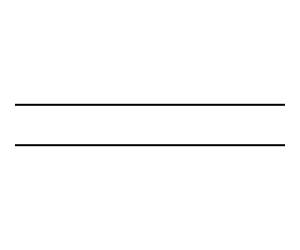
Lewis structures of ethene (C₂H₄, C=C double bond) and ethyne (C₂H₂, C≡C triple bond). In dot notation (showing only valence electrons on carbon for clarity):
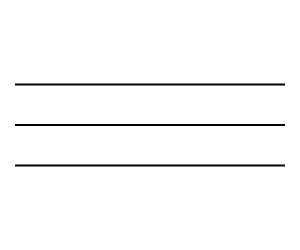
Lewis structures of ethene (C₂H₄, C=C double bond) and ethyne (C₂H₂, C≡C triple bond). Each carbon now has electrons: four from the double bond (two shared pairs) and two from each of the two single bonds.
The double bond consists of one bond (head-on overlap) and one bond (sideways overlap of orbitals). The Lewis structure doesn't show orbital geometry, but it correctly counts electron pairs.
Ethyne (): Formation of a Triple Bond
- Count valence electrons.
- Arrange atoms and form single bonds. Place the two carbons in the center with one hydrogen on each end:
This uses bonds electrons.
- Distribute remaining electrons. …
Unlock everything free for 14 days
- Full step-by-step solutions
- Concept-first explanations
- Methods, shortcuts & mistakes
- PYQ mapping + timed mock tests
Full access for 14 days. No credit card required.