Q.Draw the Lewis structures for the following molecules and ions: , , , , HCOOH.
You're viewing a preview — the full solution, concept, methods & PYQ mapping are locked.
Start your 14-day free trial to unlock the full solution →Lewis structures are drawn by counting valence electrons, arranging atoms (least electronegative in center), and completing octets via single, double, or triple bonds. The final structures for , , , , and HCOOH are shown below.
Lewis dot structures are a visual shorthand for how atoms bond in a molecule. The core idea is simple: atoms share or transfer electrons to achieve a stable octet (or duet for hydrogen). You count all valence electrons, place the least electronegative atom in the center (except hydrogen, which is always terminal), connect atoms with single bonds, then distribute remaining electrons to satisfy octets. If electrons run short, form multiple bonds.
Let’s work through each molecule step by step.
1. (Hydrogen sulfide)
Step 1: Count valence electrons.
Sulfur (Group 16) has 6 valence electrons. Each hydrogen (Group 1) has 1. Total = electrons.
Step 2: Arrange atoms.
Sulfur is the central atom (less electronegative than H, and H is always terminal). Place S in the center, with two H atoms bonded to it.
Step 3: Draw single bonds.
Each S–H bond uses 2 electrons. Two bonds use electrons. Remaining electrons: electrons (2 lone pairs).
Step 4: Complete octets.
Sulfur already has 2 bonds (4 electrons from bonds). Add the 2 lone pairs (4 electrons) to give sulfur a full octet. Each hydrogen has 2 electrons (duet) from its bond — satisfied.
Final structure:
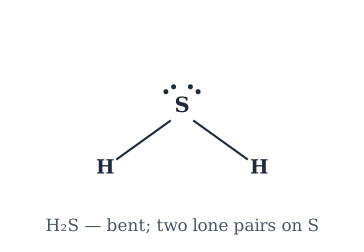
With two lone pairs on S (not shown in ASCII, but imagine two dots above and below S). This is a bent shape (VSEPR), but the Lewis structure is straightforward.
A common mistake is to put hydrogen in the center. Hydrogen can only form one bond — it never holds lone pairs in a stable Lewis structure.
2. (Silicon tetrachloride)
Step 1: Count valence electrons.
Silicon (Group 14) has 4 valence electrons. Each chlorine (Group 17) has 7. Total = electrons.
Step 2: Arrange atoms.
Silicon is less electronegative than chlorine, so Si is central. Four Cl atoms surround it.
Step 3: Draw single bonds.
Four Si–Cl bonds use electrons. Remaining: electrons.
Step 4: Complete octets.
Each chlorine needs 6 more electrons (3 lone pairs) to complete its octet. Four chlorines require electrons — exactly what remains. Silicon already has 8 electrons from its four bonds (octet satisfied).
Final structure:
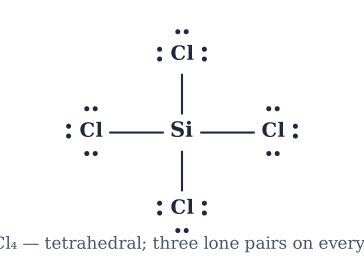
Each Cl has three lone pairs (not drawn). No multiple bonds needed.
Silicon, like carbon, can expand its octet in some compounds, but here it’s perfectly happy with 8 electrons. This is a classic tetrahedral molecule.
3. (Beryllium fluoride)
Step 1: Count valence electrons.
Beryllium (Group 2) has 2 valence electrons. Each fluorine (Group 17) has 7. Total = electrons.
Step 2: Arrange atoms.
Beryllium is central (less electronegative), with two F atoms on either side.
Step 3: Draw single bonds.
Two Be–F bonds use electrons. Remaining: electrons.
Step 4: Complete octets.
Each fluorine needs 6 more electrons (3 lone pairs). Two fluorines need electrons — exactly what’s left. Beryllium, however, only has 4 electrons from its two bonds. It does not have an octet.
Beryllium is an exception to the octet rule. It is stable with only 4 electrons (a duet of bonds). This is because beryllium’s small size and high charge density make it prefer covalent bonds without lone pairs.
Final structure:
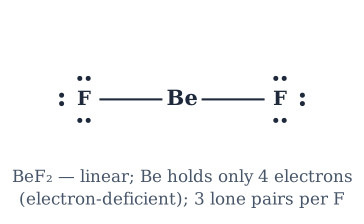
Each F has three lone pairs. Be has no lone pairs. The molecule is linear.
Do not force a double bond here to give Be an octet — that would give Be 8 electrons but violate the octet of F (which would then have 10). Beryllium compounds are electron-deficient and perfectly stable as such.
4. (Carbonate ion)
Step 1: Count valence electrons.
Carbon (Group 14) has 4. Each oxygen (Group 16) has 6. The 2− charge adds 2 more electrons. Total = electrons.
Step 2: Arrange atoms.
Carbon is central (less electronegative than oxygen). Three oxygen atoms surround it.
Step 3: Draw single bonds.
Three C–O single bonds use electrons. Remaining: electrons.
Step 4: Complete octets (tentative).
Give each oxygen 6 more electrons (3 lone pairs) to complete its octet. That uses electrons — exactly what’s left. But now carbon has only 6 electrons (from three bonds) — it needs 2 more.
Step 5: Form a double bond.
To give carbon an octet, convert one lone pair from an oxygen into a second bond with carbon. This creates a C=O double bond. Now carbon has 8 electrons. The oxygen that lost a lone pair now has 2 bonds and 2 lone pairs (still 8 electrons). The other two oxygens each have 1 bond and 3 lone pairs (8 electrons each).
Step 6: Resonance. …
Unlock everything free for 14 days
- Full step-by-step solutions
- Concept-first explanations
- Methods, shortcuts & mistakes
- PYQ mapping + timed mock tests
Full access for 14 days. No credit card required.