The Wheatstone Bridge – From Intuition to Precision
Imagine you have a single unknown resistor and you want to find its value. You could use an ohmmeter, but those are not always accurate for very small or very large resistances. A more elegant method is to compare it against known resistances in a circuit that acts like a balance scale — that is the Wheatstone bridge.
The core idea is simple: make the voltage at two points equal, so no current flows between them. When that happens, you know the ratio of the resistances.
The Circuit Layout
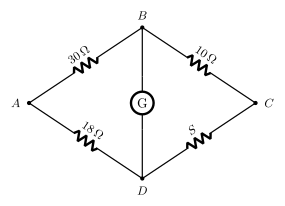
The bridge has four resistors arranged in a diamond shape:
        A
       / \
      P   Q
     /     \
    B-------C
     \     /
      R   S
       \ /
        D
A battery is connected across A and D. A sensitive galvanometer (G) is connected between B and C. The four resistors are labelled P, Q, R, and S. Usually, three are known and one (say, S) is unknown.
The Intuition: Two Voltage Dividers
Look at the left side: from A to D through P and R. That is a voltage divider. The voltage at B is a fraction of the battery voltage, determined by the ratio of P to R.
Now look at the right side: from A to D through Q and S. That is another voltage divider. The voltage at C is a fraction of the battery voltage, determined by the ratio of Q to S.
If the voltage at B equals the voltage at C, then no current flows through the galvanometer — the bridge is balanced.
The Condition for Balance
When the bridge is balanced, the voltage drop across P equals the voltage drop across Q (since both start at A), and the voltage drop across R equals the voltage drop across S (since both end at D). From the voltage divider rule:
- Voltage at B: VB=VA⋅P+RR
- Voltage at C: VC=VA⋅Q+SS
Setting VB=VC gives:
P+RR=Q+SS
Cross-multiply:
R(Q+S)=S(P+R)
RQ+RS=SP+SR
The RS terms cancel, leaving:
Or, rearranged:
QP=SR
QP=SR
That is the balance condition of the Wheatstone bridge. When this holds, the galvanometer shows zero deflection.
Measuring an Unknown Resistance
Suppose S is unknown. You set P, Q, and R to known values. You adjust R (or the ratio P/Q) until the galvanometer reads zero. Then you compute:
S=PQ⋅R
This is why the bridge is so useful: you do not need to measure current or voltage accurately — you only need to detect when current is zero. That is far more sensitive and precise.
In practice, P and Q are often made equal (a 1:1 ratio), so the unknown S simply equals R. This is the "equal-arm" bridge.
Why It Works So Well
The galvanometer is a null detector — it only tells you whether current is flowing, not how much. This eliminates errors from meter calibration, battery voltage fluctuations, and temperature effects. The accuracy depends only on the precision of the known resistors. …