Q.With the help of Kirchhoff's laws, explain the principle of the Wheatstone bridge. Why is the Wheatstone bridge method more accurate than other methods for measuring resistance?
You're viewing a preview — the full solution, concept, methods & PYQ mapping are locked.
Start your 14-day free trial to unlock the full solution →The Wheatstone bridge balance condition follows from Kirchhoff's laws; being a null method makes it inherently more accurate. (OR: potentiometer gives internal resistance via two balance lengths.)
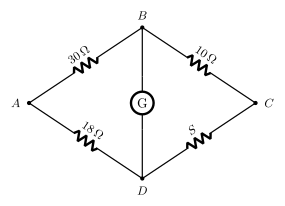
Wheatstone bridge principle (via Kirchhoff's laws): A Wheatstone bridge has four resistances arranged in a diamond/loop with a galvanometer connected across one diagonal (B-D) and a battery across the other (A-C). Applying Kirchhoff's junction rule and Kirchhoff's loop rule to the two loops ABDA and BCDB, and setting the galvanometer current (the balanced condition), one obtains, after eliminating the branch currents:
This is the balance condition of the Wheatstone bridge — if the ratio of the two known resistances equals the ratio of the other two (one of which is the unknown), no current flows through the galvanometer.
Why more accurate: The Wheatstone bridge is a null-deflection (comparison) method — the unknown resistance is found purely from the ratio of resistances at the balance point (zero galvanometer current), and does not depend on the accuracy/calibration of the galvanometer itself, nor on the exact emf of the battery or the resistance of the connecting wires (as long as balance, i.e. zero current, is correctly detected). This eliminates errors that arise in direct (deflection-type) ammeter/voltmeter measurement methods, which depend on the meter's own resistance and calibration, making the bridge method inherently more precise.
…
Unlock everything free for 14 days
- Full step-by-step solutions
- Concept-first explanations
- Methods, shortcuts & mistakes
- PYQ mapping + timed mock tests
Full access for 14 days. No credit card required.