Q.Differentiate between underground and aerial stem modifications, giving one example of each.
Concept understanding — Stem Modifications
Stem Modifications: Why Would a Stem Stop Being a Stem?
You already know the typical stem: it grows upwards, bears leaves and buds, and holds the plant up. But plants are survival machines. If a stem can do its normal job and also store food, or spread across the ground, or defend the plant, or even photosynthesise when leaves are useless — why wouldn't it? That's the entire idea behind stem modifications.
A stem modification is simply a stem that has changed its shape and function to help the plant survive in a particular environment. The key trick: no matter how weird it looks, it still has nodes and internodes, and it still bears buds or leaves. That's how you tell a modified stem apart from a root or a leaf.
Underground Stem Modifications
These stems live below the soil. They look like roots, but they are not — they have nodes, scale leaves, and buds. Their main job is perennation (surviving the winter/dry season) and storage (starch).
Rhizome
A thick, horizontal underground stem that keeps growing year after year. It stores food and can send up new shoots.
Example: Ginger. The "ginger" you buy is a rhizome. Look closely — you'll see rings (nodes) and small buds (eyes) at each node. Roots grow from the underside, shoots from the top.
Tuber
A swollen, fleshy tip of an underground stem branch. It stores massive amounts of starch.
Example: Potato. The "eyes" of a potato are actually nodes with buds. Each eye can grow into a new plant. That's why cutting a potato into pieces with an eye each works — each piece is a stem fragment.
Corm
A short, thick, solid underground stem, usually round. It stores food and has a flattened shape.
Example: Colocasia (arbi), gladiolus. A corm looks like a bulb but is solid inside — a bulb has fleshy leaf scales, a corm is all stem tissue.
Bulb
A very short, conical stem surrounded by thick, fleshy leaf scales (modified leaves) that store food. The stem itself is tiny — just a disc at the base.
Example: Onion, garlic, tulip. The onion you eat is mostly leaf scales; the actual stem is the small disc at the bottom from which roots emerge.
Subaerial Stem Modifications
These stems grow horizontally, either just above or just below the soil surface. Their job is vegetative propagation — making new plants without seeds.
Runner
A slender, horizontal stem that runs along the ground surface, rooting at nodes to form new plants.
Example: Strawberry, grass. The "runners" you see in a strawberry patch are stems. Each node that touches soil sends down roots and up a new shoot.
Stolon
Similar to a runner, but it grows above the ground and then arches down to root at the tip. It is often thicker and shorter.
Example: Mint (pudina), jasmine. A stolon grows out, bends down, and roots at the tip to form a new plant.
Offset
A short, thick runner that grows horizontally and produces a new plant at its tip. Found in aquatic plants.
Example: Water hyacinth (Eichhornia), pistia. Offsets are like mini-runners that quickly produce a daughter plant nearby.
Sucker
A lateral branch that grows underground from the base of the main stem, then emerges above ground to form a new plant.
Example: Banana, pineapple, chrysanthemum. Suckers are often used to propagate these plants — you cut them off and plant them separately.
Aerial Stem Modifications
These stems grow above ground and take on special functions like climbing, protection, or photosynthesis.
Tendril
A thin, coiling structure that helps the plant climb. It is a modified stem (or leaf, or leaflet — but here we mean stem tendrils).
Example: Grapevine, passionflower. The tendril arises from a node (axil of a leaf) — that's how you know it's a stem tendril, not a leaf tendril.
Thorn
A sharp, pointed structure that protects the plant from herbivores. It is a modified stem.
Example: Citrus (lemon, orange), bougainvillea, cactus. Thorns arise from the axil of a leaf and may bear leaves or flowers — proving they are stems, not epidermal outgrowths (like spines).
Phylloclade
A flattened, green, fleshy stem that takes over photosynthesis when leaves are reduced or absent (usually to reduce water loss).
Example: Opuntia (prickly pear), Euphorbia, asparagus. The "leaf" of Opuntia is actually a stem. It has nodes, areoles (modified buds), and sometimes even flowers. The true leaves are tiny spines that fall off early.
How to Identify a Modified Stem — The Checklist
If you see a plant part and wonder "is this a stem?", check for:
- Nodes and internodes — stems always have them.
- Buds — axillary or terminal buds are present.
- Leaves or leaf scars — stems bear leaves (or their scars).
- Origin — stems arise from the plumule (embryonic shoot) or from axillary buds.
A modified stem is any stem that has changed its form to perform a function other than (or in addition to) support and conduction, while retaining the essential stem characteristics of nodes, internodes, and buds.
Quick Comparison Table
| Modification | Example | Primary Function | Key Feature |
|---|---|---|---|
| Rhizome | Ginger | Storage, perennation | Horizontal, nodes + buds |
| Tuber | Potato | Storage | Swollen tip, eyes = nodes |
| Corm | Colocasia | Storage | Solid, round, flattened |
| Bulb | Onion | Storage | Tiny stem + fleshy leaf scales |
| Runner | Strawberry | Propagation | Slender, horizontal on soil |
| Stolon | Mint | Propagation | Arches down, roots at tip |
| Offset | Water hyacinth | Propagation | Short, thick, aquatic |
| Sucker | Banana | Propagation | Underground lateral branch |
| Tendril | Grapevine | Climbing | Coiling, from node |
| Thorn | Citrus | Protection | Sharp, from axil |
| Phylloclade | Opuntia | Photosynthesis | Flattened, green, fleshy |
The Big Picture
Every modification is an adaptation. Underground stems store food and survive harsh seasons. Subaerial stems spread the plant without seeds. Aerial stems climb, defend, or photosynthesise when leaves can't. The stem is the plant's Swiss Army knife — it can become almost anything, but it never forgets it's a stem.
'Stem Modifications class 11 biology' and 'Stem Modifications important questions for NEET' are common search queries for this NCERT-aligned topic from Morphology of Flowering Plants. Comparing stem modifications like potato tubers and onion bulbs with root modifications is a classic differentiate-between style exam question.
Underground stem modifications (e.g. potato tuber) store food beneath the soil; aerial modifications (e.g. grape tendril) help the plant climb, defend itself, or photosynthesise above ground.
Underground: potato tuber (storage). Aerial: grape stem tendril (climbing).
Some stems grow underground and become specialised, most commonly for storing food and helping the plant survive an unfavourable season -- the potato is a classic example, where the tip of an underground stem branch swells into a tuber packed with starch, still recognisable as a stem by the eyes (nodes bearing dormant buds) on its surface. Aerial stem modifications instead develop above ground for a variety of functions -- in the grape vine, an axillary bud develops into a slender, coiling stem tendril that helps the weak climbing stem grip a support, illustrating how the same organ (the stem) can be reshaped for a completely different, above-ground purpose.
Underground: potato tuber (storage). Aerial: grape stem tendril (climbing).
Separate the two categories by where the modified stem grows (below vs above the soil surface), then match each to one standard example and its function.
- Calling the potato tuber a root rather than a stem, missing the diagnostic 'eyes' (buds) that prove it is stem tissue.
- Naming a root tendril or root modification instead of a stem tendril for the aerial-climbing example.
- CBSE 2025Set ANNUAL1 markMCQQ.Match: Stem modification with Plant name.(1) Bulb(2) Corm(3) Rhizome(4) Tuber --(i) Colocasia(ii) Canna(iii) Allium cepa(iv) Solanum tuberosum(a) (1)-(iii), (2)-(i), (3)-(ii), (4)-(iv)(b) (1)-(iii), (2)-(ii), (3)-(i), (4)-(iv)(c) (1)-(iv), (2)-(ii), (3)-(i), (4)-(iii)(d) (1)-(i), (2)-(ii), (3)-(iii), (4)-(iv)
›Reveal solutionSolution
Underground stem modifications each have a classic textbook example: Bulb = onion, Corm = Colocasia, Rhizome = Canna, Tuber = potato — matching to (1)-(iii), (2)-(i), (3)-(ii), (4)-(iv).
Underground stems are modified for perennation (surviving unfavourable seasons) and food storage, and each type has a distinctive structure:
- Bulb (1) — a highly reduced, disc-like stem bearing fleshy scale leaves that store food, as in onion, Allium cepa → matches (iii).
- Corm (2) — a short, vertical, swollen underground stem (condensed rhizome) covered by scaly leaves, as in Colocasia (and Amorphophallus) → matches (i).
- Rhizome (3) — a horizontal underground stem that grows parallel to the soil surface, storing food and bearing nodes/internodes and buds, as in Canna (and ginger, turmeric) → matches (ii).
- Tuber (4) — the swollen tip of an underground stem branch that stores food and bears "eyes" (axillary buds), as in Solanum tuberosum (potato) → matches (iv).
So the full matching is (1)-(iii), (2)-(i), (3)-(ii), (4)-(iv).
✓Final answerThe correct option is (a) — (1)-(iii), (2)-(i), (3)-(ii), (4)-(iv): Bulb-Allium cepa, Corm-Colocasia, Rhizome-Canna, Tuber-Solanum tuberosum.
- CBSE 2022Set ANNUAL1 markMCQQ.Corn is a modification of(a) Root(b) Bud(c) Stem(d) Leaf
›Reveal solutionSolution
A corm is an underground, condensed, vertical stem modified for food storage → (c) Stem.
Underground plant parts must be classified by their internal features, not merely by where they grow. A root lacks nodes, internodes, buds and scale leaves; a stem always shows them.
-
A corm bears distinct nodes and internodes, scale leaves, and axillary/terminal buds.
-
Because it possesses these shoot characters, it is a modified stem, even though it grows underground.
-
Examples in the NCERT/CBSE-aligned syllabus: Colocasia, Amorphophallus, saffron (Crocus).
✓Final answer(c) Stem — a corm is a swollen underground stem modified for storage and perennation.
-
- CBSE 2020Set ANNUAL1 markMCQQ.Tuber of potato is modified :(a) leaf(b) stem(c) root(d) none of these
›Reveal solutionSolution
A potato tuber is a swollen underground stem (a stem modification for food storage), identifiable by the presence of nodes and internodes.
The potato plant's underground stem produces slender lateral branches (stolons) whose tips swell with stored starch to form tubers. Being a stem, the tuber retains nodes bearing axillary buds ('eyes') that can sprout new shoots -- roots never bear buds or nodes, which is exactly how a tuber is distinguished from a modified root.
✓Final answer(b) Stem.
- CBSE 2020Set botany1 markQ.Draw a diagram of 'Corm'. Label it.
›Reveal solutionSolution
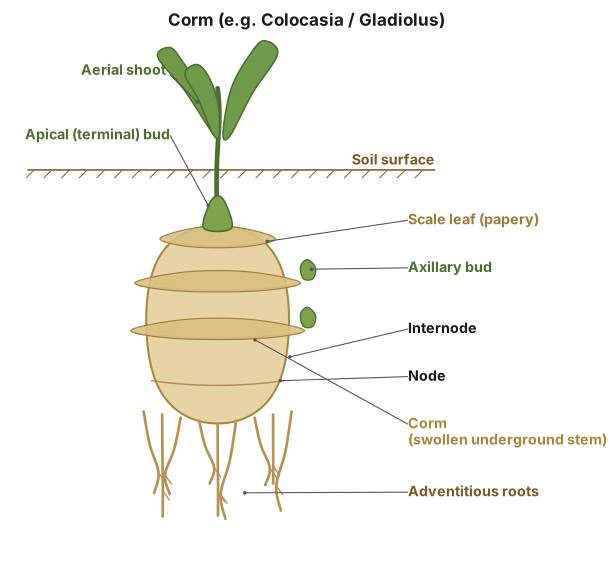
Figure — Labelled diagram of a corm (e.g. Colocasia/Gladiolus) A corm is a stem modification: a short, vertically-growing, food-storing underground stem, condensed into a rounded/disc-like shape, and — because it is a STEM, not a root — it still shows nodes, internodes, scale leaves and buds. (Examples: Colocasia, Gladiolus, Amorphophallus, Crocus.)
Since this answer is text-only, the diagram is given here as a clearly labelled structural description rather than a hand-drawn image; a student should reproduce it as an actual labelled sketch on the exam paper.
Structure of a corm (labelled parts):
- Main axis / corm body — a short, swollen, disc-shaped or rounded stem, oriented vertically, that stores food (mainly starch).
- Nodes and internodes — present but very close together (internodes highly condensed), which is what gives away that this is a stem and not a root or a bulb-like leaf-storage organ.
- Scale leaves — thin, dry, membranous leaves borne at each node, covering and protecting the corm.
- Axillary buds — found in the axil of each scale leaf; several of these grow out to form new corms (vegetative propagation), as seen in Colocasia and Gladiolus "cormels".
- Apical/terminal bud — at the top of the corm, it grows upward each season to produce the aerial shoot (leaves and, eventually, the inflorescence).
- Adventitious roots — a ring or tuft of roots arising from the base (the lower nodal region) of the corm, anchoring it and absorbing water/minerals.
A corm differs from a bulb in being solid, storage-filled STEM TISSUE all the way through, whereas a bulb stores food mainly in its fleshy leaf bases wrapped around a very small central stem (as in onion).
✓Final answerA corm is a vertical, condensed, food-storing underground STEM (e.g. Colocasia, Gladiolus) with: a swollen main axis, closely-spaced nodes bearing papery scale leaves, axillary buds (which form new corms), a terminal apical bud (produces the aerial shoot), and adventitious roots arising from its base — each of these six parts should be clearly labelled on the diagram.
🎓Unlock everything free for 14 days
- ✓Full step-by-step solutions
- ✓Concept-first explanations
- ✓Methods, shortcuts & mistakes
- ✓PYQ mapping + timed mock tests
Full access for 14 days. No credit card required.