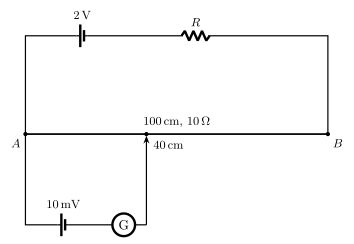
Q.a) In a potentiometer experiment why is it necessary to use a long wire? Length and resistance of a potentiometer wire are 4 m and 10 Ω respectively. It is connected to a cell of emf 2 volt. Another cell when joined to this potentiometer and null point is measured at 250 cm. Find out the emf of the second cell. b) In a metre bridge when the resistance in the left gap is 2 Ω and an unknown resistance in the right gap, the balance point is obtained at 40 cm from zero end. On shunting the unknown resistance with 2 Ω, find the shift of the balance point on the bridge. OR
You're viewing a preview — the full solution, concept, methods & PYQ mapping are locked.
Start your 14-day free trial to unlock the full solution →a) A long potentiometer wire gives a small, precise potential gradient; with wire length 4 m, resistance 10 Ω and driver emf 2 V, the potential gradient is 0.5 V/m, giving the second cell's emf as 1.25 V at null point 250 cm. b) In the metre bridge, shunting the unknown resistance (3 Ω) with 2 Ω shifts the balance point from 40 cm to 62.5 cm, a shift of 22.5 cm.
a) Why a long potentiometer wire is used: A longer wire gives a smaller potential drop per unit length (potential gradient), so the null point can be located more precisely for a given emf — this increases the sensitivity and accuracy of the potentiometer, and also allows comparison of small emfs which a short wire (large potential gradient) could not resolve.
Numerical part: Potentiometer wire: length m, resistance , driver cell emf V (assume negligible internal resistance of driver circuit, so current A).
Potential gradient:
Null point for second cell at cm m:
b) Meter bridge: Left gap , right gap (unknown) , balance point at cm from the zero (left) end. By the meter bridge principle: …
Unlock everything free for 14 days
- Full step-by-step solutions
- Concept-first explanations
- Methods, shortcuts & mistakes
- PYQ mapping + timed mock tests
Full access for 14 days. No credit card required.