Question 47 of 55
Q.(a) A battery of emf E and internal resistance r is connected to an external resistance R. Show that power in the external circuit will be maximum when R = r. Determine the expression of maximum power.
(b) What do you mean by temperature coefficient of resistance? Draw a graph of the variation of resistance of a metallic conductor with temperature. ((2+1)+(1+1))
OR
(a) Establish Wheatstone bridge principle using Kirchhoff's laws. How can you increase the sensitivity of a potentiometer?
(b) 18 cells each of internal resistance 1 Ω and emf 1.5 V each are used to send current through an external circuit of 2 Ω resistance. What is the condition for arrangement of the cells so that a maximum current can be obtained in the external circuit? ((2+1)+2)
West Bengal WbchseWest Bengal HS (WBCHSE) Board 2025Subjective· 5mImportance★★★★★
85% · 47/55 Questions
You're viewing a preview — the full solution, concept, methods & PYQ mapping are locked.
Start your 14-day free trial to unlock the full solution →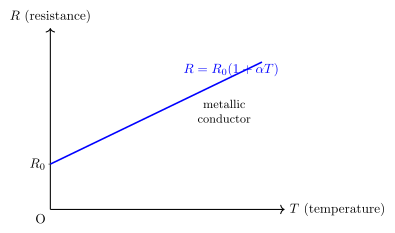
Maximising P = I²R over R by calculus gives the classic result R = r, with P_max = E²/4r; resistance of a metal increases nearly linearly with temperature, characterised by its temperature coefficient α.
- Maximum power transfer: Current in the circuit, . Power delivered to the external resistance: To maximise P with respect to R, set : Setting this to zero: . (This is indeed a maximum, as P increases for R<r and decreases for R>r.) Maximum power: substituting ,
- Temperature coefficient of resistance (α): It is defined as the fractional change in resistance per unit rise in temperature: …
Unlock everything free for 14 days
- Full step-by-step solutions
- Concept-first explanations
- Methods, shortcuts & mistakes
- PYQ mapping + timed mock tests
Full access for 14 days. No credit card required.