Q.Explain why an electromagnetic wave is called a transverse wave. Describe the relative orientation of the electric field vector, the magnetic field vector, and the direction of propagation.
🔒You're viewing a preview — the full solution, concept, methods & PYQ mapping are locked.
🔒 Start your 14-day free trial to unlock the full solution →Concept understanding — Transverse Nature of Electromagnetic Waves
Solving Maxwell's equations for a plane electromagnetic wave shows that its electric field E, its magnetic field B, and its direction of propagation are mutually PERPENDICULAR at every point and instant, with E×B pointing along the propagation direction -- making the wave transverse, since both oscillating fields lie crosswise to (never along) the direction of trav …
Both E and B oscillate perpendicular to the direction of propagation (and to each other) -- exactly the definition of a transverse wave. …
What 'transverse' means. A wave is transverse when the quantity that oscillates does so PERPENDICULAR to the direction the wave itself travels in -- like the sideways ripple on a stretched string, which moves crosswise even though the disturbance travels along the string's length. This is the opposite of a LONGITUDINAL wave (such as sound), where the oscillation is ALONG the same direction as the travel.
Applying this to an electromagnetic wave. Solving Maxwell's equations for a plane wave shows that BOTH the electric field E and the magnetic field B oscillate entirely perpendicular to the wave's direction of travel -- neither field ever has a component ALONG the direction of propagation. Since the oscillating quantities (the fields) are always crosswise to the travel direction, the wave is, by definition, transverse. …
Recall the general definition of a transverse wave, then apply it to how E and B actual …
- Stating only that E and B are perpendicular to EACH OTHER without also stating that both are perpendicular to the direction of propagation -- both facts are needed for the 'transvers …
- CBSE 2026Set 55/2/11 markMCQQ.An electromagnetic wave is propagating along the x-axis. At any instant, the phase difference (in radian) between the electric field (E) and the magnetic field (B) associated with the wave is (A) zero (B) 4π (C) 2π (D) π
›Reveal solutionSolution
In a propagating electromagnetic wave, the electric and magnetic fields oscillate in phase with each other, so the phase difference is zero. The correct option is (A).
Concept and Intuition
The question tests a fundamental property of electromagnetic waves in free space. Many students carry a vague memory that E and B are "perpendicular" and mistakenly think that means a π/2 phase difference. But perpendicularity here refers to direction in space, not a time delay.
In a plane electromagnetic wave, both fields vary sinusoidally with position and time. Maxwell's equations demand that the time-varying electric field produces the magnetic field, and vice versa — they are coupled in such a way that their peaks and zeros occur at the same instant. There is no lag between them.
Watch outA common mistake is to confuse spatial orthogonality (the fields are perpendicular to each other and to the direction of propagation) with a phase difference. They are perpendicular in space, but they oscillate in time together — zero phase difference.
Step-by-Step Reasoning
- Recall the wave equations from Maxwell's laws In free space (no charges or currents), Maxwell's equations yield wave equations for both E and B. For a wave traveling along the x-axis, the solutions are:
Ey=E0sin(ωt−kx+ϕ)
Bz=B0sin(ωt−kx+ϕ)
Notice the same argument (ωt−kx+ϕ) appears in both. This is not an assumption — it follows directly from Faraday's law and Ampère's law.
- Why the phase must be identical Consider Faraday's law for a plane wave:
∂x∂Ey=−∂t∂Bz
If Ey=E0sin(ωt−kx+ϕE) and Bz=B0sin(ωt−kx+ϕB), then:
- Left side: ∂x∂Ey=−kE0cos(ωt−kx+ϕE)
- Right side: −∂t∂Bz=−ωB0cos(ωt−kx+ϕB) …
- CBSE 2026Set ANNUAL1 markQ.Draw propagation diagram of a linearly polarised electromagnetic wave.
›Reveal solutionSolution
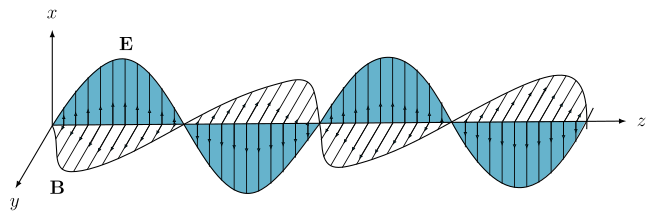
Figure — This is a 1-mark 'Draw propagation diagram of a linearly polarised EM wave' item where the drawing IS the answ In a linearly polarised electromagnetic wave, the electric and magnetic fields oscillate along two fixed, mutually perpendicular directions, both perpendicular to the direction the wave travels.
Consider a wave travelling along the x-direction. In a linearly (plane) polarised wave, the electric field vector E oscillates only along one fixed direction, say the y-axis: Ey = E0 sin(kx - omega t). The magnetic field vector B oscillates only along the z-axis, in phase with E: Bz = B0 sin(kx - omega t), with E0/B0 = c (speed of light). …
- CBSE 2026Set SEM31 markMCQQ.The electromagnetic wave travels in free space along X-direction. At a particular point in space and time, B is given by 2·4 × 10⁻⁸ k̂ (in Tesla unit), then at that point E in V/m unit is(a) 7·2 ĵ(b) 7·2 î(c) 0·8 k̂(d) 2·4 k̂
›Reveal solutionSolution
In free space E = cB in magnitude, and E, B, and the propagation direction form a right-handed set. Magnitude = 7·2 V/m; direction = ĵ. Option (a).
Step 1 — magnitude: For an electromagnetic wave in vacuum, E = cB = (3×10⁸ m/s)(2·4×10⁻⁸ T) = 7·2 V/m.
…
- CBSE 2025Set JS1 markMCQQ.The angle between polarization plane and direction of propagation of electromagnetic waves is: (A) 0∘ (B) 45∘ (C) 90∘ (D) 180∘
›Reveal solutionSolution
The propagation direction lies inside the plane of polarization, so the angle between the plane of polarization and the direction of propagation is 0∘ — option (A).
Concept. An electromagnetic wave is transverse: the electric field E and magnetic field B oscillate perpendicular to the direction of propagation. Two planes are defined:
- Plane of vibration — contains the electric-field vibration and the direction of propagation.
- Plane of polarization — passes through the direction of propagation and is perpendicular to the plane of vibration (it carries no vibrations). …
- CBSE 2025Set A1 markQ.Fill in the blank with appropriate word: Nature of propagation of electromagnetic waves are ______.
›Reveal solutionSolution
Electromagnetic waves are transverse in nature.
In an electromagnetic wave, the electric field vector E and the magnetic field vector B oscillate sinusoidally, perpendicular to each other, and both are perpendicular to the direction in which the wave travels. Since the oscillating quantities (E and B) vary in a direction perpendicular to the direction of propagation, electromagnetic waves are classif …
- CBSE 2025Set ANNUAL1 markQ.What is the nature of electromagnetic waves?
›Reveal solutionSolution
EM waves consist of time-varying electric and magnetic fields, perpendicular to each other and to the direction the wave travels, and unlike sound they can propagate through vacuum.
Key features of the nature of electromagnetic waves:
- They are transverse waves: the oscillating E and B fields are perpendicular to the direction of wave propagation.
- E and B are mutually perpendicular to each other as well, and both oscillate in phase.
- They require no material medium and can travel through vacuum, unlike mechanical waves (e.g. sound).
- In vacuum they all travel at the same speed, c = 3 x 10^8 m/s, related to the fields' amplitudes by c = E0/B0. …
- CBSE 2024Set ANNUAL1 markMCQQ.If E and B represent electric and magnetic field vectors of the electromagnetic waves, then the direction of propagation of the electromagnetic waves is that of(a) E(b) B(c) E×B(d) E⋅B
›Reveal solutionSolution
In an electromagnetic wave, E and B are mutually perpendicular and both perpendicular to the direction the wave travels; the direction of propagation is given by the cross product E×B (the direction of the Poynting vector S=μ01E×B).
Reasoning
For a plane e.m. wave travelling along, say, the x-axis, with E along y and B along z:
y^×z^=x^ …
- CBSE 2024Set ANNUAL1 markMCQQ.The oscillating electric and magnetic field vectors of an electromagnetic wave are oriented along :(a) the same direction but differ in phase by 90°(b) the same direction and are in phase(c) mutually perpendicular direction and are in phase(d) mutually perpendicular direction and differ in phase by 90°
›Reveal solutionSolution
In an EM wave, E and B oscillate perpendicular to each other and to the direction of propagation, and they are in phase.
Maxwell's equations show that an electromagnetic wave consists of oscillating electric field E and magnetic field B, both perpendicular to the direction of wave propagation and to each other (i.e. E,B and the propagation direction k form a mutually perpendicular …
- CBSE 2022Set I1 markMCQQ.Nature of electromagnetic waves is (A) transverse (B) longitudinal (C) both (A) and (B) (D) electrical
›Reveal solutionSolution
EM waves are transverse.
In an electromagnetic wave the electric field E and magnetic field B oscillate perpendicular to each other and both are perpendicular to the direction of propagation k:
E⊥B⊥k.
…
- CBSE 2021Set A1 markMCQQ.The direction of propagation of electromagnetic wave is (A) parallel to E (B) parallel to B (C) parallel to (B × E) (D) parallel to (E × B)
›Reveal solutionSolution
An EM wave propagates in the direction of E × B.
In an electromagnetic wave the electric field E, magnetic field B, and the direction of propagation are mutually perpendicular, forming a right-handed set. The direction of energy flow (Poynting vector S = (1/μ₀) E × B) gives the direction of propagation:
k^∥(E×B) …
- CBSE 2021Set ANNUAL1 markMCQQ.If E⃗ and B⃗ are electric and magnetic field vectors of an electromagnetic wave, then the direction of propagation of electromagnetic wave is –(a) E⃗×B⃗(b) E⃗(c) B⃗(d) B⃗×E⃗
›Reveal solutionSolution
An electromagnetic wave travels in the direction given by the cross product of its electric and magnetic field vectors.
In an EM wave, E and B oscillate perpendicular to each other and both are perpendicular to the direction of propagation, forming a right-handed set (E,B,v). The direction of propagation is therefore along E×B (this also matches the direction of the …
- CBSE 2019Set HE2341 markQ.Fill in the blank: The Electromagnetic waves are ______ waves.
›Reveal solutionSolution
Electromagnetic waves are transverse waves — E and B oscillate at right angles to the direction the wave travels.
In an electromagnetic wave, the electric field vector E and the magnetic field vector B oscillate sinusoidally, and both are always perpendicular to each other AND perpendicular to the direction of propagation of the wave k (i.e. E,B,k form a mutually perpendicular set, with E×B along k). S …
🎓Unlock everything free for 14 days
- ✓Full step-by-step solutions
- ✓Concept-first explanations
- ✓Methods, shortcuts & mistakes
- ✓PYQ mapping + timed mock tests
Full access for 14 days. No credit card required.