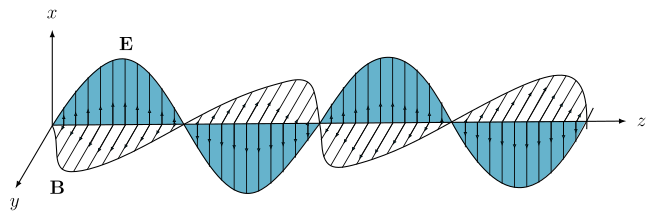
Q.(a) Depict the variation of electric field () and magnetic field () with respect to the direction of propagation of an electromagnetic wave. Write their two important characteristics.
You're viewing a preview — the full solution, concept, methods & PYQ mapping are locked.
Start your 14-day free trial to unlock the full solution →In an electromagnetic wave, and are perpendicular to each other and to the direction of propagation, forming a transverse wave. The speed of this wave in free space is , which is derived from Maxwell's equations.
(a) Variation of and with direction of propagation
An electromagnetic wave is a transverse wave. This means the oscillations of the electric and magnetic fields are perpendicular to the direction in which the wave travels.
If the wave propagates along the -axis, the electric field oscillates along the -axis and the magnetic field oscillates along the -axis. At any instant, the fields vary sinusoidally with position and time :
Here, is the wave number and is the angular frequency.
The three vectors , , and the direction of propagation form a right-handed orthogonal triad. If you curl the fingers of your right hand from to , your thumb points in the direction of propagation.
Two important characteristics of electromagnetic waves:
-
Transverse nature: Both and are perpendicular to the direction of wave propagation. Neither field has a component along the direction of travel.
-
Mutual perpendicularity: is perpendicular to . The two fields oscillate in phase — they reach their maximum and minimum values at the same points in space and time.
A common mistake is to think and are perpendicular to each other but one of them is along the direction of propagation. That is incorrect — both are transverse, so neither points along the propagation direction.
(b) Showing that gives the speed of EM waves in free space
We start from Maxwell's equations in free space (no charges, no currents):
- Gauss's law for electricity:
- Gauss's law for magnetism:
- Faraday's law:
- Ampere-Maxwell law:
The key idea is to derive a wave equation from these. A wave equation has the form , where is the wave speed.
Step 1: Take the curl of Faraday's law
Step 2: Use the Ampere-Maxwell law to replace :
Step 3: Apply the vector identity
From Gauss's law, , so the first term vanishes. We get:
Step 4: Rearrange into the standard wave equation …
Unlock everything free for 14 days
- Full step-by-step solutions
- Concept-first explanations
- Methods, shortcuts & mistakes
- PYQ mapping + timed mock tests
Full access for 14 days. No credit card required.