Q.In a plane electromagnetic wave travelling along the x-axis, the electric field oscillates along the y-axis. State along which axis the magnetic field of this wave must oscillate, and explain how this direction is fixed by the direction of propagation.
Concept understanding — Transverse Nature of Electromagnetic Waves
Solving Maxwell's equations for a plane electromagnetic wave shows that its electric field E, its magnetic field B, and its direction of propagation are mutually PERPENDICULAR at every point and instant, with E×B pointing along the propagation direction -- making the wave transverse, since both oscillating fields lie crosswise to (never along) the direction of travel, unlike a longitudinal wave such as sound. E and B oscillate exactly IN PHASE (reaching maxima and zeros together), with magnitudes locked by E=cB at every instant.
B oscillates along the z-axis, fixed by the requirement that E, B, and the propagation direction be mutually perpendicular.
The magnetic field oscillates along the z-axis. This is fixed because E, B, and the direction of propagation must all be mutually perpendicular; with E along y and propagation along x, the only direction left perpendicular to both is z.
The governing rule. Section 8.4 established that in a plane electromagnetic wave, the electric field, the magnetic field, and the direction of propagation form a mutually perpendicular set -- none of the three can point along either of the other two.
Applying it here. The wave travels along the x-axis, and its electric field oscillates along the y-axis. For the magnetic field to be perpendicular to BOTH the propagation direction (x) and the electric field (y), it can only oscillate along the one remaining perpendicular axis: the z-axis. (Equivalently, using the right-hand rule on E×B, which must point along the propagation direction +x: with E along +y, B must be along +z for their cross product to point along +x.)
Why the direction is fixed, not arbitrary. Once the direction of propagation and the orientation of ONE of the two fields is chosen (here, E along y), the orientation of the OTHER field is completely determined -- there is no freedom left to choose it independently, because Maxwell's equations require the strict mutual perpendicularity described above, with the specific handedness given by E×B pointing along the propagation direction.
The magnetic field must oscillate along the z-axis, the only direction perpendicular to both the x-axis (propagation) and the y-axis (electric field), consistent with E×B pointing along the direction of travel.
Apply the mutual-perpendicularity rule of Section 8.4 to the two given directions to find the one remaining axis for B.
- Concluding B could oscillate along y (the SAME axis as E) -- the two fields must be perpendicular to each other, never parallel.
- Forgetting to check the RIGHT-HAND rule / handedness, which fixes whether B points along +z or −z once E's direction and the propagation direction are both fixed.
- CBSE 2026Set 55/2/11 markMCQQ.An electromagnetic wave is propagating along the x-axis. At any instant, the phase difference (in radian) between the electric field (E) and the magnetic field (B) associated with the wave is (A) zero (B) 4π (C) 2π (D) π
›Reveal solutionSolution
In a propagating electromagnetic wave, the electric and magnetic fields oscillate in phase with each other, so the phase difference is zero. The correct option is (A).
Concept and Intuition
The question tests a fundamental property of electromagnetic waves in free space. Many students carry a vague memory that E and B are "perpendicular" and mistakenly think that means a π/2 phase difference. But perpendicularity here refers to direction in space, not a time delay.
In a plane electromagnetic wave, both fields vary sinusoidally with position and time. Maxwell's equations demand that the time-varying electric field produces the magnetic field, and vice versa — they are coupled in such a way that their peaks and zeros occur at the same instant. There is no lag between them.
Watch outA common mistake is to confuse spatial orthogonality (the fields are perpendicular to each other and to the direction of propagation) with a phase difference. They are perpendicular in space, but they oscillate in time together — zero phase difference.
Step-by-Step Reasoning
- Recall the wave equations from Maxwell's laws In free space (no charges or currents), Maxwell's equations yield wave equations for both E and B. For a wave traveling along the x-axis, the solutions are:
Ey=E0sin(ωt−kx+ϕ)
Bz=B0sin(ωt−kx+ϕ)
Notice the same argument (ωt−kx+ϕ) appears in both. This is not an assumption — it follows directly from Faraday's law and Ampère's law.
- Why the phase must be identical Consider Faraday's law for a plane wave:
∂x∂Ey=−∂t∂Bz
If Ey=E0sin(ωt−kx+ϕE) and Bz=B0sin(ωt−kx+ϕB), then:
- Left side: ∂x∂Ey=−kE0cos(ωt−kx+ϕE)
- Right side: −∂t∂Bz=−ωB0cos(ωt−kx+ϕB)
For these to be equal at all x and t, the cosine terms must have the same argument, so ϕE=ϕB. The fields are in phase.
- Physical interpretation At a fixed point in space, when E is maximum, B is also maximum. When E passes through zero, B also passes through zero. They rise and fall together. This is why the Poynting vector S=μ01E×B always points in the direction of propagation and has a magnitude that oscillates but never goes negative due to a phase shift.
TipA quick way to remember: In a travelling EM wave, E and B are in phase in time but perpendicular in space. The only place you get a π/2 phase difference is in a standing electromagnetic wave, not a propagating one.
✓Final answerThe phase difference is zero, so the correct option is (A).
- CBSE 2026Set ANNUAL1 markQ.Draw propagation diagram of a linearly polarised electromagnetic wave.
›Reveal solutionSolution
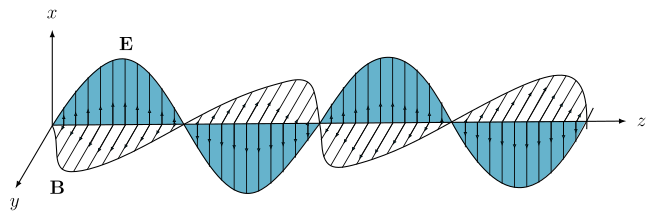
Figure — This is a 1-mark 'Draw propagation diagram of a linearly polarised EM wave' item where the drawing IS the answ In a linearly polarised electromagnetic wave, the electric and magnetic fields oscillate along two fixed, mutually perpendicular directions, both perpendicular to the direction the wave travels.
Consider a wave travelling along the x-direction. In a linearly (plane) polarised wave, the electric field vector E oscillates only along one fixed direction, say the y-axis: Ey = E0 sin(kx - omega t). The magnetic field vector B oscillates only along the z-axis, in phase with E: Bz = B0 sin(kx - omega t), with E0/B0 = c (speed of light).
A sketch of this would show, along a horizontal x-axis: a sinusoidal curve in the x-y plane representing E (oscillating up-down in y), and simultaneously a sinusoidal curve in the x-z plane representing B (oscillating in-out in z), both sine curves in phase with each other, both perpendicular to the x-axis and to each other, propagating together along +x.
✓Final answerE oscillates along y, B oscillates along z (both perpendicular to each other and to the direction of propagation x), in phase, with E0/B0 = c.
- CBSE 2026Set SEM31 markMCQQ.The electromagnetic wave travels in free space along X-direction. At a particular point in space and time, B is given by 2·4 × 10⁻⁸ k̂ (in Tesla unit), then at that point E in V/m unit is(a) 7·2 ĵ(b) 7·2 î(c) 0·8 k̂(d) 2·4 k̂
›Reveal solutionSolution
In free space E = cB in magnitude, and E, B, and the propagation direction form a right-handed set. Magnitude = 7·2 V/m; direction = ĵ. Option (a).
Step 1 — magnitude: For an electromagnetic wave in vacuum, E = cB = (3×10⁸ m/s)(2·4×10⁻⁸ T) = 7·2 V/m.
Step 2 — direction: The wave travels along +X (î) and B is along +Z (k̂). E, B and the propagation vector obey E × B ∝ direction of propagation. Since ĵ × k̂ = î, E must point along +Y (ĵ).
Step 3 — combine: E = 7·2 ĵ V/m.
✓Final answer(a) 7·2 ĵ V/m
- CBSE 2025Set JS1 markMCQQ.The angle between polarization plane and direction of propagation of electromagnetic waves is: (A) 0∘ (B) 45∘ (C) 90∘ (D) 180∘
›Reveal solutionSolution
The propagation direction lies inside the plane of polarization, so the angle between the plane of polarization and the direction of propagation is 0∘ — option (A).
Concept. An electromagnetic wave is transverse: the electric field E and magnetic field B oscillate perpendicular to the direction of propagation. Two planes are defined:
- Plane of vibration — contains the electric-field vibration and the direction of propagation.
- Plane of polarization — passes through the direction of propagation and is perpendicular to the plane of vibration (it carries no vibrations).
Why 0∘. Both planes are drawn through the line of propagation. Since the direction of propagation actually lies in the plane of polarization, the angle a line makes with a plane that contains it is 0∘. (The two planes — vibration and polarization — are mutually perpendicular, i.e. 90∘ to each other, but that is a different quantity from what is asked.)
✓Final answerOption (A) 0∘ — the direction of propagation lies in the plane of polarization.
- CBSE 2025Set A1 markQ.Fill in the blank with appropriate word: Nature of propagation of electromagnetic waves are ______.
›Reveal solutionSolution
Electromagnetic waves are transverse in nature.
In an electromagnetic wave, the electric field vector E and the magnetic field vector B oscillate sinusoidally, perpendicular to each other, and both are perpendicular to the direction in which the wave travels. Since the oscillating quantities (E and B) vary in a direction perpendicular to the direction of propagation, electromagnetic waves are classified as transverse waves — this is confirmed experimentally by the fact that light (an EM wave) can be polarised, a property unique to transverse waves.
✓Final answerTransverse.
- CBSE 2025Set ANNUAL1 markQ.What is the nature of electromagnetic waves?
›Reveal solutionSolution
EM waves consist of time-varying electric and magnetic fields, perpendicular to each other and to the direction the wave travels, and unlike sound they can propagate through vacuum.
Key features of the nature of electromagnetic waves:
-
They are transverse waves: the oscillating E and B fields are perpendicular to the direction of wave propagation.
-
E and B are mutually perpendicular to each other as well, and both oscillate in phase.
-
They require no material medium and can travel through vacuum, unlike mechanical waves (e.g. sound).
-
In vacuum they all travel at the same speed, c = 3 x 10^8 m/s, related to the fields' amplitudes by c = E0/B0.
-
They carry energy and momentum, and exert radiation pressure.
-
They are produced by accelerating (oscillating) electric charges.
✓Final answerElectromagnetic waves are transverse, non-mechanical waves consisting of mutually perpendicular, oscillating electric and magnetic fields that travel through vacuum at the speed of light.
-
- CBSE 2024Set ANNUAL1 markMCQQ.If E and B represent electric and magnetic field vectors of the electromagnetic waves, then the direction of propagation of the electromagnetic waves is that of(a) E(b) B(c) E×B(d) E⋅B
›Reveal solutionSolution
In an electromagnetic wave, E and B are mutually perpendicular and both perpendicular to the direction the wave travels; the direction of propagation is given by the cross product E×B (the direction of the Poynting vector S=μ01E×B).
Reasoning
For a plane e.m. wave travelling along, say, the x-axis, with E along y and B along z:
y^×z^=x^
which is exactly the direction of propagation. Neither E alone nor B alone can indicate the propagation direction (they lie transverse to it), and E⋅B=0 always (they are perpendicular), so it carries no directional information. Only the vector (cross) product E×B correctly points along the direction of travel.
✓Final answer(c) E×B
- CBSE 2024Set ANNUAL1 markMCQQ.The oscillating electric and magnetic field vectors of an electromagnetic wave are oriented along :(a) the same direction but differ in phase by 90°(b) the same direction and are in phase(c) mutually perpendicular direction and are in phase(d) mutually perpendicular direction and differ in phase by 90°
›Reveal solutionSolution
In an EM wave, E and B oscillate perpendicular to each other and to the direction of propagation, and they are in phase.
Maxwell's equations show that an electromagnetic wave consists of oscillating electric field E and magnetic field B, both perpendicular to the direction of wave propagation and to each other (i.e. E,B and the propagation direction k form a mutually perpendicular set). They reach their maximum and minimum values at the same place and instant — i.e. they are in phase.
✓Final answerOption (c): mutually perpendicular directions and are in phase.
- CBSE 2022Set I1 markMCQQ.Nature of electromagnetic waves is (A) transverse (B) longitudinal (C) both (A) and (B) (D) electrical
›Reveal solutionSolution
EM waves are transverse.
In an electromagnetic wave the electric field E and magnetic field B oscillate perpendicular to each other and both are perpendicular to the direction of propagation k:
E⊥B⊥k.
Because the oscillating quantities are at right angles to the propagation direction, EM waves are transverse. This is confirmed by their ability to be polarised (a property only transverse waves possess). They do not need a material medium, unlike longitudinal sound waves.
✓Final answer(A) transverse.
- CBSE 2021Set A1 markMCQQ.The direction of propagation of electromagnetic wave is (A) parallel to E (B) parallel to B (C) parallel to (B × E) (D) parallel to (E × B)
›Reveal solutionSolution
An EM wave propagates in the direction of E × B.
In an electromagnetic wave the electric field E, magnetic field B, and the direction of propagation are mutually perpendicular, forming a right-handed set. The direction of energy flow (Poynting vector S = (1/μ₀) E × B) gives the direction of propagation:
k^∥(E×B)
So the wave travels parallel to E × B, not parallel to E or B individually, and not to B × E (opposite direction).
✓Final answer(D) parallel to (E × B).
- CBSE 2021Set ANNUAL1 markMCQQ.If E⃗ and B⃗ are electric and magnetic field vectors of an electromagnetic wave, then the direction of propagation of electromagnetic wave is –(a) E⃗×B⃗(b) E⃗(c) B⃗(d) B⃗×E⃗
›Reveal solutionSolution
An electromagnetic wave travels in the direction given by the cross product of its electric and magnetic field vectors.
In an EM wave, E and B oscillate perpendicular to each other and both are perpendicular to the direction of propagation, forming a right-handed set (E,B,v). The direction of propagation is therefore along E×B (this also matches the direction of the Poynting vector S=μ01E×B, which gives the direction of energy flow).
✓Final answerDirection of propagation is E×B — option (a).
- CBSE 2019Set HE2341 markQ.Fill in the blank: The Electromagnetic waves are ______ waves.
›Reveal solutionSolution
Electromagnetic waves are transverse waves — E and B oscillate at right angles to the direction the wave travels.
In an electromagnetic wave, the electric field vector E and the magnetic field vector B oscillate sinusoidally, and both are always perpendicular to each other AND perpendicular to the direction of propagation of the wave k (i.e. E,B,k form a mutually perpendicular set, with E×B along k). Since the oscillating quantities (E and B) are perpendicular to the direction of travel, electromagnetic waves are classified as transverse waves — unlike sound, which is longitudinal.
✓Final answerTransverse.
🎓Unlock everything free for 14 days
- ✓Full step-by-step solutions
- ✓Concept-first explanations
- ✓Methods, shortcuts & mistakes
- ✓PYQ mapping + timed mock tests
Full access for 14 days. No credit card required.