Q.An electric field is uniform, and in the positive direction for positive , and uniform with the same magnitude but in the negative direction for negative . It is given that for and for . A right circular cylinder of length and radius has its centre at the origin and its axis along the -axis so that one face is at and the other is at (Fig. 1.25).
You're viewing a preview — the full solution, concept, methods & PYQ mapping are locked.
Start your 14-day free trial to unlock the full solution →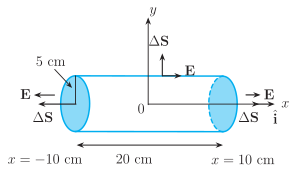
The field is anti-symmetric about the origin, so the flux through the left and right faces are equal and positive; the side flux is zero because the field is parallel to the side; the net outward flux is the sum of the two face fluxes, and by Gauss’s law that net flux equals , giving the enclosed charge.
The key insight here is that the electric field is piecewise uniform — it has the same magnitude everywhere, but flips direction at . This is exactly the field you’d get from an infinite plane of charge at the origin (though we don’t need that detail yet). The cylinder is placed symmetrically about the origin, so the field at the left face points left (into the cylinder) and at the right face points right (out of the cylinder). That’s the whole story for the faces.
For the curved side, the field is everywhere perpendicular to the axis, and the side’s area vector is radial (perpendicular to the axis). So the field is parallel to the side surface — the dot product is zero everywhere on the side. That makes the side flux zero.
Let’s work through each part.
- Flux through each flat face The area of each circular face is
For the right face at , the outward normal (pointing out of the cylinder) is . The field there is . So the flux is
Numerically, .
For the left face at , the outward normal is (pointing left, out of the cylinder). The field there is . So
Same magnitude, same sign — both positive. That makes sense: at both faces, the field points outward from the cylinder.
A common mistake is to think the left face flux is negative because the field points left. But the outward normal also points left, so the dot product is positive. Always check the direction of the outward normal, not just the field direction.
- Flux through the side of the cylinder …
Unlock everything free for 14 days
- Full step-by-step solutions
- Concept-first explanations
- Methods, shortcuts & mistakes
- PYQ mapping + timed mock tests
Full access for 14 days. No credit card required.