History · Ch 6 — Displacing Indigenous Peoples
AUSTRALIA
AUSTRALIA
The Long Human History of Australia
Human habitation in Australia is ancient, just as in the Americas. The people Europeans later lumped together as ‘aborigines’ — a general label covering many distinct societies — began arriving on the continent more than 40,000 years ago, possibly even earlier. They came from New Guinea, which was then connected to Australia by a land-bridge. The natives’ own traditions tell a different story: they did not come to Australia at all, but had always been there. Their past centuries were called the ‘Dreamtime’, a concept Europeans found hard to grasp because in it the distinction between past and present is blurred.
By the late eighteenth century, there were between 350 and 750 native communities in Australia, each with its own language. Even today, about 200 of these languages are still spoken. A separate large group of indigenous people lives in the north — the Torres Strait Islanders. The term ‘Aborigine’ is not used for them, since they are believed to have migrated from elsewhere and to belong to a different race. Together, aborigines and Torres Strait Islanders made up 2.4 per cent of Australia’s population in 2005. Australia is sparsely populated, and even now most towns lie along the coast, where the British first arrived in 1770, because the central region is arid desert.
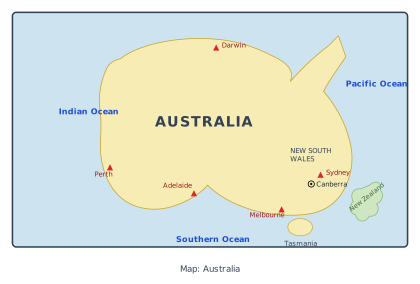
The map is a simple sketch of the Australian continent, set against the surrounding oceans that frame its isolation. The Indian Ocean washes the western and southern coasts, the Pacific Ocean lies to the east, and the Southern Ocean curves along the south — together they emphasise that Australia is a vast island, reachable only by sea. That geographical fact is the quiet point of the whole map: the British arrived by ship in 1770, and every major settlement they built hugged the coastline.
The cities marked on the map tell the story of that coastal settlement pattern. Darwin sits on the northern coast, Perth on the far southwest, Adelaide on the southern shore, and Sydney, Canberra and Melbourne cluster in the southeast. Notice what is missing — nothing in the interior. The map's emptiness at the centre mirrors the textbook's warning that the central region is arid desert, which is precisely why the towns line the coast. New South Wales is labelled as a state, a reminder that the British named the entire eastern coast after Cook's landing at Botany Bay, long before the continent was divided into colonies. Tasmania appears as the island off the southeast corner, and New Zealand lies further east across the Tasman Sea, a separate landmass that the map keeps visually distinct. …
The Europeans Reach Australia
The key dates of European contact run like this: Dutch travellers sighted Australia in 1606; Tasman landed on the island later named Tasmania in 1642; James Cook reached Botany Bay in 1770 and named the region New South Wales; and in 1788 a British penal colony was formed and Sydney was founded.
The story of interaction between European settlers, native peoples and the land in Australia resembles the Americas in many ways, though it began nearly 300 years later. Captain Cook’s initial reports about encounters with natives were enthusiastic about their friendliness. But British feeling reversed sharply when Cook was killed by a native — not in Australia, but in Hawaii. As often happened, a single incident of this kind was used by colonisers to justify subsequent acts of violence towards other people.
A description of the Sydney area in 1790 shows what the British presence did. Aboriginal production had been dramatically disturbed. The arrival of a thousand hungry mouths, followed by hundreds more, put unprecedented pressure on local food resources. For the Daruk people, the large-scale destruction of sacred places and the strange, violent behaviour towards their land was inexplicable. The newcomers knocked down trees without any reason — they were not making canoes, gathering bush honey or catching animals. Stones were moved and stacked, clay dug up, shaped and cooked, holes made in the ground, large unwieldy structures built. At first the Daruk may have equated the clearing with the creation of a sacred ceremonial ground, perhaps thinking a huge ritual gathering was to be held — dangerous business from which they should steer well clear. There is no doubt the Daruk subsequently avoided the settlement, for the only way to bring them back was by official kidnapping.
A Description of the Sydney Area in 1790. A secondary-source account of the earliest
years of British settlement around Sydney, and how the local Daruk people may have understood
what they saw:
'Aboriginal production had been dramatically disturbed by the British presence. The arrival
of a thousand hungry mouths, followed by hundreds more, put unprecedented pressure on local
food resources.
So what would the Daruk people have thought of all this? To them such large-scale
destruction of sacred places and strange, violent behaviour towards their land was
inexplicable. The newcomers seemed to knock down trees without any reason, for they were not
making canoes, gathering bush honey or catching animals. Stones were moved and stacked
together, clay dug up, shaped and cooked, holes were made in the ground, large unwieldy
structures built. At first they may have equated the clearing with the creation of a sacred
ceremonial ground… Perhaps they thought a huge ritual gathering was to be held, dangerous
business from which they should steer well clear. There is no doubt the Daruks subsequently
avoided the settlement, for the only way to bring them back was by an official kidnapping.'
— P. Grimshaw, M. Lake, A. McGrath, M. Quartly, Creating a Nation
What it shows: Read from the Daruk people's own likely point of view, the strange, …
The natives could not foresee that in the nineteenth and twentieth centuries nearly 90 per cent of them would die — from exposure to germs, from the loss of their lands and resources, and in battles against the settlers.
Convict Settlement and Land Seizure
The experiment of settling Brazil with Portuguese convicts had been abandoned when their violent behaviour provoked angry reprisals from the natives. The British had used the same practice in the American colonies until those colonies became independent, and then continued it in Australia. Most of the early settlers were convicts deported from England; when their jail terms ended, they were allowed to live as free people in Australia on condition that they never returned to Britain. With no choice but to make a life for themselves in a land so different from their own, they felt no hesitation about ejecting natives from the land they took over for cultivation.
The Development of Australia
The economic development of Australia under European settlement was not as varied as in America. Vast sheep farms and mining stations were established over a long period and with much labour, followed by vineyards and wheat farming. These came to form the basis of the country’s prosperity. When the states were united and it was decided that a new capital would be built in 1911, one name suggested for it was Woolwheatgold! Ultimately it was called Canberra — from kamberra, a native word meaning ‘meeting place’.
Some natives were employed on farms under conditions of work so harsh that it was little different from slavery. Later, Chinese immigrants provided cheap labour, as in California, but unease about being dependent on non-whites led the governments of both countries to ban Chinese immigrants. Until 1974, such was the popular fear that ‘dark’ people from South Asia or Southeast Asia might migrate to Australia in large numbers that there was a government policy to keep ‘non-white’ people out.
Key milestones in Australia’s development: self-government was granted to the Australian colonies in 1850; Chinese coolie immigration began in 1851 and was stopped by law in 1855; the gold rushes ran from 1851 to 1961; the Federation of Australia was formed in 1901 with six states; Canberra was established as capital in 1911; and between 1948 and 1975, two million Europeans migrated to Australia.
The Winds of Change
In 1968, people were electrified by a lecture by the anthropologist W.E.H. Stanner, entitled ‘The Great Australian Silence’ — the silence of historians about the aborigines. From the 1970s, as was happening in North America, there was an eagerness to understand natives not as anthropological curiosities but as communities with distinct cultures, unique ways of understanding nature and climate, and a sense of community carrying vast bodies of stories, textile, painting and carving skills — all of which should be understood, recorded and respected.
Underlying it all was the urgent question Henry Reynolds later articulated in a powerful book, Why Weren’t We Told? This condemned the practice of writing Australian history as though it had begun with Captain Cook’s ‘discovery’. Since then, university departments have been instituted to study native cultures, galleries of native art have been added to art galleries, museums have been enlarged to incorporate dioramas and imaginatively designed rooms explaining native culture, and natives have begun writing their own life histories. This has been a wonderful effort — and it came at a critical time, because if native cultures had remained ignored, much of such culture would by now have been forgotten.
From 1974, ‘multiculturalism’ has been official policy in Australia, giving equal respect to native cultures and to the different cultures of immigrants from Europe and Asia.
Land Rights and the End of Terra Nullius
From the 1970s, as the term ‘human rights’ began to be heard at meetings of the UNO and other international agencies, the Australian public realised with dismay that, in contrast to the USA, Canada and New Zealand, Australia had no treaties with the natives formalising the takeover of land by Europeans. The government had always termed the land of Australia terra nullius — that is, belonging to nobody. …
| Year | Event |
|---|---|
| 1606 | Dutch travellers sight Australia |
| 1642 | Tasman lands on the island later named Tasmania |
| 1770 | James Cook reaches Botany Bay, named New South Wales |
| Year | Event |
|---|---|
| 1850 | Self-government granted to the Australian colonies |
| 1851 | Chinese coolie immigration begins; stopped by law in 1855 |
| 1851-1961 | Gold rushes |
| 1901 | Formation of the Federation of Australia, with six states |
| 1911 | Canberra established as capital |