History · Ch 6 — Displacing Indigenous Peoples
The Gold Rush, and the Growth of Industries
The Gold Rush, and the Growth of Industries
The promise of gold had always hovered over North America, but it became a concrete obsession in the 1840s when traces of the metal were found in California. That discovery triggered the Gold Rush, pulling thousands of eager Europeans across the Atlantic in the hope of making a quick fortune.
Drawn by us to help you understand the concept clearly, and verified to make sure it's accurate. For exams, practice from your NCERT textbook's own diagram.
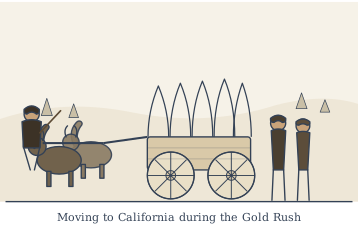
The photograph shows a team of oxen yoked to a covered wagon, its wooden hoops arched over the wagon bed, with a group of men standing beside it on a bare, dusty hillside track. The caption reads 'Moving to California as part of the Gold Rush' -- this is not a posed studio portrait but a working record of overland travel: the ox-cart was the technology that carried a settler family and its belongings west, long before railways reached most of the continent.
What the image does not show is just as telling as what it does: no gold, no pan, no mining claim, no crowd of prospectors. The Gold Rush of 1849 drew thousands of Europeans across the Atlantic with the promise of sudden wealth, but the wagon in this photograph carries a family toward a quieter outcome -- land to farm, not gold to dig. Most who came west in the Gold Rush's wake ended up as settlers, not miners. …
The rush did more than fill mining camps — it forced the building of railway lines across the continent, and for that back-breaking labour, thousands of Chinese workers were recruited. The USA’s transcontinental railway was completed by 1870; Canada’s followed in 1885.
The sheer speed of this expansion struck contemporaries. Andrew Carnegie, a poor Scottish immigrant who rose to become one of the first millionaire industrialists in the USA, captured it in a famous contrast: “The old nations creep on at a snail’s pace, the Republic thunders on at the speed of an express.
Andrew Carnegie on America's speed of growth. Andrew Carnegie, a poor Scottish immigrant
who became the USA's first industrial millionaire, contrasted the pace of the "old" world with
the new:
'The old nations creep on at a snail's pace… the Republic thunders on at the speed of an
express.'
— Andrew Carnegie
What it shows: Carnegie's own rags-to-riches story was exactly the promise that drew
immigrants across the Atlantic — his boast about America's speed captures the industrial …
”
Why did industry grow so fast here, when in England the Industrial Revolution had been driven by peasants losing land and moving to factory jobs? In North America the reasons were different. Industries developed to manufacture railway equipment, so that rapid transport could link distant places, and to produce machinery that would make large-scale farming easier. Industrial towns grew and factories multiplied in both the USA and Canada. The result was dramatic: in 1860 the USA was still an undeveloped economy; by 1890 it had become the leading industrial power in the world.
Large-scale agriculture expanded alongside industry. Vast areas were cleared and divided up into farms.
Drawn by us to help you understand the concept clearly, and verified to make sure it's accurate. For exams, practice from your NCERT textbook's own diagram.
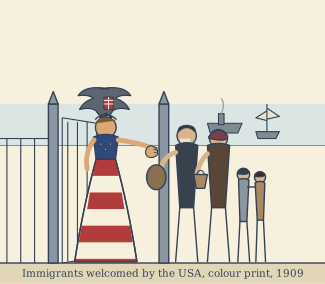
The photograph is a colour print, not a real scene: it shows Columbia, a female figure personifying the United States, dressed in a stars-and-stripes gown with an eagle overhead, standing at an ornate wrought-iron gate and welcoming a family of immigrants -- an elderly bearded man, a woman, and two children carrying bundles and a basket -- who have just arrived, a ship visible on the water behind them. Dated 1909, it is a piece of patriotic, idealised imagery, not a photograph of an actual event.
The print's message is generous: America as an open gate, welcoming the poor and the hopeful. That message was genuinely believed by many of the immigrants who crossed the Atlantic in these decades, and the chapter treats it as sincere -- this really was the dream that drew them. But the chapter also asks the image to be read against what came before it in the same period: by 1890 the bison had been almost exterminated, ending the hunting life native peoples of the plains had followed for centuries, and by 1892 the USA's continental expansion was declared complete, the land already divided into states. …
The cost was enormous — by 1890 the bison had been almost exterminated, and with them ended the hunting life that native peoples had followed for centuries. …
The photograph shows a small, isolated ranch house sitting on open prairie land. A wagon and a few horses stand nearby, and the sepia tone of the image gives it the feel of a late-nineteenth-century record. There is nothing grand about the scene — no fences stretching to the horizon, no large barns, no signs of a thriving town. The homestead is modest, the kind a single family could build and work with their own hands.
That plainness is exactly the point. The caption calls this ranch “the dream of poor European immigrants,” and the image captures why so many crossed the Atlantic. In Europe, land was scarce, expensive, and largely controlled by established families or big farmers. A poor labourer or tenant farmer had little realistic hope of ever owning a plot of his own. In North America, by contrast, vast stretches of prairie were being cleared, surveyed, and divided into farms. A determined immigrant could claim land, build a house, and work toward a future that was simply unavailable back home.
The photograph also speaks to the speed and scale of that transformation. The text around it describes how the USA went from an undeveloped economy in 1860 to the world’s leading industrial power by 1890. Railways were being laid across the continent, machinery was making large-scale farming possible, and the frontier was being steadily pushed west. This ranch is a snapshot of that process at the human level — the individual family that the railways, the land grants, and the industrial boom were all ultimately serving. The dream was not wealth or glory; it was a piece of land, a house, and the independence that came with both. …